Table of Contents
Overview
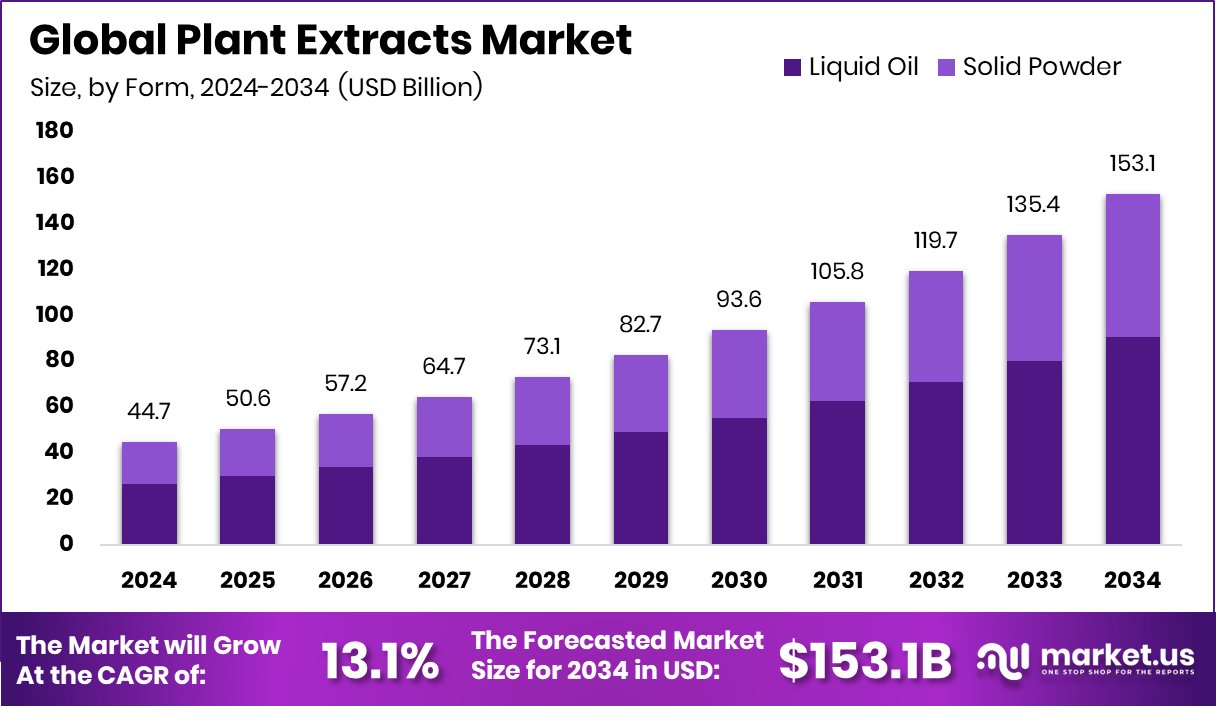
New York, NY – January 22, 2026 – The global plant extracts market is projected to reach USD 153.1 billion by 2034, rising sharply from USD 44.7 billion in 2024 at a 13.1% CAGR. The Asia-Pacific region leads with 43.50% share, contributing USD 19.4 billion, driven by strong agricultural capacity and expanding natural-ingredient industries. Plant extracts are concentrated compounds sourced from different plant parts, valued for preserving flavor, color, nutrients, and bioactive properties in a consistent and stable form.
The market operates across agriculture, extraction technologies, and downstream sectors such as food, health, cosmetics, and industrial applications. Its growth is strongly influenced by rapid innovation in extraction science. Several funding milestones highlight this momentum. Genomines raised $45 million to extract critical metals through bioengineered plants, showing diversification beyond traditional applications. WVU researchers secured $8 million to build a rare earth extraction facility, emphasizing academic support for advanced extraction methods.
Broader interest in bio-based extraction is reflected in a $500 million Japanese-funded hydrogen extraction project and a $1 million grant supporting DNA extraction technologies. Additionally, major industrial investment continues, such as Standard Lithium and Equinor receiving $225 million from the U.S. to develop a lithium extraction facility. Together, these initiatives demonstrate rising confidence in plant-linked and bio-based extraction systems, supporting long-term market expansion.
➤ Click the sample report link for complete industry insights: https://market.us/report/global-plant-extracts-market/request-sample/
Key Takeaways
- The Global Plant Extracts Market is expected to be worth around USD 153.1 billion by 2034, up from USD 44.7 billion in 2024, and is projected to grow at a CAGR of 13.1% from 2025 to 2034.
- In the plant extracts market, the liquid oil form leads with 59.3% share, driven by applications.
- In the plant extracts market, essential oils type accounts for 38.4%, reflecting strong aromatherapy demand.
- In the plant extracts market, food and beverages end use holds 39.6%, driven by clean-label trends.
- The plant extracts market in Asia-Pacific reached 43.50%, accounting for USD 19.4 Bn in value.
➤ Directly purchase a copy of the report – https://market.us/purchase-report/?report_id=171420
Report Scope
| Report Features | Description |
|---|---|
| Market Value (2024) | USD 44.7 Billion |
| Forecast Revenue (2034) | USD 153.1 Billion |
| CAGR (2025-2034) | 13.1% |
| Segments Covered | By Form (Liquid Oil, Solid Powder), By Type (Essential Oils, Oleoresins, Flavonoid, Alkaloids, Carotenoids, Others), By End Use Industry (Food and Beverages, Cosmetics and Personal Care, Pharmaceuticals, Nutraceuticals, Others) |
| Competitive Landscape | ADM, Aethon, BASF SE, Botanic Healthcare, Carbery Group, Dohler, Kerry, Martin Bauer, Symrise, Truly Essential |
Key Market Segments
By Form
Liquid oil remained the dominant form in the plant extracts market in 2024, accounting for 59.3% of the total share. Its leadership is driven by its versatility, consistent performance, and ease of integration into manufacturing processes. Liquid oil extracts blend smoothly into a wide range of formulations without affecting texture or stability, making them suitable for food, cosmetics, pharmaceuticals, and industrial applications. Their ability to offer uniform dispersion and efficient absorption further strengthens their value, allowing manufacturers to achieve predictable results at scale.
These advantages make liquid oils the preferred choice for brands aiming for quality, stability, and formulation flexibility. As demand for natural and functional ingredients continues to rise across industries, the liquid oil segment maintains a strong competitive edge, reinforcing its position as the most widely adopted form in the plant extracts market.
By Type
Essential oils led the plant extracts market by type in 2024, securing a 38.4% global share. Their dominance reflects their strong aromatic intensity, concentrated potency, and consistent functional performance across diverse applications. Extracted from flowers, leaves, seeds, and bark, essential oils offer natural fragrance, therapeutic benefits, and bioactive properties that appeal to both manufacturers and consumers. Their ability to deliver results in very small quantities makes them cost-efficient while maintaining product quality.
Essential oils remain a cornerstone ingredient in personal care, wellness, aromatherapy, home care, and natural formulations. Their long-established commercial relevance, combined with growing consumer interest in natural and clean-label solutions, supports continued demand. In 2024, essential oils held their market leadership by aligning with evolving lifestyle trends and offering reliable performance, keeping them at the forefront of the plant extracts industry.
By End Use
The food and beverages sector dominated plant extract consumption in 2024, holding a 39.6% share of the market. This leadership stems from the industry’s ongoing shift toward natural flavors, clean-label formulations, and plant-based ingredients. Plant extracts play a critical role in enhancing taste, aroma, color, and nutritional appeal, making them integral to product innovation across beverages, snacks, processed foods, and functional nutrition. Their ability to improve sensory experience while supporting health-oriented consumer preferences drives widespread adoption.
Manufacturers increasingly rely on plant extracts for consistency, ingredient transparency, and differentiation in competitive product categories. Growing demand for natural sweeteners, antioxidants, botanical infusions, and herbal flavors further strengthens the segment’s position. As consumers continue choosing natural over synthetic additives, the food and beverages industry remains the largest and most influential end-use market for plant extracts.
Regional Analysis
The Plant Extracts Market displays distinct regional trends, with Asia-Pacific leading at 43.50% and USD 19.4 billion, driven by its strong production base, abundant raw materials, and extensive use of natural ingredients across food, cosmetics, and wellness industries. This dominance reflects the region’s advanced processing capabilities and high consumption of plant-derived products.
North America follows as a mature and stable market, supported by established supply chains and strong demand for clean-label and natural formulations. Europe maintains steady growth, reinforced by its long-standing preference for plant-based ingredients in pharmaceuticals, cosmetics, and food sectors.
Meanwhile, the Middle East & Africa region remains in an early development phase, gradually expanding usage as consumer awareness and industrial applications grow. Latin America contributes through its rich biodiversity and increasing investment in extraction and processing activities. Together, these regions create a balanced global landscape shaped by varying levels of adoption and resource advantages.
Top Use Cases
- Natural Health and Medicine Support: Plant extracts are widely used to support health and treat diseases because they contain bioactive compounds that may help regulate body systems and fight illnesses. Scientists are studying how certain plant chemicals can support heart health, reduce inflammation, and help manage metabolic disorders like diabetes. These extracts form the basis of many herbal supplements and traditional medicines used around the world.
- Natural Food Additives and Preservatives: In the food industry, plant extracts are added to foods to improve taste, aroma and nutrition. Some extracts are used as natural preservatives that slow spoilage and help food stay fresh longer, offering a cleaner alternative to synthetic additives.
- Skincare and Cosmetics: Plant extracts are common in skincare products because they can protect and nourish skin. They help improve hydration, reduce signs of aging, and shield skin from environmental stress. Extracts like aloe vera, green tea, and botanicals are used in creams, lotions, shampoos, and serums.
- Agriculture & Sustainable Crop Protection: Plant extracts are used to create natural alternatives to pesticides and herbicides. They can help protect crops from pests and diseases while reducing reliance on harmful chemicals, making farming more eco-friendly and sustainable.
- Antibacterial and Antimicrobial Agents: Certain plant extracts contain compounds that can fight harmful bacteria and microbes. For example, research finds that essential oils and other plant-derived extracts can act as natural antimicrobials, useful for disinfecting or as eco-friendly antibacterial agents.
- Nutraceuticals and Dietary Supplements: Plant extracts are used to create supplements that deliver concentrated nutrients and health benefits. These include antioxidants, vitamins, and other phytochemicals that may boost immunity and overall wellness.
Recent Developments
- In December 2025, Botanic Healthcare introduced CornFit™, a patented cornsilk extract designed for blood sugar support and nutrition benefits, marking a new product launch in its plant extract portfolio.
- In May 2024, Carbery and Synergy Flavours experts exhibited together at Vitafoods Europe 2024. They showed new taste and ingredient concepts for nutrition and beverage products, including natural flavour pairings and protein beverage solutions.
Conclusion
The Plant Extracts Market is steadily advancing as industries shift toward cleaner, natural, and plant-based ingredients. Growing interest in herbal wellness, natural flavors, and sustainable sourcing continues to strengthen demand across food, cosmetics, pharmaceuticals, and nutrition sectors. Innovation in extraction technologies and wider acceptance of botanical ingredients further support long-term market growth.
As consumers increasingly prefer plant-derived alternatives over synthetic options, manufacturers are investing more in quality, purity, and traceable supply chains. Overall, the market is positioned for sustained expansion, driven by rising global awareness of natural products and the continuous diversification of plant-based applications.
Discuss your needs with our analyst
Please share your requirements with more details so our analyst can check if they can solve your problem(s)