Table of Contents
Overview
New York, NY – April 02, 2026 – Pine components are processed pine wood elements such as boards, mouldings, panels, frames, and structural sections, widely used in residential, commercial, furniture, and interior applications. Their continued appeal comes from a balance of durability, light weight, easy machining, and a clean, natural finish, making them practical for both load-bearing and decorative purposes. Because pine is renewable and adaptable, it remains a dependable material choice as construction methods become faster and more standardized.
Market momentum is being reinforced by accelerating building activity and the flow of capital into construction innovation. A $3 million pre-Series A investment in a construction technology startup and $7.3 million raised by a construction fintech platform reflect growing modernization across project workflows, indirectly supporting demand for ready-to-install pine parts. Expanding commercial infrastructure is another catalyst, with record $61 billion data center deals in 2025 increasing the need for framing, fit-outs, and interior wood elements.
Future potential is further strengthened by technology-led construction systems. Polyuse’s ¥2.7 billion Series B funding for 3D-printing development, an AI-driven procurement startup securing $20 million Series A, and Contineu’s $1.2 million seed round all indicate faster, more efficient building cycles, creating stronger opportunities for standardized pine components in modern construction and interior systems.
➤ Click the sample report link for complete industry insights: https://market.us/report/pine-components-market/request-sample/
Key Takeaways
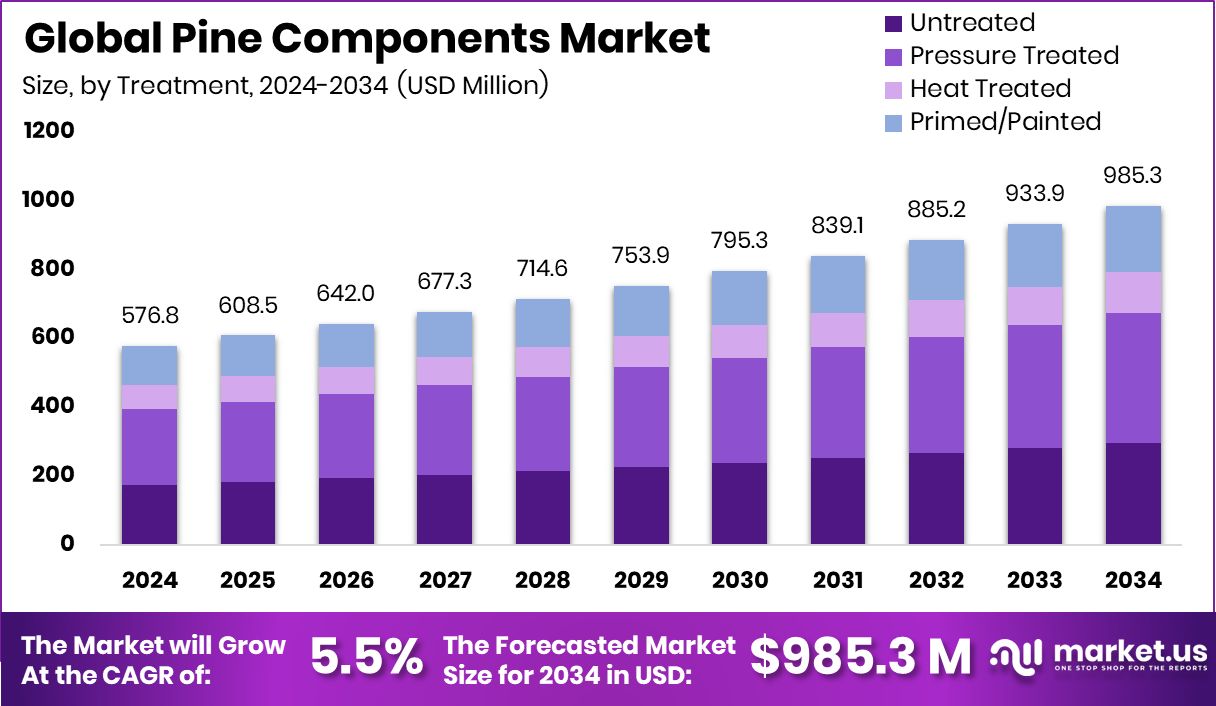
- The Global Pine Components Market is expected to be worth around USD 985.3 million by 2034, up from USD 576.8 million in 2024, and is projected to grow at a CAGR of 5.5% from 2025 to 2034.
- The Pine Components Market grows steadily as pressure-treated variants hold a strong 38.4% share.
- Finger-jointed pine dominates product type demand with its superior stability, capturing 59.1% market share.
- Knotty grade pine remains popular for aesthetic applications, accounting for 38.7% of total volume.
- Window frames drive consistent demand in applications, representing 27.2% of overall market consumption globally.
- Construction remains the leading end-use sector, contributing a significant 49.8% to market expansion.
- In North America, the market reached USD 185.1 Mn, securing 32.10% share.
➤ Directly purchase a copy of the report – https://market.us/purchase-report/?report_id=175224
Market Segments
By Treatment
Pressure-treated pine led demand with 38.4% share, driven by its strong resistance to moisture, insects, and decay. Its durability made it highly suitable for outdoor structures, framing, and humid environments. Rising home renovation and DIY activities further strengthened adoption, as consumers favored affordable yet long-lasting wood solutions.
Growing urban development and infrastructure repair projects also supported this segment. Continuous advancements in treatment processes improved product safety, lifespan, and compliance with environmental regulations, while increasing preference for sustainable and durable construction materials ensured continued demand across residential and commercial building applications.
By Product Type
Finger-jointed pine dominated with 59.1% share, supported by its dimensional stability, smooth finish, and reduced defects. It remained a preferred option for mouldings, trims, panels, and engineered interior components due to consistent quality and minimal warping. Manufacturers increasingly adopted automated joining systems to enhance strength and production efficiency.
The segment also benefited from sustainability trends, as it maximizes the use of smaller wood sections and reduces raw material waste. Its balance of performance, cost efficiency, and eco-friendly resource utilization made it highly attractive for modern residential and commercial construction needs.
By Grade / Quality
Knotty-grade pine captured 38.7% share, fueled by rising demand for rustic, natural-looking interiors. Its distinctive grain patterns and visible knots made it especially popular in wall paneling, cabinetry, furniture, and decorative residential applications. Consumers and designers increasingly favored this grade for vintage, farmhouse, and country-style aesthetics, while its affordability added to its appeal. Improved finishing and protective surface treatments helped preserve both durability and visual texture. Growing global renovation activity and demand for budget-friendly yet stylish wood solutions continued to strengthen knotty-grade pine usage in both homes and select commercial interiors.
By Application
Window frames represented 27.2% share, driven by pine’s lightweight nature, machinability, and natural insulation properties. The material remained widely used in residential construction for its ability to combine thermal efficiency with attractive aesthetics. Rising interest in sustainable and energy-efficient housing has increased the use of wooden frames as an alternative to PVC and aluminum.
Manufacturers improved coatings, lamination, and weather-resistant finishes to enhance product lifespan. Renovation projects, particularly in mature housing markets, also supported steady demand, making pine window components a reliable choice for both new builds and refurbishment work.
By End-Use Industry
Construction remained the largest end-use segment with 49.8% share, supported by pine’s affordability, versatility, and compatibility with modern building systems. It was extensively used in framing, joinery, interior finishing, and paneling across residential and commercial projects. Rapid urban expansion, housing demand, and infrastructure upgrades in emerging economies significantly boosted consumption.
Increasing adoption of green building standards and certified wood products further strengthened demand. Government support for sustainable construction and energy-efficient materials also contributed to growth. As global residential and commercial development continued expanding, construction remained the core driver of pine component demand.
Regional Analysis
North America led the Pine Components Market with a 32.10% share valued at USD 185.1 million, supported by strong construction activity, high adoption of engineered pine products, and steady home renovation demand across the U.S. and Canada. Europe maintained stable growth due to a strong preference for premium pine components in windows, doors, furniture, and interior finishing. Asia Pacific continued expanding as rapid industrial growth and rising residential and commercial construction increased pine material consumption.
The Middle East & Africa showed gradual progress, driven by urban development and greater use of wood in interior applications. Latin America contributed moderate growth, supported by improving building activity and demand for affordable wood solutions. Overall, while all regions showed positive momentum, North America remained the dominant market due to its mature construction sector and broad end-use adoption.
Top Use Cases
- Door and Window Frames: Pine components are widely used for door frames, window frames, and mouldings because they are easy to cut, shape, and finish. They also provide good insulation and a clean, natural look for homes.
- Furniture Making: Pine is a popular choice for beds, cabinets, wardrobes, tables, chairs, and shelves. It is lightweight, affordable, and easy for carpenters to design into many furniture styles.
- Wall Panels and Ceiling Cladding: Pine panels are commonly used in interior walls and ceilings to create warm, natural-looking spaces. Designers pine for decorative cladding, trims, and rustic interiors.
- Structural Framing: Pine components are heavily used in house framing, beams, roof supports, and ceilings because the wood is strong yet easy to work with during construction.
- Flooring and Stair Parts: Pine is often used for wood flooring, staircases, and floorboards due to its warm texture and cost advantage over hardwood. It is common in both traditional and modern homes.
- Outdoor Decking and Fencing: Treated pine components work well in decks, fences, terrace boards, and garden structures, especially where moisture resistance is needed.
Notable Company Developments
- In June 2025, Metsä Group completed the divestment of its wood supply business in Latvia to ACA Timber. This development helps the company sharpen its focus on its core wood processing and engineered product operations while still maintaining long-term pulpwood and chip deliveries for production continuity.
- In November 2024, Weyerhaeuser announced a $500 million investment to build a new TimberStrand® LSL facility in Arkansas. This is a major development for pine-based building components because TimberStrand products are widely used in framing, beams, studs, and structural applications.
- In February 2024, Stora Enso’s latest official annual update highlighted its continued strategy to grow in renewable wood construction materials and engineered wood solutions. For pine components, this supports wider use of finger-jointed parts, glue-laminated window components, and structural pine timber in sustainable building systems.
Conclusion
The Pine Components Market continues to show steady growth, supported by rising demand from construction, furniture, interior finishing, and renovation activities worldwide. Pine remains a preferred material because it is lightweight, cost-effective, easy to process, and suitable for both structural and decorative applications. Growing interest in sustainable construction and certified wood products is further strengthening its use across residential and commercial projects.
Advanced manufacturing methods such as finger-jointing, lamination, and precision treatment are improving product quality and reducing waste. With ongoing urbanization, infrastructure upgrades, and modern building trends, pine components are expected to remain an important and reliable material choice across multiple industries globally.
Discuss your needs with our analyst
Please share your requirements with more details so our analyst can check if they can solve your problem(s)