Table of Contents
Overview
New York, NY – March 30, 2026 –The global parabens market is steadily growing as brands place greater focus on product safety, shelf life, and large-scale distribution. Parabens continue to be widely used in cosmetics, personal care, pharmaceuticals, and household products because they effectively prevent the growth of bacteria, yeast, and mold while remaining cost-efficient and highly stable in formulations. Their continued use in lotions, creams, shampoos, and related products helps maintain freshness and quality during storage, transport, and repeated consumer use.
Growth is strongly supported by increasing demand for long-lasting beauty and wellness products as companies expand across wider retail networks. At the same time, innovation in preservation technology is influencing future formulation strategies. Chinova Bioworks’ $6 million Series A funding reflects rising interest in natural shelf-life technologies that are shaping preservative development trends.
Expansion across related consumer brands also supports consistent preservative demand. Owl’s Brew secured $9 million in Series A funding, while an industry alum raised $8 million for a natural perfume startup, both pointing to growing product pipelines that still require reliable preservation systems. Madison Reed’s $33 million expansion funding, followed by an additional $51 million round for store growth, further highlights increasing production volumes and the need for safe, scalable preservation solutions across expanding product portfolios globally.
➤ Click the sample report link for complete industry insights: https://market.us/report/parabens-market/request-sample/
Key Takeaways
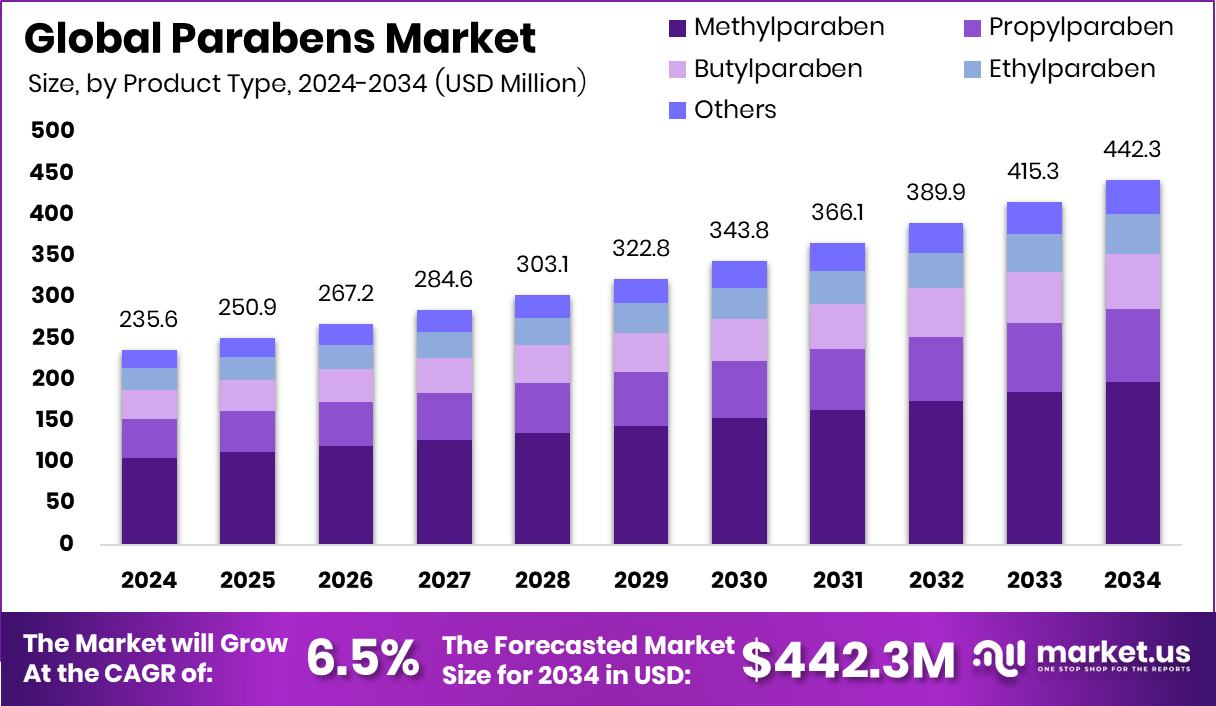
- The Global Parabens Market is expected to be worth around USD 442.3 million by 2034, up from USD 235.6 million in 2024, and is projected to grow at a CAGR of 6.5% from 2025 to 2034.
- In the Parabens Market, methylparaben dominates product types, holding a 44.7% share due to formulation use.
- Cosmetics and personal care lead the Parabens Market end-use segment, accounting for 49.1% of consumption.
- The Asia Pacific reported a total market valuation of USD 94.0 Mn that year.
➤ Directly purchase a copy of the report – https://market.us/purchase-report/?report_id=175003
Market Segments
By Product Type
Methylparaben remained the leading product type in the parabens market in 2024, capturing a 44.7% share due to its strong preservative efficiency, affordability, and wide formulation compatibility. It is extensively used in water-based products such as lotions, creams, shampoos, and pharmaceutical preparations because it offers reliable protection against bacteria and fungi while preserving product stability over long storage periods.
Manufacturers continue to favor it for its consistent performance across different pH levels and temperature conditions. Its low dosage requirement, proven safety history, and cost-effectiveness make it a preferred choice for large-scale production, reinforcing its dominant role despite growing interest in alternative preservatives.
By End Use
The cosmetics and personal care segment led parabens demand in 2024 with a 49.1% market share, driven by strong global use of daily beauty and hygiene products. Items such as moisturizers, makeup, haircare, deodorants, and sunscreens rely on parabens to prevent microbial contamination and maintain safety during repeated use. Their ability to preserve texture, fragrance, and product performance makes them essential for manufacturers focused on shelf-life stability.
Rising urban populations, greater beauty awareness, and continuous product innovation continue to support demand in this segment. Although clean-label preferences are growing, cosmetics and personal care remain the most consistent and dominant end-use sector for parabens worldwide.
Regional Analysis
Asia Pacific led the parabens market with a 39.9% share valued at USD 94.0 million, supported by strong cosmetics, personal care, and hygiene product consumption across major economies. Its large manufacturing base and rising daily-use product demand continue to strengthen regional leadership. North America maintained stable growth due to high dependence on personal care formulations and established safety regulations that support preservative use.
Europe remained a significant market, driven by consistent demand from skincare, haircare, and pharmaceutical products. Meanwhile, the Middle East & Africa showed gradual expansion through urban lifestyle shifts, while Latin America held a moderate share supported by local production and expanding retail distribution channels.
Top Use Cases
- Cosmetics and Skincare: Parabens are widely used in creams, lotions, moisturizers, makeup, sunscreens, and face washes. They stop bacteria and mold from growing in water-based beauty products, helping them stay safe for daily use.
- Hair Care Products: Shampoos, conditioners, hair serums, and styling gels often use parabens to keep formulas fresh for a long time. This helps prevent spoilage when products are opened many times.
- Pharmaceutical Products: Parabens are used in creams, ointments, syrups, and some liquid medicines to stop microbial contamination and protect medicine quality during storage.
- Food and Beverage Preservation: Some processed foods and drinks use parabens as preservatives to reduce fungal and bacterial growth, which helps improve shelf life.
- Household and Hygiene Products: Liquid soaps, hand washes, shaving gels, and cleaning liquids may contain parabens to keep them stable and safe after repeated use.
- Industrial and Specialty Formulations: Parabens are also used in specialty liquid formulations where long storage life and microbial protection are important, especially in water-rich products.
Notable Company Developments
- In April 2024, Clariant completed the acquisition of Lucas Meyer Cosmetics. This company works on high-value cosmetic ingredients for skincare and beauty products. This move strengthens Clariant’s personal care and preservation solutions business, helping it offer better ingredients for creams, lotions, and cosmetic formulations that need stable shelf life and safety systems.
Conclusion
The parabens market continues to show stable growth, supported by strong demand from cosmetics, personal care, pharmaceuticals, and household products, where long shelf life and microbial safety are essential. Methylparaben remains the leading product type due to its cost efficiency and proven performance, while cosmetics and personal care stay the largest end-use segment. Asia Pacific leads regional demand through strong manufacturing and rising hygiene product use.
Although natural and clean-label alternatives are gaining attention, parabens remain widely preferred because of their reliability, low usage levels, and affordability. Continued product expansion by beauty and wellness brands will keep supporting steady demand for effective preservation systems in the coming years.
Discuss your needs with our analyst
Please share your requirements with more details so our analyst can check if they can solve your problem(s)