Table of Contents
Overview
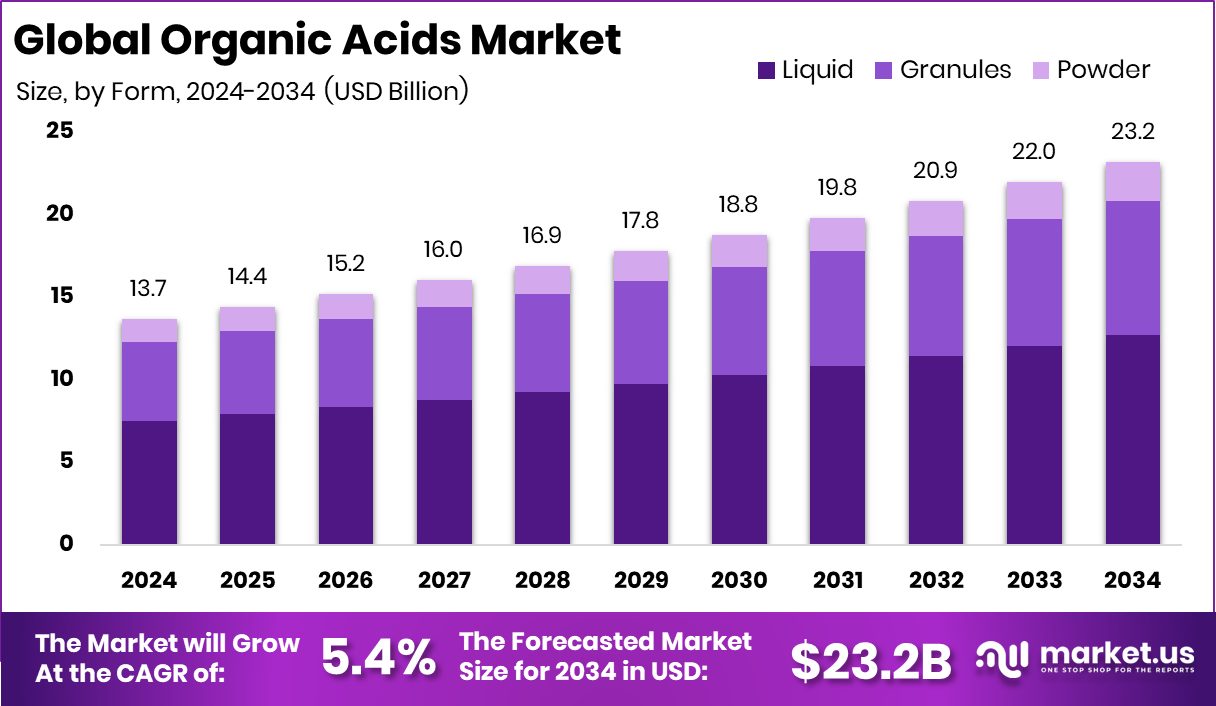
The global organic acids market is set for steady expansion, rising from USD 13.7 billion in 2024 to about USD 23.2 billion by 2034, growing at a 5.4% CAGR. Strong industrial adoption helped Asia-Pacific secure 38.40% share, equal to USD 5.2 billion, supported by food processing, agriculture, and chemical manufacturing demand.
Organic acids such as lactic, citric, acetic, and succinic acids occur naturally in plants, animals, and microbes. They are widely used for food preservation, flavor balance, digestion support, animal nutrition, and industrial reactions. Their compatibility with fermentation-based production aligns well with the global shift toward sustainable and bio-based manufacturing.
Market momentum reflects rising preference for natural ingredients over synthetic additives across food, agriculture, pharmaceuticals, and personal care. Investment activity confirms this trend, including Afyren’s €21 million funding to scale biobased organic acid production and TripleW’s $16.5 million Series B to produce lactic acid from food waste.
Biotechnology progress is further accelerating growth. BioMADE invested $26.9 million across 17 projects, while Pow.bio raised $9.5 million to expand continuous fermentation platforms, improving efficiency and cost structures.
Agriculture and clean-label foods remain key demand drivers. Supportive initiatives include the USDA’s $1 million four-year grant for sustainable soil practices, Swansea’s BioHUB receiving £4.5 million from UKRI, and Two Brothers Organic Farms raising ₹14.5 crore, strengthening regional organic acid value chains.
Top Key Players in the Market
- Archer Daniels Midland Company
- BASF SE
- Celanese Corporation
- E.i. Dupont De Nemours and Company
- Eastman Chemical Company
- Henan Jindan Lactic Acid Technology and Co.
- Tate and Lyle Plc.
- The Dow Chemical Company
1. Archer Daniels Midland Company (ADM)
ADM is a global food processing and nutrition solutions company that transforms crops into ingredients for food, feed, fuel, and industrial applications. The company focuses heavily on agricultural supply chains, sustainable nutrition, and innovative fermentation-based ingredients. Its operations span processing plants, transportation networks, and research facilities across North America, Europe, Asia, and Latin America. ADM’s strategy emphasizes expanding plant-based solutions and improving global food security.
The company has strengthened its portfolio through investments in biotechnology, alternative proteins, and sustainable agriculture. ADM also highlights responsible sourcing, emissions reduction, and renewable energy use across its supply chains. With a diverse global footprint, ADM continues to support major industries including food, beverages, pharmaceuticals, animal nutrition, and bioenergy.
| Information | Details |
|---|---|
| Company Name | Archer Daniels Midland Company |
| Founded | 1902 |
| Founders | George A. Archer & John W. Daniels |
| Headquarters | Chicago, Illinois, USA |
| Global Presence | 200+ countries |
| Core Products | Ingredients, oils, sweeteners, animal nutrition |
| Business Segments | Nutrition, Ag Services, Carbohydrate Solutions |
| Website | https://www.adm.com |
2. BASF SE
BASF is one of the world’s largest chemical producers, delivering solutions across chemicals, materials, industrial applications, agriculture, coatings, and nutrition. Its technology-driven model emphasizes innovation and sustainable manufacturing. BASF develops advanced materials for industries such as automotive, construction, agriculture, and consumer goods while investing in carbon-neutral production pathways.
The company operates an integrated global production network known as “Verbund,” enabling efficient resource use, energy savings, and process optimization. BASF also highlights climate-neutral goals, circular economy initiatives, and collaborations with global industries to accelerate sustainable chemistry solutions.
| Information | Details |
|---|---|
| Company Name | BASF SE |
| Founded | 1865 |
| Founder | Friedrich Engelhorn |
| CEO | Dr. Martin Brudermüller |
| Headquarters | Ludwigshafen, Germany |
| Core Products | Chemicals, materials, crop protection |
| Business Segments | Chemicals, Materials, Industrial Solutions |
| Global Presence | 80+ countries |
| Sustainability Goal | Net-zero emissions by 2050 |
| Website | https://www.basf.com |
3. Celanese Corporation
Celanese is a global chemical and specialty materials company supplying engineered polymers, acetate products, and chemical intermediates. The company focuses on solutions for automotive, electronics, pharmaceuticals, consumer goods, and industrial applications. Through advanced chemistry and materials science, Celanese supports innovation across high-value industries.
Celanese emphasizes productivity, operational efficiency, and sustainability, particularly through energy-efficient manufacturing and specialty materials that support lightweighting and product longevity. It continues to expand its specialty materials portfolio through technology partnerships and product innovations.
| Information | Details |
|---|---|
| Company Name | Celanese Corporation |
| Founded | 1918 |
| CEO | Lori J. Ryerkerk |
| Headquarters | Irving, Texas, USA |
| Core Products | Engineered materials, acetyl chain |
| Business Segments | Engineered Materials & Acetyl Chain |
| Global Presence | 20+ countries |
| Website | https://www.celanese.com |
4. E.I. DuPont de Nemours and Company
DuPont is a global materials science company offering specialty solutions in electronics, advanced polymers, protection fabrics, adhesives, and industrial applications. It focuses on high-performance materials that support mobility, electronics manufacturing, industrial processes, and safety technologies. DuPont’s R&D-driven approach enhances product reliability across demanding environments.
The company also invests heavily in sustainability, targeting reduced emissions, renewable-based materials, and recyclable product designs. Its innovation centers support collaboration with industrial and academic partners, enabling ongoing research in electronics, automotive, and medical technologies.
| Information | Details |
|---|---|
| Company Name | DuPont |
| Founded | 1802 |
| Founder | Éleuthère Irénée du Pont |
| CEO | Edward D. Breen |
| Headquarters | Wilmington, Delaware, USA |
| Core Products | Electronics materials, adhesives, fabrics |
| Business Segments | Electronics & Industrial, Water & Protection |
| Global Presence | 40+ countries |
| Website | https://www.dupont.com |
5. Eastman Chemical Company
Eastman is a global specialty materials company producing advanced additives, polymers, and chemicals for packaging, transportation, healthcare, consumer goods, and agriculture. The company focuses on molecular recycling technologies, carbon reduction, and environmentally responsible manufacturing.
Eastman’s innovation centers support development of specialty polymers, coatings, films, and sustainable materials. The company has also invested in large-scale recycling plants to accelerate the circular economy while reducing plastic waste.
| Information | Details |
|---|---|
| Company Name | Eastman Chemical Company |
| Founded | 1920 |
| CEO | Mark J. Costa |
| Headquarters | Kingsport, Tennessee, USA |
| Core Products | Specialty plastics, films, chemicals |
| Business Segments | Advanced Materials, Additives & Functional Products |
| Global Presence | 100+ countries served |
| Sustainability Focus | Circular economy & molecular recycling |
| Website | https://www.eastman.com |
6. Henan Jindan Lactic Acid Technology Co.
Henan Jindan specializes in the production of lactic acid, lactate salts, and polylactic acid (PLA). The company uses fermentation-based technologies to supply biodegradable materials and food-grade lactic acid used in food preservation, pharmaceuticals, and industrial applications.
Henan Jindan’s strategy focuses on expanding its PLA capacity, improving fermentation efficiency, and supporting bio-based manufacturing. The company also highlights environmental stewardship and green production processes.
| Information | Details |
|---|---|
| Company Name | Henan Jindan Lactic Acid Technology Co., Ltd. |
| Headquarters | Henan, China |
| Core Products | Lactic acid, lactates, PLA |
| Business Focus | Fermentation-based production |
| Global Presence | Exports to multiple regions |
| Website | http://www.hnjindan.com |
7. The Dow Chemical Company
Tate & Lyle is a global food and beverage ingredients provider offering sweeteners, fibers, stabilizers, and specialty ingredients. The company supports food manufacturers with solutions for sugar reduction, texture improvement, fiber enrichment, and clean-label product development.
Tate & Lyle invests strongly in R&D centers across the U.S., UK, and Europe, helping accelerate the development of nutrition-enhancing ingredients. Sustainability remains central to its operations, with initiatives focused on regenerative agriculture and reduced environmental impact.
| Information | Details |
|---|---|
| Company Name | Dow |
| Founded | 1897 |
| Founder | Herbert Henry Dow |
| CEO | Jim Fitterling |
| Headquarters | Midland, Michigan, USA |
| Core Products | Plastics, performance chemicals, coatings |
| Business Segments | Packaging & Specialty Plastics, Industrial Intermediates |
| Global Presence | 160+ countries |
| Website | https://www.dow.com |
Conculsion
Organic acids continue to gain strong relevance across global industries as demand shifts toward natural, safe, and sustainable ingredients. Their versatility in food preservation, agriculture, pharmaceuticals, and green manufacturing positions them as essential bio-based alternatives to synthetic chemicals. Ongoing innovation in fermentation and biotechnology is helping producers improve efficiency and expand applications. Supportive investments, clean-label trends, and environmentally conscious farming practices further strengthen market adoption. As sustainability pressures rise and industries pursue healthier and greener production methods, organic acids remain a key driver of progress, enabling cleaner formulations, responsible agriculture, and more resilient value chains worldwide.
Discuss your needs with our analyst
Please share your requirements with more details so our analyst can check if they can solve your problem(s)