Table of Contents
Overview
New York, NY – March 05, 2026 – The global oil refining industry continues to expand as countries invest in infrastructure to convert crude oil into essential fuels such as petrol, diesel, and jet fuel. Refining involves separating crude oil into various components and upgrading them so they meet modern quality and safety standards. This process is critical for transportation, industrial activity, and power generation, particularly in economies that still rely heavily on fossil fuels.
The oil refining market represents the global network of refineries, supply systems, infrastructure, and trade activities that support the transformation of crude oil into usable fuel products. It also includes refinery construction, modernization, capacity expansion, and the distribution of refined fuels. Government policies and financial institutions play a major role in shaping the industry by approving projects and influencing long-term energy supply strategies.
Investment in new refineries is a major growth driver. Georgia’s Development Fund committed $8.2 million toward the construction of the Kulevi oil refinery to strengthen regional processing capacity. The Reserve Bank of India also approved a $700 million Exim Bank line of credit to Mongolia to support the development of a crude oil refinery and enhance cross-border energy cooperation.
Strong domestic fuel demand is also encouraging large projects. In Nigeria, a proposed $50 billion refinery received an important regulatory approval, reflecting the country’s effort to expand local refining and reduce fuel imports. At the same time, global financial pressure is influencing investments, as Australia’s Future Fund was urged to withdraw $175 million from a Russian oil refiner.
Large-scale private financing is creating new opportunities in the sector. A major African financier confirmed that over $4 billion has been invested in the Dangote refinery, highlighting the role of private capital in building mega-refineries that support job creation, reduce fuel imports, and improve regional fuel supply stability.
➤ Click the sample report link for complete industry insights: https://market.us/report/oil-refining-market/request-sample/
Key Takeaways
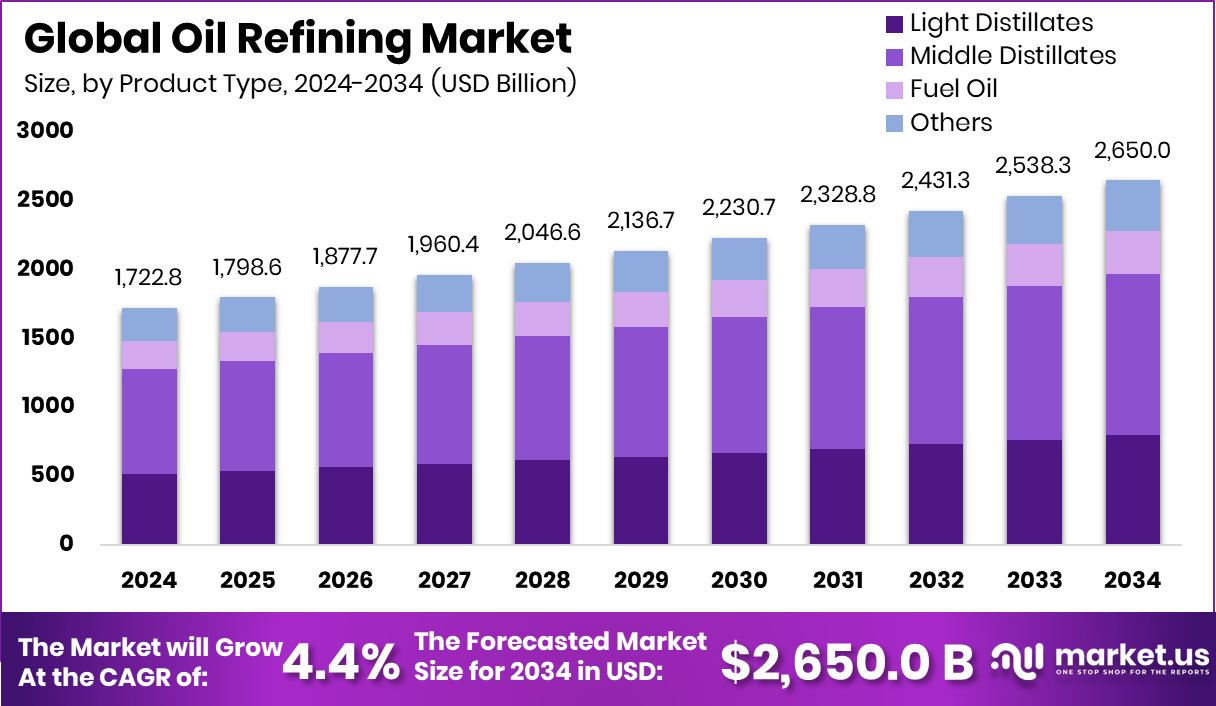
- The Global Oil Refining Market is expected to be worth around USD 2,650.0 billion by 2034, up from USD 1722.8 billion in 2024, and is projected to grow at a CAGR of 4.4% from 2025 to 2034.
- In Oil Refining Market, middle distillates lead product types, capturing 44.2% share through fuel demand.
- In Oil Refining Market applications, transportation dominates usage with 39.7% share driven by mobility growth.
- By complexity type, conversion processes dominate Oil Refining Market operations, holding 38.4% share worldwide today.
- In Europe, the oil refining market reached USD 789.0 Bn, holding a 45.80% share overall.
➤ Directly purchase a copy of the report – https://market.us/report/oil-refining-market/request-sample/
Report Scope
| Report Features | Description |
|---|---|
| Market Value (2024) | USD 1722.8 Billion |
| Forecast Revenue (2034) | USD 2,650.0 Billion |
| CAGR (2025-2034) | 4.4% |
| Segments Covered | By Product Type (Light Distillates, Middle Distillates, Fuel Oil, Others), By Application (Transportation, Aviation, Marine Bunker, Petrochemical, Residential and Commercial, Agriculture, Electricity, Rail and Domestic Waterways, Others), By Complexity Type (Topping, Hydro-Skimming, Conversion, Deep Conversion, Others) |
| Competitive Landscape | Aramco, Sinopec, ExxonMobil, Royal Dutch Shell, Total Energies, Chevron Corporation, Rosneft, Valero Energy Corporation, Phillips 66, Marathon Petroleum Corporation |
Key Market Segments
By Product Type Analysis
In 2024, middle distillates dominated the oil refining market, accounting for 44.2% of the product type share. Fuels such as diesel, jet fuel, and heating oil remain essential for transportation, aviation, and industrial operations worldwide. Their consistent demand and relatively higher refining margins encourage producers to prioritize middle distillate output. These fuels support freight movement, energy supply, and global trade, making them a key component of refinery production strategies.
Growing infrastructure projects, mining activities, and international trade have strengthened demand for these fuels. To meet market needs, refineries continue upgrading hydrocracking and distillation units to boost middle distillate production. This approach also helps refiners manage fluctuations in gasoline demand while ensuring a stable fuel supply for both developed and emerging economies.
By Application Analysis
Transportation led the oil refining market in 2024, representing 39.7% of total application demand. The sector relies heavily on refined petroleum products such as diesel and jet fuel to support road freight, aviation, and maritime transport. Despite improvements in fuel efficiency, expanding logistics networks, increasing passenger travel, and the rapid growth of e-commerce, continue to drive strong demand for transportation fuels.
In developing regions, urbanization and highway expansion have further increased the need for transport fuels. While alternative energy and electric mobility are gradually gaining attention, traditional refined fuels still dominate long-distance and heavy-duty transport. As a result, transportation remains a primary demand driver that influences refinery capacity planning and fuel production globally.
By Complexity Type Analysis
In 2024, conversion refineries accounted for 38.4% of the oil refining market by complexity type. These refineries use advanced technologies such as catalytic cracking, hydrocracking, and coking to convert heavy crude fractions into lighter and more valuable products. This higher processing capability allows refiners to maximize production of middle distillates and transportation fuels while efficiently handling heavier crude oil types.
Increasing variations in crude oil quality and pressure on refining margins have encouraged investment in conversion capacity. These complex facilities offer greater flexibility in meeting evolving fuel standards and demand patterns. As a result, conversion refineries provide a competitive advantage by improving profitability and ensuring long-term efficiency in global refining operations.
Regional Analysis
Regional performance in the global oil refining market varies based on fuel demand, refinery complexity, and crude oil availability. Europe leads the market, holding 45.80% share and generating USD 789.0 billion, supported by a strong network of advanced refineries, consistent transportation fuel demand, and active intra-regional trade. European refiners focus heavily on middle distillates and conversion capacity to meet strict fuel standards and logistics requirements.
North America maintains strong efficiency through integrated refining and petrochemical systems, supported by stable demand from freight and aviation sectors and flexible crude sourcing. Asia Pacific continues to expand refining capacity due to rapid industrial growth, increasing vehicle ownership, and rising fuel consumption.
Meanwhile, the Middle East & Africa leverage proximity to crude reserves and export-focused refineries, while Latin America prioritizes refining for regional energy security and local fuel demand.
Top Use Cases
- Transportation Fuels: One of the biggest uses of oil refining is producing fuels for transportation. Refineries convert crude oil into products such as petrol (gasoline), diesel, and jet fuel. These fuels power cars, trucks, ships, and airplanes used every day for travel and freight movement. Without refining, crude oil cannot be directly used as fuel. Refineries separate and upgrade crude oil to make these fuels safe and efficient for engines. Transportation fuels make up the largest share of refined oil products globally and are essential for global trade, logistics, and daily mobility.
- Road Construction and Infrastructure: Refineries produce asphalt (bitumen), a heavy petroleum product widely used for building and maintaining roads, highways, and airport runways. Asphalt provides durability and weather resistance for pavement surfaces. This refined product plays a major role in infrastructure development and transportation networks worldwide. Without refined bitumen, large-scale road construction and maintenance would be much more difficult and costly.
- Heating and Electricity Generation: Some refined petroleum products are used as heating oil or fuel oil to warm buildings and generate electricity in power plants and industrial boilers. In colder regions or areas with limited natural gas supply, heating oil remains an important energy source. Industries also use fuel oil in large furnaces and boilers to produce heat and steam needed for manufacturing processes.
- Lubricants for Machines and Engines: Refineries produce lubricating oils and greases that help machines run smoothly. These lubricants reduce friction between moving parts in engines, industrial equipment, and machinery. They are essential for vehicles, manufacturing plants, and heavy machinery used in construction and mining. Without refined lubricants, machines would wear out faster and operate less efficiently.
- Production of Medicines and Chemical Products: Oil refining also supports the production of chemicals used in pharmaceuticals and medical products. Petrochemical compounds derived from refined oil are used in the manufacture of medicines, medical equipment, and chemical ingredients for healthcare products. These materials are essential in modern healthcare systems and pharmaceutical manufacturing.
Recent Developments
- In December 2024, Sinopec completed the second-phase expansion of the Zhenhai Refinery and petrochemical complex in China. The project involved an investment of about CNY 41.6 billion (around USD 5.69 billion) and added 18 production units, including atmospheric distillation, catalytic cracking, and polypropylene units. This expansion helps Sinopec produce more refined fuels and petrochemical materials while creating higher-value chemical supply chains.
- In November 2024, Aramco partnered with Sinopec and Fujian Petrochemical to start construction of a new integrated refinery and petrochemical complex in Fujian, China. The facility will include a 16-million-ton-per-year refinery (about 320,000 barrels per day) along with petrochemical units. The project will help supply fuels and chemicals to the growing Asian market and strengthen Aramco’s downstream presence in China.
- In April 2024, ExxonMobil reported strong refining performance with record refining throughput during the first quarter of the year. The company improved refinery operations and efficiency to process more crude oil and produce refined fuels for global markets. This shows ExxonMobil’s continued focus on maximizing production from its existing refinery network.
Conclusion
The oil refining market remains an essential part of the global energy system, supporting transportation, industry, and everyday fuel needs. Refineries play a critical role in converting crude oil into useful products such as fuels, lubricants, and petrochemical feedstocks. Demand continues to be shaped by economic growth, infrastructure development, and rising mobility in many regions.
At the same time, refiners are focusing on improving efficiency, upgrading processing technologies, and adapting to changing fuel standards. Investments in modern refining facilities and integrated petrochemical operations are also increasing. Overall, the industry continues to evolve while maintaining its importance in ensuring a reliable fuel supply and supporting global economic activity.
Discuss your needs with our analyst
Please share your requirements with more details so our analyst can check if they can solve your problem(s)