Table of Contents
Overview
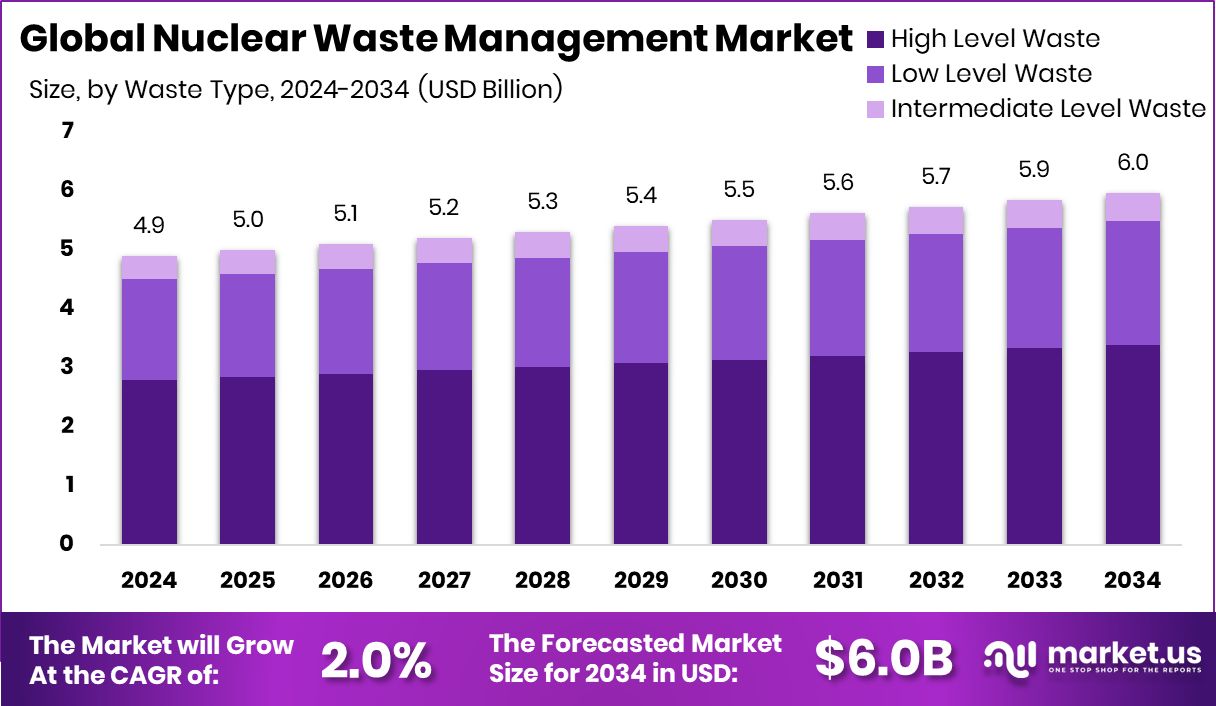
New York, NY – December 09, 2025 – The global nuclear waste management market is projected to grow steadily, reaching around USD 6.0 billion by 2034, up from USD 4.9 billion in 2024, with a modest 2.0% CAGR from 2025 to 2034. The Asia-Pacific region leads the market, holding a dominant 44.90% share, representing an estimated USD 2.2 billion in market value, supported by ongoing nuclear programs and government-led waste handling initiatives.
Nuclear waste management focuses on the controlled handling of radioactive by-products generated from nuclear power plants, medical treatments, and scientific research. Activities include waste collection, treatment, safe transportation, interim storage, and long-term or permanent disposal. These processes are designed to minimize risks to human health, ecosystems, and water resources over extremely long timeframes while complying with strict regulatory standards.
Market growth is closely tied to public funding and long-term national responsibilities. Germany’s nuclear phase-out has resulted in KENFO committing €24 billion for radioactive waste disposal. Globally, governments have accumulated more than USD 44 billion to support construction of permanent nuclear waste repositories.
Investment in safety and research is also rising. A newly established nuclear safety institute secured USD 66 million in funding, while universities in Western countries received USD 5 million to advance nuclear fuel disposal research. Additionally, innovation opportunities are expanding, as shown by the UK Nuclear Decommissioning Authority allocating £30 million to develop new technologies for decommissioning, monitoring, and waste-reduction solutions.
➤ Click the sample report link for complete industry insights: https://market.us/report/global-nuclear-waste-management-market/request-sample/
Key Takeaways
- The Global Nuclear Waste Management Market is expected to be worth around USD 6.0 billion by 2034, up from USD 4.9 billion in 2024, and is projected to grow at a CAGR of 2.0% from 2025 to 2034.
- Nuclear Waste Management Market sees High Level Waste lead due to long-term containment complexity, 56.9%.
- Nuclear Waste Management Market is driven by Pressurized Water Reactors dominance reflecting operating stability worldwide at 49.8%.
- Nuclear Waste Management Market favors Storage disposal methods, ensuring interim safety regulatory compliance globally, 49.1%.
- In the Asia-Pacific region, Nuclear Waste Management reached USD 2.2Bn, holding 44.90% market share region.
➤ Directly purchase a copy of the report – https://market.us/purchase-report/?report_id=168134
Report Scope
| Report Features | Description |
|---|---|
| Market Value (2024) | USD 4.9 Billion |
| Forecast Revenue (2034) | USD 6.0 Billion |
| CAGR (2025-2034) | 2.0% |
| Segments Covered | By Waste Type (High Level Waste, Low Level Waste, Intermediate Level Waste), By Reactor Type (Pressurized Water Reactor, Boiling Water Reactor, Gas Cooled Reactor, Pressurized Heavy Water Reactor), By Disposal Method (Incineration, Storage, Deep Geological Disposal, Others) |
| Competitive Landscape | Augean, Veolia Environnement SA., Svensk Karnbranslehantering AB, Bechtel Corporation, Stericycle, Inc., JGC HOLDINGS CORPORATION, EnergySolutions, Perma-Fix Environmental Services, Inc., Waste Control Specialists LLC (WCS) |
Key Market Segments
By Waste Type Analysis
In 2024, High Level Waste accounted for a leading 56.9% share of the Nuclear Waste Management Market under the By Waste Type segment, highlighting its critical role within the industry. This segment dominates due to the extreme radioactivity, long lifespan, and elevated risk associated with these materials, which demand specialized handling throughout their lifecycle.
Managing high-level waste involves tightly regulated processes, including shielded transportation, advanced containment systems, and long-term storage or disposal strategies that remain effective for decades. Due to these demands, a significant portion of industry expenditure and operational planning is focused on this waste type. Regulatory authorities also impose the highest safety standards on high-level waste, requiring constant monitoring and robust infrastructure.
The strong market share reflects how facility design, storage technologies, and disposal programs are largely developed around high-level waste requirements. Ongoing needs for environmental protection, safety validation, and long-term isolation ensure that this segment remains the primary focus of nuclear waste management efforts worldwide.
By Reactor Type Analysis
In 2024, the Pressurized Water Reactor (PWR) segment led the Nuclear Waste Management Market by reactor type, capturing a 49.8% share. This dominance is mainly due to the extensive global deployment of PWR technology and the consistent generation of radioactive waste during reactor operations.
Waste produced by pressurized water reactors follows well-defined pathways, requiring systematic handling, standardized storage methods, and reliable long-term management solutions. As many PWR facilities move into mature operating phases, demand remains strong for efficient waste treatment and disposal planning.
This significant market share shows that much of the existing management infrastructure, regulatory compliance systems, and operational procedures are designed around PWR waste characteristics. As a result, pressurized water reactors continue to influence investment decisions and long-term strategies across nuclear waste management activities.
By Disposal Method Analysis
In 2024, Storage led the Nuclear Waste Management Market under the By Disposal Method segment, holding a 49.1% share. This leadership reflects the ongoing dependence on secure storage systems to manage radioactive waste safely for long durations.
Storage solutions remain essential in regions where permanent disposal sites are not yet operational. These facilities rely on engineered containment, strict safety controls, and continuous supervision to minimize environmental and human risk. Regular inspections and monitoring help meet regulatory requirements and maintain system integrity.
The strong 49.1% market share highlights storage as a vital transitional solution between waste generation and final disposal. Its continued use ensures safety, operational balance, and reliability, making storage a central pillar of current nuclear waste management practices worldwide.
Regional Analysis
Asia-Pacific led the Nuclear Waste Management Market in 2024, accounting for a dominant 44.90% share, valued at USD 2.2 Bn. This position is supported by rapid expansion in nuclear power capacity and strong government focus on long-term waste storage, monitoring, and disposal systems to handle increasing waste from operating and aging reactors.
North America remains a mature market, shaped by strict regulations and long-standing waste management responsibilities, with continued emphasis on controlled storage and future disposal readiness.
Europe shows stable progress, driven by reactor decommissioning and rigorous environmental compliance. The Middle East & Africa region is at an early stage, closely aligned with developing nuclear programs. Latin America records steady growth, concentrating on safe interim storage aligned with national policies.
Top Use Cases
- Interim storage of spent nuclear fuel: After a reactor is shut down or fuel is replaced, spent fuel is stored in specially designed pools or dry-casks. These storage systems keep the fuel cooled and shield radiation until a long-term plan is ready.
- Safe treatment and packaging of radioactive waste: Before disposal or long-term storage, waste (solid, liquid, or gaseous) is treated, immobilized or solidified, and placed in sealed containers. This lowers risk, makes handling safer, and prevents leaks
- Deep underground disposal (geological repositories): For highly radioactive or long-lived waste, one of the safest solutions is to bury it deep under stable rock layers. This isolates the waste for thousands (even hundreds of thousands) of years, protecting people and the environment.
- Long-term environmental safety and containment: Radioactive waste often remains hazardous for many years. Robust management — including secure containment, engineered barriers, and controlled storage — ensures that radioactivity doesn’t leak into soil, water, or air during that time.
- Regulatory compliance and public protection: Because radioactive waste can harm humans and ecosystems, strict regulations govern its handling, transport, storage, and disposal. Proper waste management ensures compliance and keeps radiation exposure within safe limits.
- Sustainability and future-use readiness: Some waste streams can be reprocessed or recycled. Meanwhile, robust waste-management systems maintain flexibility — enabling future technologies or disposal options while keeping waste secure.
Recent Developments
- In February 2025, Veolia Nuclear Solutions completed the acquisition of Daher Nuclear Technologies (effective 31 December 2024). This expanded Veolia’s radioactive-waste management capabilities in France by combining Veolia’s nuclear services with DNT’s expertise.
- In October 2024, SKB received a permit from Sweden’s Land and Environmental Court to build and operate a permanent repository for spent nuclear fuel in Forsmark, along with an encapsulation plant at Oskarshamn. This permission cleared the way for preparatory site work to begin.
- In July 2024, Japan-based Muroosystems signed an agreement to acquire all shares of NUKEM, a German firm known for radioactive waste management and nuclear decommissioning services. The deal covers NUKEM’s core assets and transfers its business under new ownership. This marks a fresh start for NUKEM under Muroosystems’ management.
Conclusion
The nuclear waste management market plays a vital role in ensuring the safe and responsible handling of radioactive materials generated from energy production, healthcare, and research activities. It focuses on protecting human health, natural resources, and future generations through secure treatment, storage, and disposal practices.
As nuclear facilities age and environmental expectations become stricter, long-term waste responsibility continues to gain importance. Governments and operators increasingly prioritize safety, regulatory compliance, and environmental stewardship.
Innovation in storage systems, monitoring technologies, and disposal methods is also shaping current approaches. Overall, nuclear waste management remains a foundational element of the nuclear value chain, supporting operational stability, public trust, and sustainable use of nuclear technologies worldwide.
Discuss your needs with our analyst
Please share your requirements with more details so our analyst can check if they can solve your problem(s)