Table of Contents
Overview
New York, NY – April 01, 2026 – The Nordic cross-laminated timber (CLT) and lumber processing market combines sustainably managed forestry, advanced sawmilling, and engineered wood manufacturing into a streamlined low-carbon construction ecosystem. CLT panels, formed by layering timber boards in alternating directions, deliver strength, dimensional stability, and lightweight performance, while Nordic lumber processing ensures a reliable flow of precision-graded boards for structural applications. This integrated value chain supports faster installation, lower onsite labor requirements, and reduced emissions across residential, commercial, and public infrastructure projects.
Market momentum is being reinforced by strong construction-technology and financing activity. Billd secured $7.3 million, BRKZ raised $30 million in debt financing, and Mango added $3 million to improve procurement speed and project cash flow. On the technology side, Polyuse raised ¥2.7 billion for 3D-printing systems, while Contineu secured $1.2 million to expand AI-powered site intelligence, improving predictability and timber workflow efficiency. Robotics is also accelerating adoption, with Gravis Robotics raising €19 million for robotic excavation systems that complement CLT’s prefabricated nature.
In parallel, $61 billion in data-center construction deals is increasing demand for rapid-build structural solutions. Together, digital fabrication, automation, and sustainable building policies are creating strong opportunities for Nordic CLT and lumber suppliers to scale into larger, more complex projects globally.
➤ Click the sample report link for complete industry insights: https://market.us/report/nordic-cross-laminated-timber-clt-and-lumber-processing-market/request-sample/
Key Takeaways
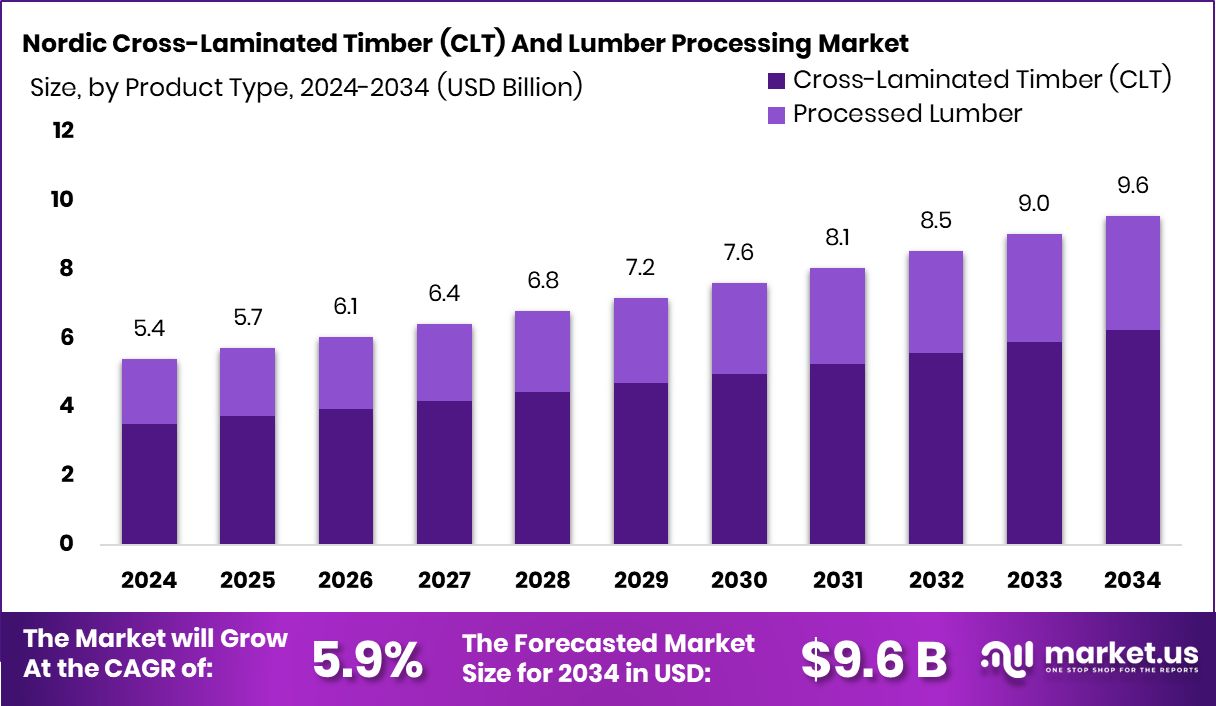
- The Global Nordic Cross-Laminated Timber (CLT) And Lumber Processing Market is expected to be worth around USD 9.6 billion by 2034, up from USD 5.4 billion in 2024, and is projected to grow at a CAGR of 5.9% from 2025 to 2034.
- Nordic CLT dominates with 65.3%, driven by sustainable building practices and advanced regional lumber processing technologies.
- Construction leads with 56.1%, as Nordic nations accelerate timber-based infrastructure and low-carbon development projects.
- Europe generated a strong market value of USD 2.1 Bn overall.
➤ Directly purchase a copy of the report – https://market.us/purchase-report/?report_id=175207
Market Segments
By Product Type
In 2024, Cross-Laminated Timber (CLT) dominated the Nordic CLT and lumber processing market with a 65.3% share, driven by rising demand for engineered wood in sustainable construction. Strong regional spruce and pine availability, close sawmill integration, and better value recovery continue to strengthen CLT’s position over traditional sawn timber. Manufacturers are expanding press capacity, improving moisture control, and automating grading systems to meet structural standards. Growth is further supported by modular building demand, though resin costs, energy prices, and logistics remain key margin challenges.
By Application
Construction accounted for 56.1% of the Nordic CLT and lumber processing market in 2024, making it the leading application segment. Demand is fueled by multi-storey housing, schools, and commercial retrofits that favor CLT for fast assembly, fire-tested performance, and lower onsite waste. This trend pushes lumber processors to maintain consistent strength grading, precise drying, and accurate planing for smooth CLT and glulam production. Future growth will depend on easier permitting, standardized timber design codes, and stable supply contracts supporting renovation and hybrid urban building projects.
Regional Analysis
In 2024, Europe led the Nordic CLT and lumber processing market with a 39.5% share valued at USD 2.1 billion, supported by mature mass-timber adoption and strict carbon policies. North America grew steadily through supportive code changes for taller timber buildings. Asia Pacific showed emerging potential with sustainability-driven construction growth, while Latin America and the Middle East & Africa remained smaller, gradually developing markets.
Top Use Cases
- Multi-storey residential buildings: Nordic CLT is widely used in apartments and housing blocks because it is strong, lightweight, and quick to install. Prefabricated wall and floor panels reduce labor time and create less site waste.
- Schools and public buildings: CLT works well for schools, offices, and civic buildings due to fast assembly, fire-tested performance, and good acoustic comfort. It also creates warm indoor spaces.
- Modular and prefabricated construction: Factories process Nordic lumber into ready-to-install CLT panels for modular homes and prefab buildings. This improves speed, precision, and reduces material waste.
- Industrial and warehouse buildings: Large-span CLT panels are increasingly used in industrial buildings and warehouses in Nordic climates because of durability and sustainability benefits.
- Roof, floor, and wall systems: Processed timber boards are converted into CLT slabs used for roofs, floors, and structural walls in both residential and commercial projects.
- Low-carbon urban developments: Nordic cities are using CLT in large urban projects to cut carbon emissions, speed up construction, and improve cleaner building environments.
Notable Company Developments
- In May 2025, Stora Enso completed the acquisition of Finnish sawmill company Junnikkala. This development strengthens its Nordic lumber processing network and secures an efficient wood supply for future engineered wood and timber products. The move also supports better sawmill integration and long-term raw material availability for CLT-related solutions.
- In September 2024, Pölkky continued its Kajaani sawmill modernization and investment project, improving sawing, drying, and lumber flow efficiency. This development strengthens raw material quality and supply reliability for Nordic CLT and lumber processing applications, while supporting faster delivery and better yield from Northern Finnish pine.
Conclusion
The Nordic Cross-Laminated Timber (CLT) and lumber processing market is positioned for steady long-term growth as sustainable construction, low-carbon building targets, and prefabricated methods gain wider acceptance. Strong forestry resources, advanced sawmill integration, and rising automation continue to improve production efficiency and material quality across the region. Growing use in housing, schools, commercial spaces, and hybrid urban projects highlights CLT’s versatility and structural advantages
. Support from digital design, robotics, and smarter construction workflows further strengthens adoption. As regulations increasingly favor green materials and faster building cycles, Nordic producers are well placed to expand into larger, more complex, and higher-value timber construction applications globally.
Discuss your needs with our analyst
Please share your requirements with more details so our analyst can check if they can solve your problem(s)