Table of Contents
Overview
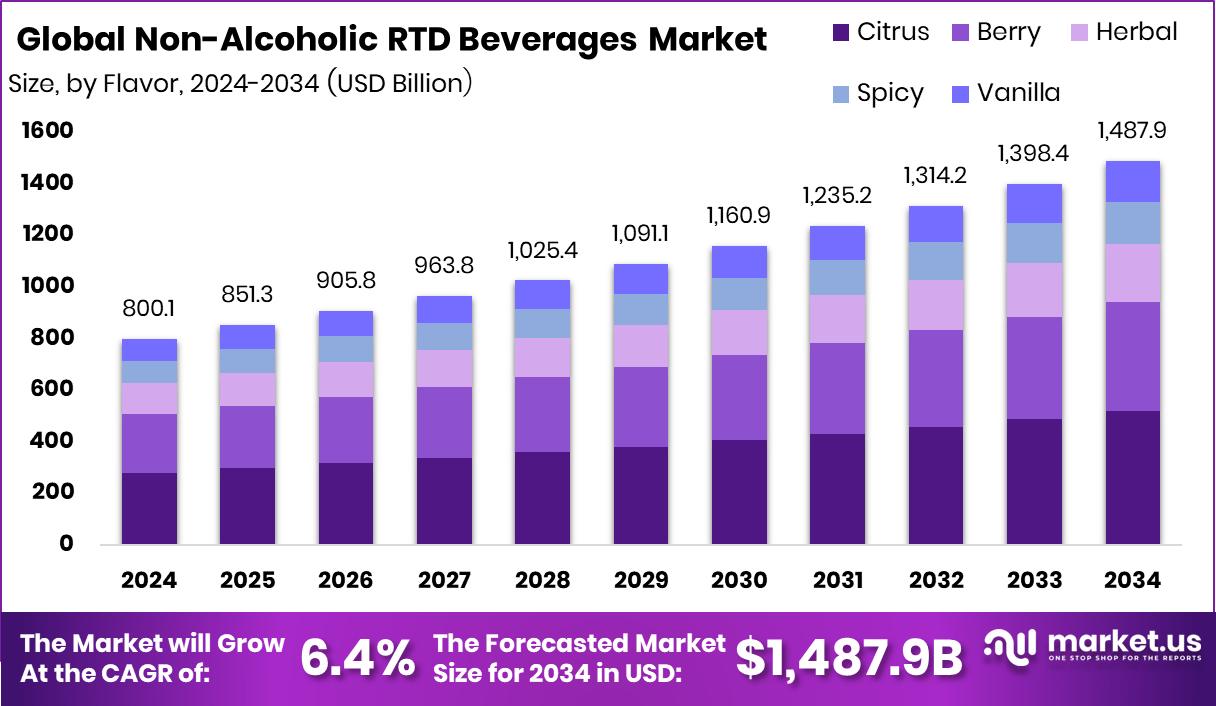
New York, NY – March 25, 2026 – The global non-alcoholic ready-to-drink (RTD) beverages market is on a strong growth trajectory, projected to rise from USD 800.1 billion in 2024 to around USD 1,487.9 billion by 2034, expanding at a CAGR of 6.4%. Asia Pacific remains the leading region, driven by high consumption levels, contributing approximately USD 345.6 billion.
Non-alcoholic RTD beverages include pre-packaged drinks such as sodas, flavored water, teas, juices, energy drinks, and functional beverages. Their convenience and wide variety make them popular for busy, on-the-go lifestyles across all age groups.
Market growth is fueled by shifting consumer preferences toward healthier and more convenient hydration options. Increasing urbanization and demand for quick refreshment are encouraging companies to expand product lines with innovative flavors, natural ingredients, and low- or no-sugar alternatives.
Investor interest is accelerating innovation and brand expansion in this space. Culture Pop Soda secured $15 million in equity funding to scale its offerings, while Cove Soda raised $15 million in Series A funding to strengthen its North American presence. Lahori attracted Rs 200 crore in funding, raising its valuation to Rs 2,800 crore. Olipop achieved valuations between $1.85 billion and nearly $2 billion after recent funding rounds. Additionally, a modern soda brand secured $50 million from J.P. Morgan Private Capital, highlighting strong investor confidence.
➤ Click the sample report link for complete industry insights: https://market.us/report/global-non-alcoholic-rtd-beverages-market/request-sample/
Key Takeaways
- The Global Non-Alcoholic RTD Beverages Market is expected to be worth around USD 1,487.9 billion by 2034, up from USD 800.1 billion in 2024, and is projected to grow at a CAGR of 6.4% from 2025 to 2034.
- Carbonated soft drinks dominate the Non-Alcoholic RTD Beverages Market with 39.4% share globally today.
- Citrus flavor leads the Non-Alcoholic RTD Beverages Market, capturing 34.9% consumer preference worldwide currently overall.
- Hypermarkets and supermarkets lead distribution in the Non-Alcoholic RTD Beverages Market with 49.1% share dominance.
- The Asia Pacific recorded a USD 345.6 Bn market value during 2024 overall.
➤ Directly purchase a copy of the report – https://market.us/purchase-report/?report_id=174697
Market Segments
By Product Analysis
Carbonated soft drinks dominated the Non-Alcoholic RTD Beverages Market in 2024, holding a 39.4% share of total demand. Their strong position comes from widespread consumer familiarity, easy availability, and consistent taste preferences across all age groups. These beverages benefit heavily from impulse buying and high retail visibility, especially in urban areas where consumers seek quick refreshment.
Ongoing product innovation, including low-sugar variants and natural sweeteners, has helped maintain relevance despite health concerns. Their affordability, variety, and mass appeal ensured carbonated soft drinks remained the leading product segment throughout the year.
By Flavor Analysis
Citrus flavors dominated the Non-Alcoholic RTD Beverages Market in 2024, capturing a 34.9% share of overall flavor consumption. Popular options like lemon, orange, and mixed citrus remained widely preferred due to their refreshing taste and association with natural freshness. Consumers link citrus with hydration and energy, making it a daily consumption choice across multiple RTD categories.
Demand increased further during warmer seasons, reinforcing its popularity. Manufacturers continued focusing on citrus-based innovations, including low-calorie and fortified options, helping the segment maintain its lead over berry, cola, and other emerging flavors.
By Distribution Channel Analysis
Hypermarkets and supermarkets dominated the Non-Alcoholic RTD Beverages Market in 2024, securing a 49.1% share of total distribution. Their strength lies in offering a wide product variety, attractive discounts, and the convenience of one-stop shopping. Consumers prefer these outlets for bulk purchases and price comparisons.
Strong foot traffic, especially in urban and semi-urban areas, supports high sales volumes. In-store promotions, combo deals, and product visibility further influence buying behavior. Although online and convenience stores are expanding, hypermarkets and supermarkets remain the primary distribution channel due to accessibility and consumer trust.
Regional Analysis
In 2024, Asia Pacific dominated the Non-Alcoholic RTD Beverages Market with a 43.2% share, reaching USD 345.6 billion, driven by strong urban consumption, rising demand for ready-to-drink formats, and expanding retail networks across China, India, and Southeast Asia. North America showed steady growth with increasing preference for functional and low-calorie beverages.
Europe followed with demand for natural and premium RTD options. Latin America emerged with growing youth-driven consumption, while the Middle East & Africa saw gradual growth supported by retail expansion and rising demand for non-alcoholic alternatives.
Top Use Cases
- Quick Hydration Anytime: RTD beverages are commonly used for fast hydration during busy routines. People drink them at work, travel, or daily activities because they are ready to consume instantly. Many drinks help maintain body fluid balance and prevent dehydration, especially in heat or fatigue conditions.
- Energy Boost for Sports & Fitness: Sports and energy RTD drinks are widely used by athletes and gym-goers. They help replace lost fluids, electrolytes, and energy during or after workouts. This supports endurance and recovery after physical activity.
- Healthy Alternative to Alcohol: Non-alcoholic RTD drinks are used in social events as a substitute for alcoholic beverages. People can enjoy similar flavors and experiences without intoxication, making them popular among health-conscious and sober consumers.
- Convenient On-the-Go Consumption: One of the biggest uses is convenience. These drinks require no preparation—just open and drink. They are ideal for picnics, office breaks, travel, and outdoor activities where carrying equipment is impractical.
- Functional Health & Wellness Drinks: Many RTD beverages are designed for wellness, offering benefits like hydration, focus, or energy. Some include caffeine or added ingredients that may help improve alertness or mood for short periods.
- Daily Refreshment & Taste Variety: People use RTD beverages simply for refreshment and enjoyment. With many flavors and types (tea, juices, soda, etc.), they satisfy taste preferences while offering an easy drinking option anytime.
Notable Company Developments
- In March 2025, PepsiCo, a global company that makes soft drinks, juices, energy drinks, and packaged beverages, announced the acquisition of Poppi, a prebiotic soda brand. Poppi makes low-sugar, functional RTD drinks focused on gut health.
- In February 2025, Keurig Dr Pepper launched new flavors across major brands like Dr Pepper, 7UP, A&W, and Snapple. These are ready-to-drink beverages designed to attract younger consumers with new tastes and seasonal varieties, strengthening its RTD portfolio.
- In December 2024, Coca-Cola agreed to acquire Billson’s, an Australia-based ready-to-drink beverage brand. Although known for multiple drink types, the deal supports Coca-Cola’s broader strategy to expand its RTD portfolio and strengthen its presence in the Australian beverage market.
Conclusion
The Non-Alcoholic RTD Beverages Market continues to grow steadily, driven by changing consumer lifestyles and rising demand for convenient, ready-to-drink options. The growing preference for healthier beverages, including low-sugar, functional, and natural-ingredient drinks, is shaping product innovation. Strong retail presence and expanding online channels are improving accessibility worldwide.
Asia-Pacific continues to lead regional growth, while other regions exhibit steady adoption. Continuous investments, new product launches, and evolving consumer tastes are expected to support long-term expansion. Overall, the market reflects a shift toward convenience, wellness, and diverse flavor experiences across global consumers.
Discuss your needs with our analyst
Please share your requirements with more details so our analyst can check if they can solve your problem(s)