Table of Contents
Overview
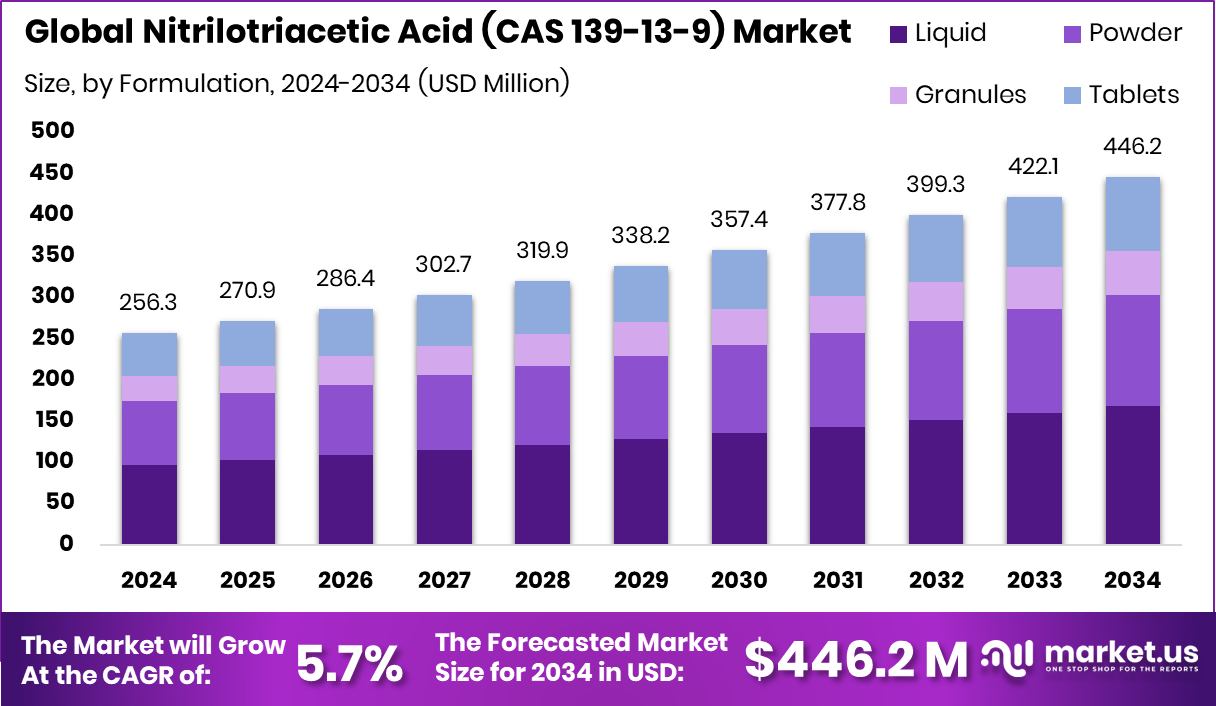
New York, NY – December 26, 2025 – The global Nitrilotriacetic Acid (CAS 139-13-9) market is on a steady growth path, projected to reach USD 446.2 million by 2034, rising from USD 256.3 million in 2024, at a CAGR of 5.7% between 2025 and 2034. North America remains the leading region, holding 45.90% share, which equals USD 117.6 million, driven by strong industrial and municipal demand.
Nitrilotriacetic Acid is a synthetic chelating agent used to capture metal ions such as calcium, magnesium, and iron. Its ability to improve water softness, reduce scaling, and stabilize industrial formulations makes it valuable in water treatment, detergents, agriculture, and industrial cleaning applications. Market demand closely follows infrastructure development, stricter water-quality regulations, and the growing need for reliable metal control in processing systems.
Growth is strongly supported by rising investments in water and wastewater infrastructure. Key funding activities include USD 50 million invested in Membrane Group, €130 million secured by Iraq for sanitation projects, and £42 million allocated to regulated water treatment initiatives, all of which expand chelant usage.
Additional momentum comes from USD 131 million in federal deals for PFAS-affected plant upgrades and USD 78 million for water quality improvements in New York, boosting chemical demand. Looking ahead, innovation-backed projects such as €2.3 million raised by HULO for AI-based leak detection highlight opportunities for Nitrilotriacetic Acid in smarter, more efficient water management systems.
➤ Click the sample report link for complete industry insights: https://market.us/report/global-nitrilotriacetic-acid-cas-139-13-9-market/request-sample/
Key Takeaways
- The Global Nitrilotriacetic Acid (CAS 139-13-9) Market is expected to be worth around USD 446.2 million by 2034, up from USD 256.3 million in 2024, and is projected to grow at a CAGR of 5.7% from 2025 to 2034.
- In the Nitrilotriacetic Acid (CAS 139-13-9) market, liquid formulations hold 37.8%, supported by easy handling in water treatment systems.
- Metal chelation leads the Nitrilotriacetic Acid (CAS 139-13-9) market with 44.6%, driven by demand for efficient ion control processes.
- Agriculture accounts for 23.9% of the Nitrilotriacetic Acid (CAS 139-13-9) market, supporting micronutrient availability in soils.
- Strong water treatment demand positions North America at 45.90% reaching USD 117.6 Mn.
➤ Directly purchase a copy of the report – https://market.us/purchase-report/?report_id=169648
Report Scope
| Report Features | Description |
|---|---|
| Market Value (2024) | USD 256.3 Million |
| Forecast Revenue (2034) | USD 446.2 Million |
| CAGR (2025-2034) | 5.7% |
| Segments Covered | By Formulation (Liquid, Powder, Granules, Tablets), By Application (Metal Chelation, Water Treatment, Surface Treatment, Cleaning Products, Others), By End-Use (Agriculture, Textile, Plastics, Paper and Pulp, Personal Care, Pharmaceuticals, Others) |
| Competitive Landscape | Ava Chemicals Private Limited, Triveni Chemicals, IRO Group, Brandt Chemical, Zhonglan Industry, Humica Weihai Inteational, Remedy Labs |
Key Market Segments
By Formulation Analysis
In 2024, the liquid formulation emerged as the leading segment in the Nitrilotriacetic Acid (CAS 139-13-9) market, accounting for a 37.8% share. This leadership is mainly due to its ease of use in applications that require accurate dosing and rapid solubility.
Liquid forms blend seamlessly into water treatment systems and continuous industrial operations, reducing preparation steps and handling time. Their compatibility with automated dosing systems further improves operational efficiency, especially in large-scale municipal and industrial facilities.
From a logistics perspective, liquid formulations simplify storage and on-site handling, offering flexibility to end users managing complex processes. These functional advantages make liquid nitrilotriacetic acid a reliable option for consistent chelation performance with minimal residue concerns. As industries continue to prioritize efficiency and process control, liquid formulations maintain strong and stable demand throughout the year.
By Application Analysis
Metal chelation dominated the application landscape in 2024, holding a 44.6% market share. This reflects the core role of nitrilotriacetic acid in binding metal ions such as calcium, magnesium, and iron across industrial and environmental systems.
Effective metal control is essential for preventing scaling, managing water hardness, and maintaining process stability. Nitrilotriacetic acid delivers consistent chelation performance under varying operational conditions, making it highly dependable in complex treatment environments.
Its predictable behavior supports smoother system operation and reduces interference from unwanted metal reactions. Industries value this reliability, particularly in multi-stage treatment processes where stability is critical. As a result, metal chelation remained the primary consumption channel, reinforcing its position as the most significant application segment within the overall market.
By End-Use Analysis
In 2024, agriculture led the end-use segment with a 23.9% share, driven by the need for efficient nutrient management. Nitrilotriacetic acid plays a key role in improving micronutrient availability by preventing metal ions from becoming inactive in soil and fertilizer systems. This chelation function supports better nutrient uptake by crops, contributing to more consistent agricultural output.
Farmers and agribusinesses favor inputs that enhance productivity while remaining easy to apply, and nitrilotriacetic acid fits well into existing agricultural formulations. Its stable performance across different crop management practices helps reduce variability in nutrient delivery. These benefits, combined with the ongoing focus on improving soil efficiency and yield reliability, allowed agriculture to remain the largest end-use contributor during the year.
Regional Analysis
North America leads the Nitrilotriacetic Acid (CAS 139-13-9) market with a 45.90% share, valued at USD 117.6 million, supported by a well-established industrial base and consistent use of chelating agents in regulated processes. Strong integration of industrial operations with water quality management systems continues to sustain stable regional demand.
Europe represents a mature, regulation-driven market where adoption is guided by strict environmental standards and long-standing chemical processing practices. Demand remains steady, focused on compliance and formulation consistency rather than rapid volume expansion.
Asia Pacific shows gradual growth, backed by expanding industrial activity and infrastructure development across emerging economies. Market uptake is closely tied to rising production output and increasing alignment with standardized chemical usage.
The Middle East & Africa region remains smaller but developing, with demand driven by targeted improvements in industrial utilities and water management systems.
Latin America records moderate, incremental growth, supported by ongoing industrial modernization and practical application-based demand rather than aggressive market expansion.
Top Use Cases
- Water Treatment and Softening: Nitrilotriacetic Acid (NTA) is widely used to keep water systems running smoothly by binding metals like calcium, magnesium, iron and stopping scale build-up in pipes, boilers and treatment plants. This helps improve water flow and system efficiency.
- Detergents and Cleaning Products: NTA is added to laundry and industrial detergents as a chelating agent. It grabs metal ions in hard water that would otherwise weaken cleaning agents. By doing this, it helps detergents clean fabrics and surfaces better.
- Agriculture – Micronutrient Delivery: In farming, NTA helps micronutrients like iron and zinc stay dissolved in soil or fertilizer solutions, making them easier for plants to absorb, which supports healthier crop growth.
- Industrial Processing (Textile & Paper): NTA helps improve industrial operations such as dyeing fabrics and bleaching in paper production by preventing unwanted metal ions from interfering with these processes.
- Metal Cleaning and Scale Control: In various manufacturing and plant environments, NTA helps remove metal deposits and prevents corrosion by binding metal particles in cleaning formulations and metal processing fluids.
- Laboratory and Scientific Uses: Scientists use NTA in labs for special chemical tests and purification methods. One example is using NTA to attach nickel to a surface so that proteins with specific tags can be separated and purified.
Recent Developments
- In June 2025, Government customs data shows Ava Chemicals was active in import/export shipments, including chelating chemicals and industrial products, with a trading history up to June 28, 2025. This indicates they remain operationally active in global trade.
Conclusion
The Nitrilotriacetic Acid (CAS 139-13-9) market shows steady and balanced progress, supported by its essential role as a chelating agent across water treatment, agriculture, detergents, and industrial processing. Its ability to control metal ions, improve system efficiency, and support consistent performance makes it a dependable input in regulated and technical applications.
Demand is reinforced by ongoing infrastructure upgrades, stricter water quality standards, and the need for reliable process chemicals. Regional growth remains stable, with mature markets ensuring consistency while emerging regions gradually expand usage. Overall, the market benefits from practical functionality rather than short-term trends, positioning nitrilotriacetic acid as a long-term, utility-driven chemical with sustained relevance across multiple end-use sectors.
Discuss your needs with our analyst
Please share your requirements with more details so our analyst can check if they can solve your problem(s)