Table of Contents
Overview
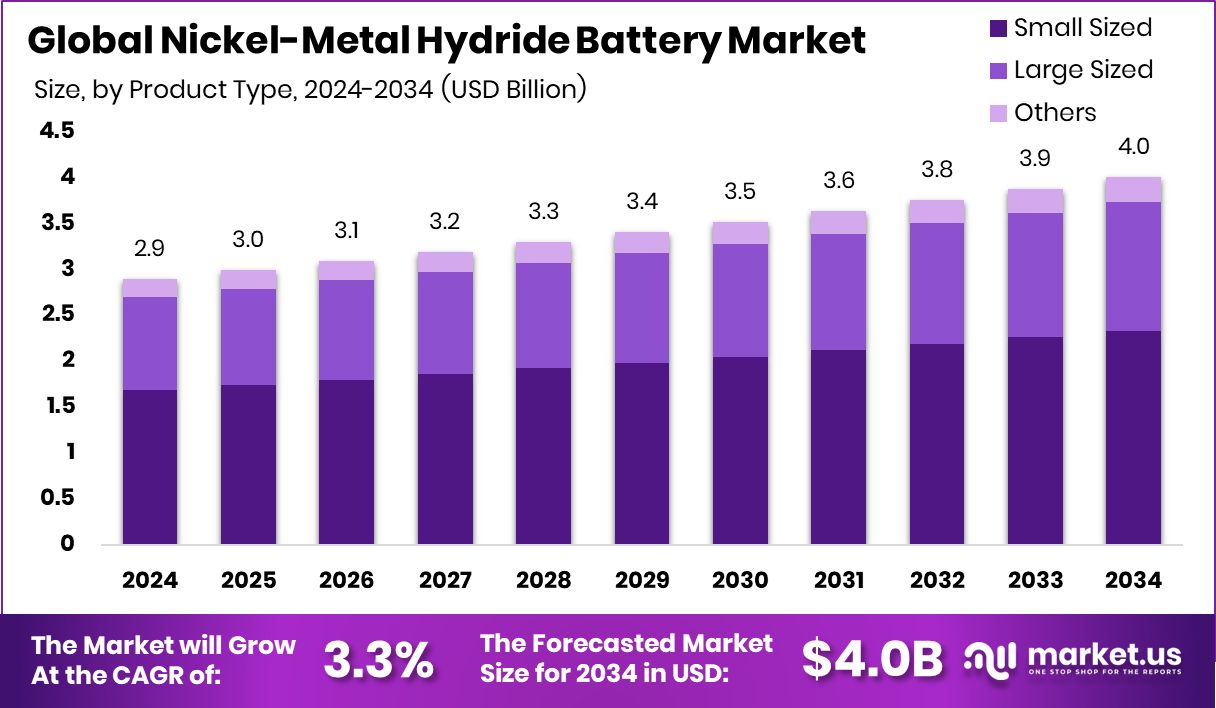
New York, NY – December 17, 2025 – The global Nickel-Metal Hydride (NiMH) battery market is on a steady growth path, projected to reach around USD 4.0 billion by 2034, rising from USD 2.9 billion in 2024, at a 3.3% CAGR between 2025 and 2034. Asia-Pacific leads demand, accounting for 43.80% of the global market, valued at approximately USD 1.2 billion, driven by strong hybrid vehicle adoption and established battery manufacturing ecosystems.
NiMH batteries are rechargeable energy storage systems that rely on nickel oxide hydroxide and hydrogen-absorbing metal alloys. They are valued for their safety, durability, and stable performance across long operating cycles. These characteristics make them suitable for hybrid electric vehicles, medical equipment, consumer electronics, and backup power systems, where reliability is often prioritized over size or weight.
Market growth is supported by continued government encouragement for electrification. Policy initiatives include an EV grant scheme worth £1.3 billion, £3,750 purchase discounts on electric vehicles, and ongoing discussions around reallocating a £950 million motorway charging fund to expand infrastructure. These measures sustain interest in electrified transport and related battery technologies.
Consumer economics further support demand. Drivers are estimated to save around £850 annually by switching to electric vehicles, helping offset concerns such as a proposed $250 annual EV fee. Together, these factors keep NiMH batteries relevant within evolving electric mobility and energy storage systems.
➤ Click the sample report link for complete industry insights: https://market.us/report/global-nickel-metal-hydride-battery-market/request-sample/
Key Takeaways
- The Global Nickel- Metal Hydride Battery Market is expected to be worth around USD 4.0 billion by 2034, up from USD 2.9 billion in 2024, and is projected to grow at a CAGR of 3.3% from 2025 to 2034.
- Small sized products dominate the Nickel-Metal Hydride Battery Market with 58.2% share due to designs.
- HEV applications lead the Nickel-Metal Hydride Battery Market holding 46.8% as hybrids balance efficiency sustainability.
- Consumer electronics drive the Nickel-Metal Hydride Battery Market with 49.7% demand from everyday portable devices.
- Nickel-Metal Hydride Battery Market in Asia-Pacific reached USD 1.2 Bn, representing 43.80% share.
➤ Directly purchase a copy of the report – https://market.us/purchase-report/?report_id=168663
Report Scope
| Report Features | Description |
|---|---|
| Market Value (2024) | USD 2.9 Billion |
| Forecast Revenue (2034) | USD 4.0 Billion |
| CAGR (2025-2034) | 3.3% |
| Segments Covered | By Product Type (Small Sized, Large Sized, Others), By Application (HEV, Retail Market, Cordless Phone, Dust Collector, Personal Care, Lighting Tools, Others), By End-user (Consumer Electronics, Hybrid and Electric Vehicles, Others) |
| Competitive Landscape | Axiss Technology, BYD Company, Camelion Batterien GmbH, Duracell, DYNAMIS Batterien GmbH, EPT Battery, FDK CORPORATION, GP Batteries, Grepow Battery, GS Yuasa |
Key Market Segments
By Product Type Analysis
In 2024, the Small Sized segment held a dominant position in the By Product Type category of the Nickel-Metal Hydride Battery Market, capturing a 58.2% share. This leadership is driven by strong adoption in applications that need compact, dependable, and cost-efficient power sources.
Small sized NiMH batteries are favored where space constraints and consistent energy delivery are essential. Their safe operation during repeated charge-discharge cycles makes them suitable for long-term use in established devices and systems.
Manufacturers continue to prioritize this segment because of its reliable performance, well-understood production methods, and seamless integration with existing product designs. Demand is further supported by regular replacement cycles, as many end-use products are specifically designed around small sized NiMH battery formats.
By Application Analysis
In 2024, HEV dominated the By Application segment of the Nickel-Metal Hydride Battery Market, accounting for a 46.8% share. This leadership reflects the long-term reliance on NiMH technology in hybrid electric vehicles, where safety, reliability, and steady power delivery are critical.
Hybrid vehicle platforms continue to use NiMH batteries because they perform consistently across different driving conditions and temperature ranges. The 46.8% share highlights ongoing adoption in hybrid powertrains that combine electric support with internal combustion engines.
Automakers favor NiMH batteries for HEVs due to their proven operating stability, predictable service life, and compatibility with existing vehicle architectures. As a result, this application segment retains its leading position, supported by mature hybrid designs and sustained demand for efficient and practical hybrid mobility solutions.
By End-user Analysis
In 2024, Consumer Electronics led the by-end-user segment of the Nickel-Metal Hydride Battery Market with a 49.7% share, reflecting strong dependence on NiMH batteries in everyday electronic products. These devices require safe, rechargeable, and stable power solutions, supporting continued use of this battery chemistry.
The 49.7% share is driven by consistent replacement demand, as many consumer electronics are specifically engineered around NiMH battery designs. Users value these batteries for their reliable output, straightforward handling, and long-term performance stability.
Manufacturers supplying the consumer electronics sector continue to prioritize NiMH production to meet recurring usage and replacement needs. Consequently, this end-user segment remains a major contributor to overall market volume, sustained by broad product adoption and ongoing consumer demand.
Regional Analysis
Asia-Pacific leads the Nickel-Metal Hydride Battery Market with a 43.80% share, valued at USD 1.2 Bn, supported by strong manufacturing capacity, established supply chains, and broad adoption of rechargeable batteries across industries. High production volumes and sustained consumption help the region maintain leadership in both value and demand.
North America represents a mature and stable market, driven by the continued use of dependable battery technologies in transportation, industrial systems, and consumer electronics. Growth here is supported mainly by steady replacement demand.
Europe maintains balanced participation, influenced by structured energy policies and long-term reliance on proven rechargeable battery chemistries with predictable performance.
The Middle East & Africa remain a developing market, with adoption centered on industrial applications, backup power, and gradual electrification efforts.
Latin America shows emerging demand, supported by increasing use of rechargeable batteries in consumer products and mobility, ensuring a steady regional presence.
Top Use Cases
- Hybrid Electric Vehicles (HEVs): NiMH batteries are widely used in hybrid cars to power the electric motor alongside the fuel engine because they give reliable, steady energy and can handle repeated charging and discharging over time.
- Consumer Electronics (Remotes, Cameras, Phones): These batteries power everyday gadgets like TV remotes, digital cameras, cordless phones, and portable audio equipment, offering rechargeable power that lasts longer than single-use batteries.
- Power Tools & Toys: NiMH packs are used in cordless drills, screwdrivers, remote-controlled toys, and portable lamps where reusable energy and durability are key for frequent use.
- Medical Devices: Devices like portable medical instruments and some emergency life-support equipment use NiMH batteries because they can deliver stable power and are safer than some older battery types.
- Backup Power Systems: NiMH batteries are used in backup power units for telecom equipment or emergency lights, helping keep systems running when mains power fails.
- Household Equipment: Common appliances like flashlights, cordless razors, and rechargeable household gadgets use NiMH batteries because they can be charged many times, reducing waste and cost compared to throw-away batteries
Recent Developments
- In August 2025, Camelion was recognized with the “100% HK Branding Award – GBA ESG Sustainable Development Enterprise Prize.” This shows the company is being acknowledged for its brand strength and environmental, social, and governance (ESG) focus.
- In August 2025, Duracell launched a new range of lithium coin batteries (CR2032, CR2025, CR2016) in India. These have a non-toxic bitter coating and child-resistant packaging to reduce risks of accidental swallowing by young children.
Conclusion
The Nickel-Metal Hydride Battery Market continues to hold an important position within the broader energy storage landscape. Its strength lies in proven safety, long service life, and dependable performance across established applications such as hybrid vehicles, consumer electronics, and backup power systems. While newer battery technologies attract attention, NiMH remains relevant where reliability and cost stability matter most.
Ongoing use in mature products and steady replacement demand support market continuity. As electrification and rechargeable energy use expand globally, Nickel-Metal Hydride batteries are expected to maintain a stable role, serving applications that value durability, predictable performance, and well-understood manufacturing processes.
Discuss your needs with our analyst
Please share your requirements with more details so our analyst can check if they can solve your problem(s)