Table of Contents
Market Overview
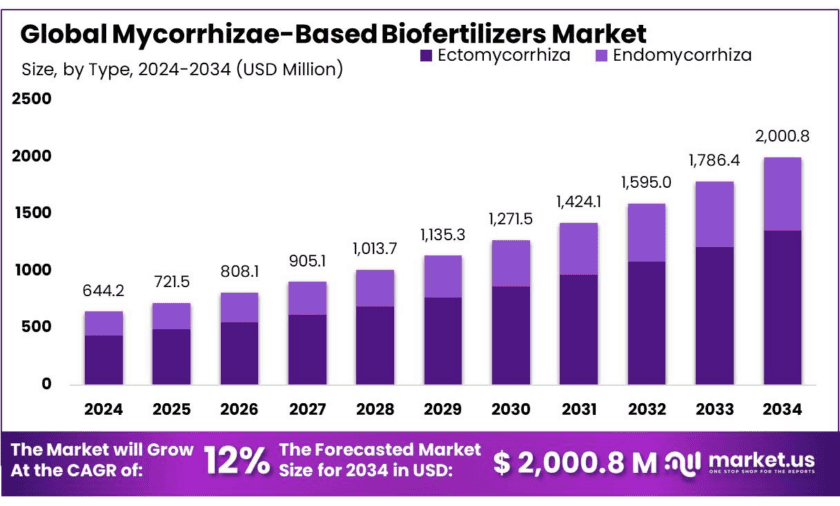
The Global Mycorrhizae-Based Biofertilizers Market shows strong growth potential. Market size will rise from USD 644.2 million in 2024 to approximately USD 2000.8 million by 2034. This expansion represents a compound annual growth rate of 12.0% between 2025 and 2034.
Mycorrhizal fungi form symbiotic relationships with plant roots. These fungi enhance nutrient uptake, improve soil health, and increase plant resistance to diseases and environmental stresses. Farmers value these benefits particularly in regions with poor soil fertility.
Government initiatives play a crucial role in promoting biofertilizer adoption. Programs like the Paramparagat Krishi Vikas Yojana (PKVY) provide financial assistance to farmers for biofertilizer procurement. Farmers receive Rs 50,000 per hectare over three years under this scheme.
The Indian Council of Agricultural Research (ICAR) confirms biofertilizer effectiveness. According to ICAR, biofertilizers can improve crop yields by 10-25%. Moreover, these products supplement chemical fertilizers by 20-25% when used together.
Consequently, farmers reduce input costs while maintaining productivity. The combination of government support, scientific validation, and environmental benefits drives market expansion. This creates a favorable ecosystem for mycorrhizae-based biofertilizer adoption globally.
Key Takeaways
- The Global Mycorrhizae-Based Biofertilizers Market size is expected to be worth around USD 2000.8 million by 2034, from USD 644.2 million in 2024, growing at a CAGR of 12.0%.
- Ectomycorrhizae-based biofertilizers held a dominant market position, capturing more than a 67.9% share.
- Solid form mycorrhizae-based biofertilizers held a dominant market position, capturing more than a 61.4% share.
- Soil application dominated the mycorrhizae-based biofertilizer market, capturing more than a 42.3% share.
- The Cereals and grains segment led the mycorrhizae-based biofertilizer market, capturing more than a 44.3% share.
- North America held a dominant position in the global mycorrhizae-based biofertilizer market, capturing more than a 42.9% share, equivalent to approximately USD 276.3 million.
➤ Download Exclusive Sample Of This Premium Report (Including Full TOC, Table & Figures): https://market.us/report/mycorrhizae-based-biofertilizers-market/request-sample/
Market Segmentation Overview
By Type
Ectomycorrhizae-based biofertilizers led the market with a 67.9% share in 2024. This segment dominates due to widespread application in forestry, horticulture, and ornamental plant cultivation. Ectomycorrhizal fungi form symbiotic relationships with plant roots, enhancing nutrient uptake and improving plant resilience.
Endomycorrhizae continue experiencing steady growth despite a smaller market share. This growth comes from applicability across vegetables, fruits, and cereals. Endomycorrhizal fungi aid phosphorus uptake and improve soil structure. Increasing farmer awareness about sustainable agriculture practices supports this segment’s expansion.
By Form
Solid form mycorrhizae-based biofertilizers captured a 61.4% market share in 2024. Farmers prefer solid formulations due to ease of application, longer shelf life, and cost-effectiveness. These products come as powders, granules, or pellets for direct soil application.
Solid formulations ensure uniform distribution and effective mycorrhizal fungi colonization. The rising demand for organic produce further supports this segment’s growth. Government initiatives promoting organic farming and bio-based inputs also bolster solid biofertilizer adoption.
By Mode of Application
Soil application dominated with a 42.3% share in 2024. This method remains most widely adopted due to simplicity and cost-effectiveness for large-scale farming. Direct soil incorporation helps establish symbiotic relationships between fungi and plant roots.
Soil application enhances nutrient uptake and promotes overall plant health. Farmers recognize long-term advantages, including enhanced crop yields and improved environmental stress resilience. Government subsidies for sustainable farming further drive the adoption of this application method.
By Crop Type
Cereals and grains led with a 44.3% share in 2024. Extensive cultivation of rice, wheat, and maize drives this dominance. These staple crops respond highly to the mycorrhizal fungi benefits, including enhanced phosphorus uptake and improved soil structure.
Government initiatives like the National Mission for Sustainable Agriculture (NMSA) support adoption. Programs such as Paramparagat Krishi Vikas Yojana (PKVY) provide financial assistance and training. These efforts improve soil health, enhance productivity, and reduce farming’s environmental impact.
Drivers
Government support and policy initiatives drive the mycorrhizae-based biofertilizers market in India. The Indian government allocated approximately USD 180 million in 2024 under the National Mission on Sustainable Agriculture (NMSA) to support farmers using bio-inputs. This financial backing encourages farmers to reduce chemical fertilizer dependency.
Additionally, the PM-PRANAM scheme incentivizes states that reduce chemical fertilizer consumption. States adopting microbial fertilizers receive direct benefits from this program. According to ICAR, biofertilizers can improve crop yields by 10-25% and supplement chemical fertilizers by 20-25%. These statistics demonstrate clear economic advantages for farmers.
Major Challenges
Limited awareness and knowledge among farmers hinder widespread adoption. A 2025 study in the European Journal of Sustainable Development Research identifies inadequate publicity and lack of awareness as significant barriers. Many farmers in rural areas lack access to information and training resources about biofertilizer benefits.
Disorganized training programs further compound this challenge. Without proper education, farmers may misuse biofertilizers or remain skeptical about their efficacy. The Soil Health Management (SHM) program aims to promote biofertilizer use, but effectiveness suffers from low farmer engagement. Integrating biofertilizer education into agricultural curricula would help address this gap.
Business Opportunities
Government support and policy backing create substantial business opportunities. Under PKVY, MOVCDNER, and NMOOP schemes, the government actively facilitates organic farming method adoption. Companies can partner with state governments to supply mycorrhiza-based biofertilizers for these programs. This creates reliable, large-scale distribution channels.
ICAR’s development of improved biofertilizer strains tailored to different crops offers another opportunity. According to ICAR, these strains improve crop yields by 10-25% and supplement chemical fertilizers by 20-25%. Companies can license these technologies and develop region-specific products. This approach reduces farmer cultivation costs while creating market differentiation.
Regional Analysis
North America leads the global mycorrhizae-based biofertilizer market with a 42.9% share in 2024, worth approximately USD 276.3 million. The United States drives this leadership through robust agricultural infrastructure and strong consumer demand for organic products. Sustainable farming practices are widely adopted across the region.
Canada plays a pivotal role through its emphasis on environmental conservation. Cold-climate farming in British Columbia demonstrates biofertilizer effectiveness in improving soil fertility and combating acidity. Government initiatives aimed at reducing carbon emissions further support market expansion. Consequently, both countries present significant growth opportunities for biofertilizer companies.
Top Key Players
- Novozymes A/S
- UPL Limited
- Premier Tech Ltd
- Plant HealthCare plc
- Groundwork BioAg Ltd
- Valent BioSciences LLC
- Atens-Agrotechnologías Naturales S.L.
- Lallemand Inc.
- Agri Life
- Privi Life Sciences
Conclusion
The global mycorrhizae-based biofertilizers market demonstrates. Ectomycorrhizae and solid formulations dominate their respective segments. Key challenges include limited farmer awareness and knowledge gaps. However, government programs like PKVY and ICAR research provide strong support. Companies can capitalize on opportunities through partnerships with state governments and licensing of improved fungal strains. The combination of environmental benefits, cost savings, and policy backing ensures continued market expansion.
Discuss your needs with our analyst
Please share your requirements with more details so our analyst can check if they can solve your problem(s)