Table of Contents
Overview
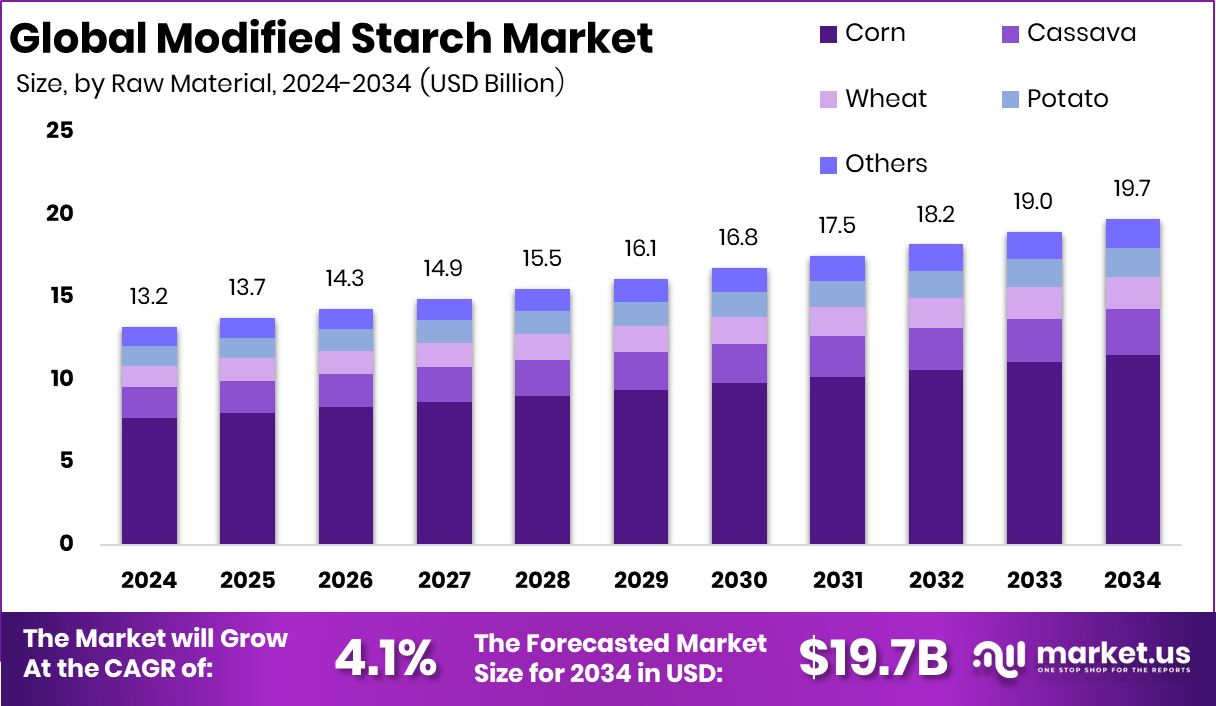
New York, NY – January 21, 2026 – The global modified starch market is set to rise from USD 13.2 billion in 2024 to USD 19.7 billion by 2034, growing steadily as manufacturers rely on starch systems for stability, texture, and consistency. North America remains a key contributor, holding a 43.70% share valued at USD 5.7 billion. Modified starch, improved through physical, enzymatic, or chemical processes, performs better under heat, acidity, and processing stress. This makes it essential in soups, sauces, bakery applications, and ready-to-eat foods where uniform texture and shelf stability matter.
Market momentum is closely tied to changing food trends and ingredient innovation. New-age brands are developing multifunctional and fermented ingredients, creating fresh demand for starch-based binding and texturizing systems. Summ Ingredients’ €1.7 million funding, secured to launch a multifunctional fermented protein category, reflects this shift. High-protein and low-carb products also depend on starch to balance nutrition with desirable mouthfeel. This is evident as BetterBrand raised $6 million in Series A funding to expand its better-for-you bagel offering.
Opportunities are widening in protein snacks and performance foods. Protein bar startup David, launched in September 2024, first raised $10 million in seed funding and later secured $75 million in a Series A round, highlighting how scaling protein-rich products continues to drive demand for advanced modified starch solutions.
➤ Click the sample report link for complete industry insights: https://market.us/report/global-modified-starch-market/request-sample/
Key Takeaways
- The Global Modified Starch Market is expected to be worth around USD 19.7 billion by 2034, up from USD 13.2 billion in 2024, and is projected to grow at a CAGR of 4.1% from 2025 to 2034.
- Corn dominates the modified starch market, holding 58.3% share due to wide availability and cost efficiency.
- Starch esters and ethers lead the modified starch market by type, accounting for 42.6% share globally.
- Thickeners represent 32.6% of the modified starch market, driven by texture and consistency needs.
- Food and beverages account for 41.5% of the modified starch market, supported by processed food demand.
- North America leads the Modified Starch Market, holding 43.70% share, generating USD 5.7 Bn.
➤ Directly purchase a copy of the report – https://market.us/purchase-report/?report_id=171313
Report Scope
| Report Features | Description |
|---|---|
| Market Value (2024) | USD 13.2 Billion |
| Forecast Revenue (2034) | USD 19.7 Billion |
| CAGR (2025-2034) | 4.1% |
| Segments Covered | By Raw Material (Corn, Cassava, Wheat, Potato, Others), By Type (Starch Esters and Ethers, Resistant, Cationic, Pre-gelatinized, Others), By Function (Thickeners, Stabilizers, Binders, Emulsifiers, Others), By Application (Food and Beverages, Animal Feed, Paper, Pharmaceuticals, Textiles, Others) |
| Competitive Landscape | AGRANA Beteiligungs-AG, Archer-Daniels-Midland Company, Cargill Incorporated, Emsland-Stärke GmbH, Kent Corporation, Ingredion Incorporated, Roquette Frères, SMS Corporation, Tate & Lyle PLC, Tereos, The cooperative Royal Avebe U.A. |
Key Market Segments
By Raw Material
Corn continues to dominate the Modified Starch Market with a 58.3% share, supported by its wide availability, cost efficiency, and consistent processing behavior. Its neutral taste and stability under heat, shear, and acidity make it ideal for diverse food and industrial applications. Manufacturers prefer corn-based modified starch because it delivers reliable viscosity, smooth texture, and predictable performance at scale.
The strong agricultural supply chain further strengthens its position, ensuring stable quality and supply. This dominance highlights corn’s balance of functionality and affordability, making it the most dependable raw material for large-volume modified starch production.
By Type
Starch Esters and Ethers lead the market with a 42.6% share, driven by their superior stability in demanding processing environments. These types withstand heat, acidity, and mechanical stress, making them suitable for complex formulations in food and industrial sectors. Their predictable thickening, binding, and emulsifying abilities ensure consistent product quality across manufacturing stages.
The 42.6% share reflects the growing need for ingredients that maintain structure and texture during production, distribution, and storage. Overall, starch esters and ethers remain the preferred choice for applications requiring high functionality and dependable performance.
By Function
Thickeners hold the largest share in the Modified Starch Market at 32.6%, reflecting their essential role in texture and viscosity management. Modified starch used as a thickener enhances mouthfeel, consistency, and visual appeal across sauces, soups, bakery fillings, and processed foods. The dominance of thickeners stems from their ability to deliver stability during heating, cooling, and storage, ensuring uniform product performance.
As manufacturers demand more precision in formulation, starch-based thickeners remain foundational for achieving smooth textures and stable structures, reinforcing their importance across key food and industrial categories.
By Application
Food and Beverages lead the application segment with a 41.5% share, showcasing the sector’s reliance on modified starch for texture, stability, and shelf-life improvement. These starches support sauces, snacks, bakery products, dairy alternatives, and ready-to-eat meals by maintaining consistent quality through processing and storage. Their functionality ensures products retain desirable taste, appearance, and performance at scale.
The 41.5% dominance reflects ongoing demand for dependable ingredients that withstand heat, freezing, and mechanical stress. As convenience foods and processed formulations continue to expand, the food and beverage industry remains the primary driver of modified starch consumption.
Regional Analysis
North America leads the Modified Starch Market with a 43.70% share worth USD 5.7 billion, driven by its strong processed food sector and advanced starch manufacturing capabilities. High demand for packaged meals, sauces, bakery items, and convenience foods continues to reinforce its dominance. Europe follows with steady consumption supported by clean-label trends and established industrial users, including paper and pharmaceuticals.
Asia Pacific is rapidly expanding due to rising urbanization, a growing food processing industry, and increased reliance on texture-enhancing ingredients. In the Middle East & Africa, demand grows gradually through rising packaged food intake and food service expansion. Latin America benefits from agricultural availability and wider use of cost-efficient starch derivatives in local food production.
Top Use Cases
- Thickening Sauces, Soups & Gravies: Modified starch is widely used to make sauces, soups, and gravies smooth and consistent. It helps liquids blend without becoming lumpy and keeps the texture stable even when heated or cooled.
- Improving Frozen Foods: In frozen meals and desserts, modified starch prevents separation and texture changes when products are frozen and then reheated. It helps maintain mouthfeel and quality after thawing.
- Stabilizing Salad Dressings and Dairy Products: Modified starch acts as an emulsifier and stabilizer—keeping oil and water mixed in dressings, sauces, and some dairy products so they don’t separate.
- Binding and Tablet Ingredients in Medicine: In the pharmaceutical industry, modified starch is used to bind tablet ingredients, help capsules hold together, and improve how medicines dissolve.
- Improving Bakery Products: In breads, pies, cakes, and other baked items, modified starch enhances texture, moisture retention, and structure. It also controls how products behave in ovens and freezers.
- Paper, Cosmetic & Industrial Uses: Modified starch serves as a binder in paper production, adds smoothness to coatings, and is included in cosmetics (e.g., pastes or powders) to help texture and absorbency.
Recent Developments
- In December 2024, AGRANA’s starch subsidiary AGRANA Stärke GmbH signed an agreement with INGREDION Germany GmbH to form a joint venture focused on developing starch production in Romania. This move strengthens AGRANA’s position in starch manufacturing and builds closer cooperation with another major starch producer.
- In March 2024, ADM’s financial report showed that its Carbohydrate Solutions segment — which includes starch and sweetener products—posted improved performance compared to the previous year. This reflects the company’s ongoing focus on starch-based ingredient production and operations within its broader product segment.
Conclusion
The Modified Starch Market continues to strengthen as food, beverage, and industrial sectors rely on starch-based solutions for texture, stability, and processing performance. Its growth is supported by rising demand for convenient meals, bakery items, sauces, and products that must remain consistent through cooking, freezing, and storage.
Advancements in ingredient technology and clean-label reformulation are expanding the use of modified starch across both established and emerging applications. As producers focus on reliability and versatility, modified starch remains a core functional ingredient that helps manufacturers achieve uniform quality, improved shelf life, and better product experience without altering familiar recipes.
Discuss your needs with our analyst
Please share your requirements with more details so our analyst can check if they can solve your problem(s)