Table of Contents
Overview
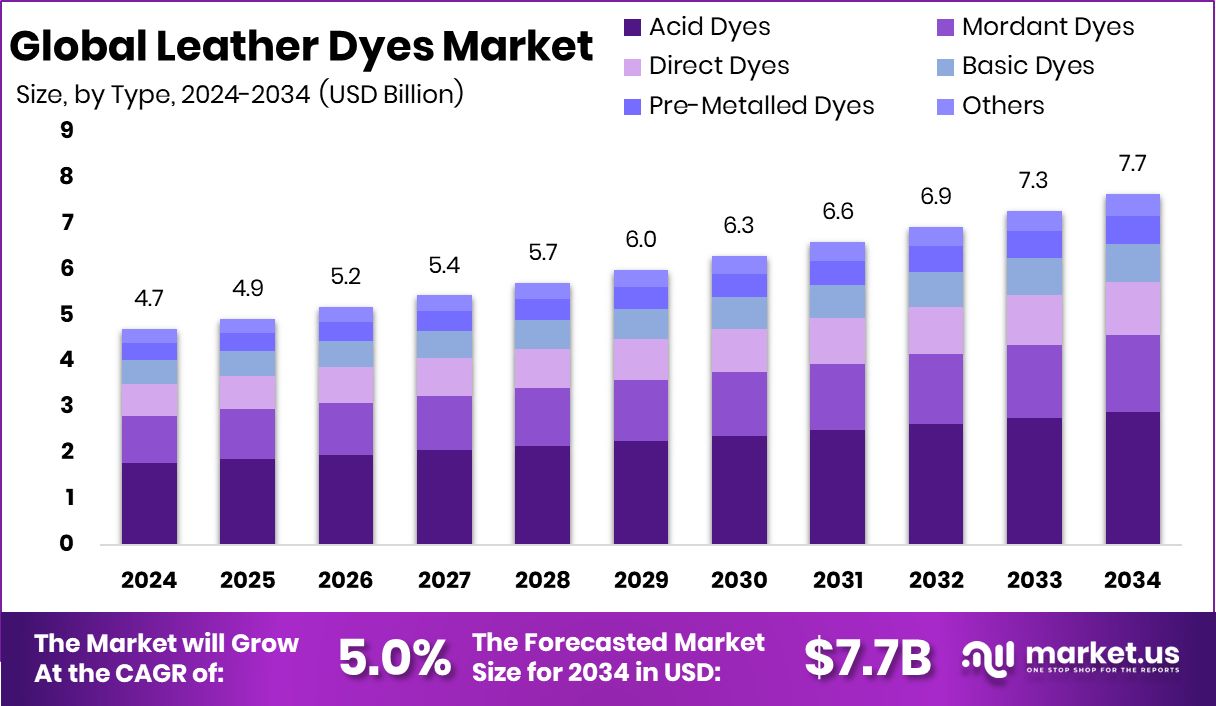
New York, NY – February 23, 2026 – The Global Leather Dyes Market is set to grow from USD 4.7 billion in 2024 to USD 7.7 billion by 2034, advancing at a 5.0% CAGR, with Asia Pacific holding USD 2.2 billion due to its strong manufacturing and export base. Leather dyes are specialized colorants formulated to penetrate natural hides, ensuring long-lasting color, softness, and durability across footwear, apparel, furniture, and automotive leather. The market covers dye producers, tanneries, and downstream users whose demand shifts with fashion cycles, material innovation, and sustainability expectations.
Growth is strongly driven by the global transition toward cleaner and more eco-friendly leather processing. A notable boost came from the European Union’s $4.05 million funding for DITF’s Fabulose project, aimed at supporting eco-leather and greener dye technologies. The market is also shaped by rising demand for safer, natural coloring alternatives, demonstrated by Nature Coatings securing $2.45 million to advance bio-based pigment solutions increasingly used in fashion and leather applications.
A major opportunity emerges in circular and waste-derived dye innovations. This is reinforced by a startup raising $3.7 million for vegetal-waste-based dyes, showing strong investor confidence in fossil-free, sustainable coloration. Together, these developments highlight a market shifting steadily toward environmentally responsible leather dye solutions.
➤ Click the sample report link for complete industry insights: https://market.us/report/global-leather-dyes-market/request-sample/
Key Takeaways
- The Global Leather Dyes Market is expected to be worth around USD 7.7 billion by 2034, up from USD 4.7 billion in 2024, and is projected to grow at a CAGR of 5.0% from 2025 to 2034.
- In the Leather Dyes Market, Acid dyes dominate with a 37.8% share due to strong penetration performance.
- In the Leather Dyes Market, footwear applications lead with a 32.6% share driven by consistent demand globally.
- The Asia Pacific Leather Dyes Market reached a USD 2.2 Bn value in 2024.
➤ Directly purchase a copy of the report – https://market.us/purchase-report/?report_id=173259
Report Scope
| Report Features | Description |
|---|---|
| Market Value (2024) | USD 4.7 Billion |
| Forecast Revenue (2034) | USD 7.7 Billion |
| CAGR (2025-2034) | 5.0% |
| Segments Covered | By Type (Acid Dyes, Mordant Dyes, Direct Dyes, Basic Dyes, Pre-Metalled Dyes, Others), By Application (Footwear, Automotive Interiors, Furniture Upholstery, Garments, Bags, Others) |
| Competitive Landscape | Archroma, BASF, Huntsman Corporation, Clariant, Lanxess, Stahl Holdings, Kiri Industries, Dystar, TFL Leather |
Key Market Segments
By Type
Acid dyes remained the leading category in 2024, holding 37.8% of the Leather Dyes Market due to their strong compatibility with protein-based and chrome-tanned leather. Their ability to deliver rich, uniform shades with excellent color fastness keeps them highly preferred across footwear, upholstery, and fashion accessories. Tanneries favor acid dyes for their predictable behavior under varying pH levels, reduced rework, and smooth integration into modern leather finishing lines.
Continuous improvements in dye formulation, enhanced bath exhaustion, and compliance with tightening environmental norms further reinforce their dominance. As export-focused leather processors prioritize consistency, eco-compliant chemistry, and operational efficiency, acid dyes continue to anchor the type segment with reliable and scalable performance.
By Application
Footwear led the Leather Dyes Market in 2024 with a 32.6% share, supported by strong demand for leather shoes, safety footwear, and premium lifestyle products. This segment relies heavily on dyes that ensure consistent color matching, durability, and abrasion resistance, making high-performance leather dyes essential for visual appeal and product longevity. Growth in Asia’s large-scale footwear production, coupled with expanding branded manufacturing and rising global fashion cycles, continues to sustain demand.
Manufacturers increasingly focus on seasonal shades, trend-driven designs, and efficient dyeing processes to support mass output. As leather-based footwear remains a staple in both fashion and industrial categories, the segment maintains its position as the largest application area for leather dyes.
Regional Analysis
The Leather Dyes Market displays strong regional differentiation, with Asia Pacific leading at 48.10% (USD 2.2 Bn) due to its large tanning clusters, high footwear and accessories output, and strong export networks supporting global brands. Europe remains a mature, quality-focused market driven by premium leather goods and strict processing standards.
North America shows consistent demand from automotive interiors, furniture, and lifestyle leather products, where durability and color stability are essential. The Middle East & Africa region is experiencing gradual growth as tanning capacity and consumption of finished leather goods expand.
Latin America continues to maintain a steady role, supported by its long-established leather industry and export-oriented production, contributing to the overall global market balance.
Top Use Cases
- Coloring Finished Leather Products: Leather dyes are used to add rich, even colors to shoes, bags, wallets, belts and other leather products so they look attractive and consistent in shade.
- Leather Crafting and Customization: Artisans and hobbyists dye natural leather (like vegetable-tanned hides) to personalize handmade goods, letting them achieve unique hues while maintaining the leather’s texture.
- Fashion Leather Goods Production: In the fashion industry, dyes help create colorful accessories and apparel that match seasonal trends, such as vibrant handbags or leather jackets.
- Automotive Leather Interiors: Leather dyes give car seats and steering wheel covers the correct color while helping the leather stay durable, resist sunlight fading, and look uniform across large surfaces.
- Leather Furniture Coloring: Dyes are applied to sofas, chairs, and other interior leather items to provide long-lasting, deep shades that enhance home décor and wear well over time.
- Industrial Leather Goods: Products like gloves, belts, and protective gear are dyed to improve visibility, uniformity, and performance, especially when they are exposed to frequent use or harsh conditions.
Recent Developments
- In January 2026, Archroma participated in the India International Leather Fair (IILF) (1–3 Feb 2026) for the first time to showcase its advanced leather solutions, including LUPRINTAN® acrylics, syntans, and DORANIL® dyes, which help tanneries achieve better performance and meet strict color-fastness standards. This marked a stronger commitment to the leather industry and sustainable dyeing chemistry.
- In March 2025, Huntsman Textile Effects (the dye division originally part of Huntsman) released a third-generation AVITERA® ROSE SE poly-reactive dye range. These dyes offer better sustainability, using less water and energy while delivering bright, durable colors for cellulosic materials. This reflects ongoing innovation in dye chemistry that is important for textile and similar dye applications.
- In July 2024, BASF introduced Haptex® 4.0, a new recyclable polyurethane solution for making synthetic leather. It allows synthetic leather to be fully recycled together (with PET fabric) without waste and supports long-lasting performance in footwear, automotive interiors, furniture, and fashion applications.
Conclusion
The Leather Dyes Market is steadily evolving as manufacturers and brands shift toward cleaner processing, better color performance, and sustainable material choices. The growing demand for high-quality leather in footwear, fashion, furniture, and automotive interiors continues to shape dye innovation. Companies are focusing on improved dye penetration, richer shades, and safer formulations that reduce environmental impact.
Advancements in bio-based pigments and waste-derived dye solutions also support a more circular leather ecosystem. With rising expectations for consistent quality and eco-friendly production across global tanning hubs, the market is positioned to expand through continuous technological upgrades and stronger commitments to responsible leather coloration.
Discuss your needs with our analyst
Please share your requirements with more details so our analyst can check if they can solve your problem(s)