Table of Contents
Overview
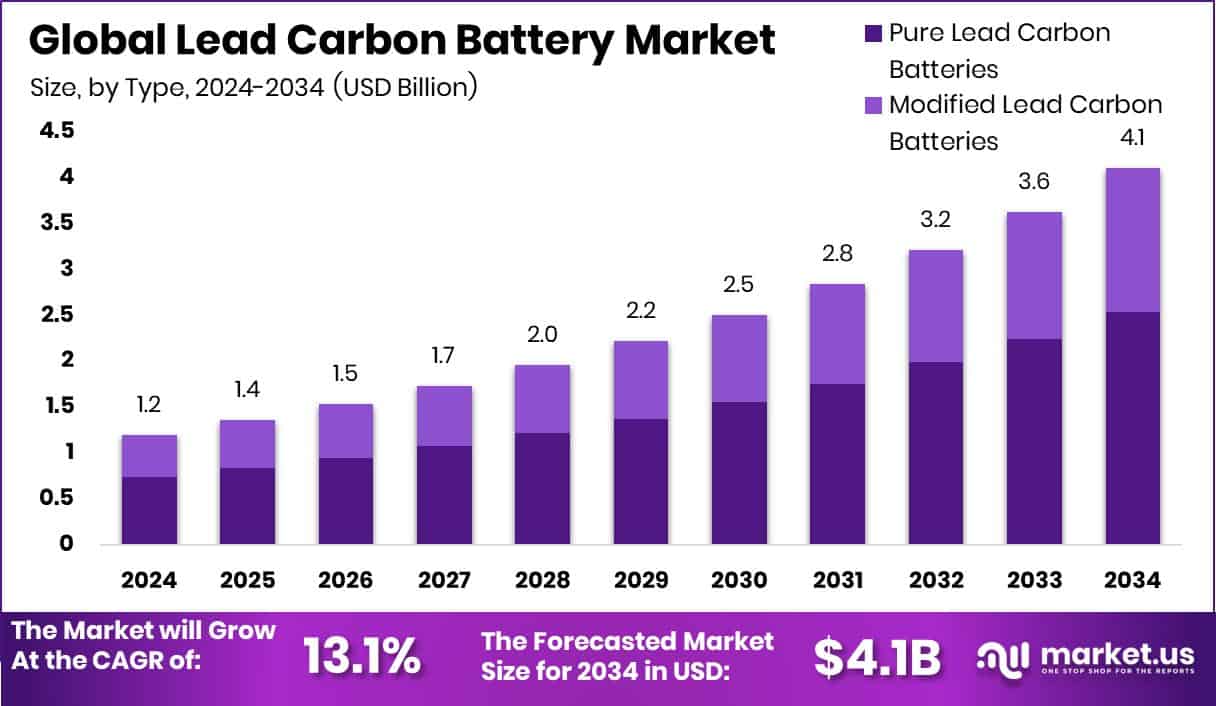
New York, NY – Dec 04, 2025 – The global Lead Carbon Battery Market is on a strong growth path, expected to rise from USD 1.2 billion in 2024 to about USD 4.1 billion by 2034, expanding at a 13.1% CAGR between 2025 and 2034. North America plays an important role in this growth, supported by renewable energy demand and funding, with the regional market valued at nearly USD 0.5 billion.
Lead carbon batteries are an improved version of traditional lead-acid batteries, where carbon is added to the negative electrode. This enhancement reduces sulfation, improves charge acceptance, and significantly extends cycle life. As a result, these batteries perform well under partial state-of-charge conditions and frequent cycling, making them suitable for solar and wind energy storage, telecom backup power, microgrids, and grid-support systems.
Market growth is driven by the need for cost-effective, safe, and durable energy storage solutions, especially in regions facing unstable grid conditions and rising renewable installations. Compared with conventional flooded or VRLA batteries, lead carbon batteries offer a better balance between performance, safety, and lifecycle costs.
Innovation and funding continue to strengthen the market. Notable examples include UT Dallas leading a USD 30 million battery initiative, Porsche joining Group14’s USD 400 million Series C round, Sicona Battery Technologies securing AUD 22 million, and Verkor raising €2 billion for a low-carbon battery gigafactory. Additionally, government support such as the DOE’s USD 1.8 billion carbon initiative and USD 1.2 billion awarded to U.S. carbon air-capture hubs builds a favorable ecosystem that indirectly supports lead carbon battery adoption.
➤ Click the sample report link for complete industry insights: https://market.us/report/global-lead-carbon-battery-market/request-sample/
Key Takeaways
- The Global Lead Carbon Battery Market is expected to be worth around USD 4.1 billion by 2034, up from USD 1.2 billion in 2024, and is projected to grow at a CAGR of 13.1% from 2025 to 2034.
- Pure Lead Carbon Batteries hold a 61.9% share, driving efficiency and long-cycle performance in the Lead Carbon Battery Market.
- Flooded Lead Carbon Batteries lead with 69.2%, supporting rugged storage needs across industrial and off-grid environments.
- Renewable Energy Storage captures 35.7%, as the Lead Carbon Battery Market benefits from growing solar and wind systems.
- Energy and Utilities dominate with 38.8%, boosting long-duration storage adoption in the Lead Carbon Battery Market.
- The 43.80% market share shows strong Lead Carbon Battery adoption across North America.
➤ Directly purchase a copy of the report – https://market.us/purchase-report/?report_id=167325
Report Scope
| Report Features | Description |
|---|---|
| Market Value (2024) | USD 1.2 Billion |
| Forecast Revenue (2034) | USD 4.1 Billion |
| CAGR (2025-2034) | 13.1% |
| Segments Covered | By Type (Pure Lead Carbon Batteries, Modified Lead Carbon Batteries), By Technologyn(Flooded Lead Carbon Batteries, Valve-Regulated Lead Carbon Batteries (VRLA)), By Application (Renewable Energy Storage, Telecommunication, Uninterruptible Power Supply (UPS), Electric Vehicles and Hybrid Vehicles, Grid Stabilization, Others), By End-User (Energy and Utilities, Transportation, IT and Telecom, Industrial and Commercial Sectors, Others) |
| Competitive Landscape | ShuangDeng, China Tianneng, Furukawa, Eastpenn, Sacred Sun, Huafu Energy Storage, Axion |
Key Market Segments
By Type Analysis
In 2024, Pure Lead Carbon Batteries held a dominant market position in the By Type segment of the Lead Carbon Battery Market, with a 61.9% share. This strong preference reflects their longer cycle life, better charge efficiency, and improved performance under partial-state-of-charge conditions, making them suitable for renewable storage, telecom backup, and grid applications.
The higher share also signals rising demand from solar-linked microgrids and energy storage systems, where consistent cycling and reliability matter. Their durability and reduced sulfation benefit end-users seeking stable long-term storage solutions without frequent replacements. As energy systems continue shifting toward cleaner and more distributed setups, Pure Lead Carbon Batteries maintain traction due to their balance of cost, lifespan, and operational stability.
By Technology Analysis
In 2024, Flooded Lead Carbon Batteries led the By Technology segment of the Lead Carbon Battery Market, holding a 69.2% share, highlighting their strong acceptance across energy storage applications. Their dominance is mainly linked to their ability to handle deep cycling, deliver stable backup power, and provide cost-efficient storage solutions. These batteries are well suited for renewable energy systems, off-grid installations, and industrial backup, where frequent charge–discharge cycles are common.
Their design supports easier maintenance and longer operational life compared to other lead carbon variants, making them practical for large and long-duration deployments. Users continue to prefer this technology because it combines proven performance with price advantages, especially in utility and industrial settings.
As demand for reliable storage grows alongside renewable energy expansion and grid support needs, Flooded Lead Carbon Batteries maintain strong traction due to their durability, operational stability, and economic benefits, allowing them to remain the leading technology choice in 2024.
By Application Analysis
In 2024, Renewable Energy Storage dominated the By Application segment of the Lead Carbon Battery Market, accounting for a 35.7% share, reflecting the accelerating transition toward clean energy systems worldwide. This strong position is driven by the need for reliable storage solutions that can manage the intermittent nature of solar and wind power. Lead carbon batteries are well-suited for such uses because they handle frequent charging and discharging effectively and perform reliably at partial states of charge.
Their growing adoption is especially visible in microgrids, hybrid energy systems, and off-grid renewable projects, where stability and durability are essential. The leading share also signals wider use in community-scale power systems and rural electrification, where cost control and dependable backup power are critical.
As renewable installations continue expanding across regions, lead-carbon batteries are increasingly chosen for energy storage roles due to their stable performance, long cycle life, and practical fit for evolving renewable infrastructure needs.
By End-User Analysis
In 2024, Energy and Utilities led the By End-User segment of the Lead Carbon Battery Market, capturing a 38.8% share, showing strong demand from power sector applications. This dominance reflects the growing need for dependable energy storage to maintain grid stability, support renewable power integration, and manage peak electricity loads. Lead carbon batteries are well-suited for these uses because they deliver long cycling life and stable performance under partial-state-of-charge conditions common in utility operations.
The significant share also highlights increasing deployment in substation backup systems, frequency regulation services, and long-duration storage installations. Utilities prefer this technology as it offers consistent output and durability in demanding operating environments.
As power companies continue upgrading grid infrastructure and adding renewable-linked storage assets, lead carbon batteries remain an attractive solution due to their operational resilience, predictable performance, and long lifecycle, allowing them to maintain a leading position among end-user segments in 2024.
Regional Analysis
North America dominates the Lead Carbon Battery Market with a 43.80% share, valued at USD 0.5 Bn, driven by rising demand for renewable energy storage and dependable backup power across utilities and commercial facilities. Strong investment in grid modernization and energy storage systems supports this leadership, where consistent cycling performance and stable operation are increasingly important.
Europe records steady adoption as countries continue expanding renewable capacity and prioritizing long-duration storage to manage solar and wind intermittency. This focus encourages wider use of storage solutions across utility, industrial, and commercial applications.
Asia Pacific is gaining momentum as developing economies accelerate renewable installations and seek cost-efficient storage for solar-linked systems and off-grid electrification. Frequent cycling capability makes lead carbon batteries attractive in these markets.
The Middle East & Africa show emerging demand tied to hybrid power systems in remote and high-temperature conditions. Latin America advances gradually as energy storage becomes part of clean-energy and electrification strategies, while North America remains the leading contributor based on the provided values.
Top Use Cases
- Renewable Energy Storage (Solar & Wind Integration): Lead-carbon batteries are widely used to store electricity generated from solar panels and wind turbines. They absorb surplus energy when production is high and release it when generation falls (e.g. during night or low-wind periods), helping smooth out fluctuations in supply.
- Microgrids & Off-Grid / Remote Area Power Systems: In places where there is no stable grid connection — remote villages, off-grid communities, or isolated installations — lead-carbon batteries are used as the main energy storage backbone when paired with local renewable generation (solar or wind) or hybrid generators.
- Backup Power for Telecom, Data-Centers, and Infrastructure: For telecommunications base-stations, data-centers, and similar critical infrastructure, lead-carbon batteries provide reliable backup power during grid outages or instability.
- Grid Stabilization and Ancillary Services (Voltage / Frequency Regulation, Peak Shaving): Lead-carbon battery systems can respond quickly to changes in supply and demand, offering grid services such as frequency regulation, voltage support, or peak-load management.
- Commercial and Industrial Energy Storage (Large-Scale Battery Energy Storage Systems, BESS): Industries and industrial zones deploy lead-carbon battery banks for storing energy, shifting electricity usage to off-peak hours, or providing backup power for manufacturing, operations, or facility loads.
- Hybrid Power Systems & Start–Stop or Electric Vehicle Auxiliary Systems: Lead-carbon batteries combine aspects of both capacitors (fast charging/discharging) and lead-acid batteries (energy storage), which can be useful in hybrid energy systems.
Recent Developments
- In August 2025, Tianneng expanded its global footprint by opening a new office in Türkiye (Istanbul) — showing its push into international markets with its battery and energy-storage solutions.
- In June 2024, Shuangdeng showcased its energy-storage portfolio — including lead-acid and lead-carbon batteries — at Intersolar Europe 2024 in Munich. This demonstrated their push for global exposure of their storage technologies across renewables, households, and commercial energy-storage solutions.
Conclusion
The Lead Carbon Battery Market continues to gain attention as industries seek dependable and cost-effective energy storage solutions. These batteries offer strong durability, stable performance under frequent cycling, and proven safety, making them suitable for renewable energy storage, backup systems, and grid support applications.
Their compatibility with existing lead-acid manufacturing and recycling infrastructure further supports adoption across both developed and emerging regions. Growing focus on cleaner energy systems, grid resilience, and distributed power networks encourages wider use of lead carbon technology where long life and operational reliability are required.
As energy storage needs expand across utilities, commercial facilities, and remote installations, lead carbon batteries remain a practical option that balances performance, sustainability, and affordability, supporting steady market development in the coming years.
Discuss your needs with our analyst
Please share your requirements with more details so our analyst can check if they can solve your problem(s)