Table of Contents
Overview
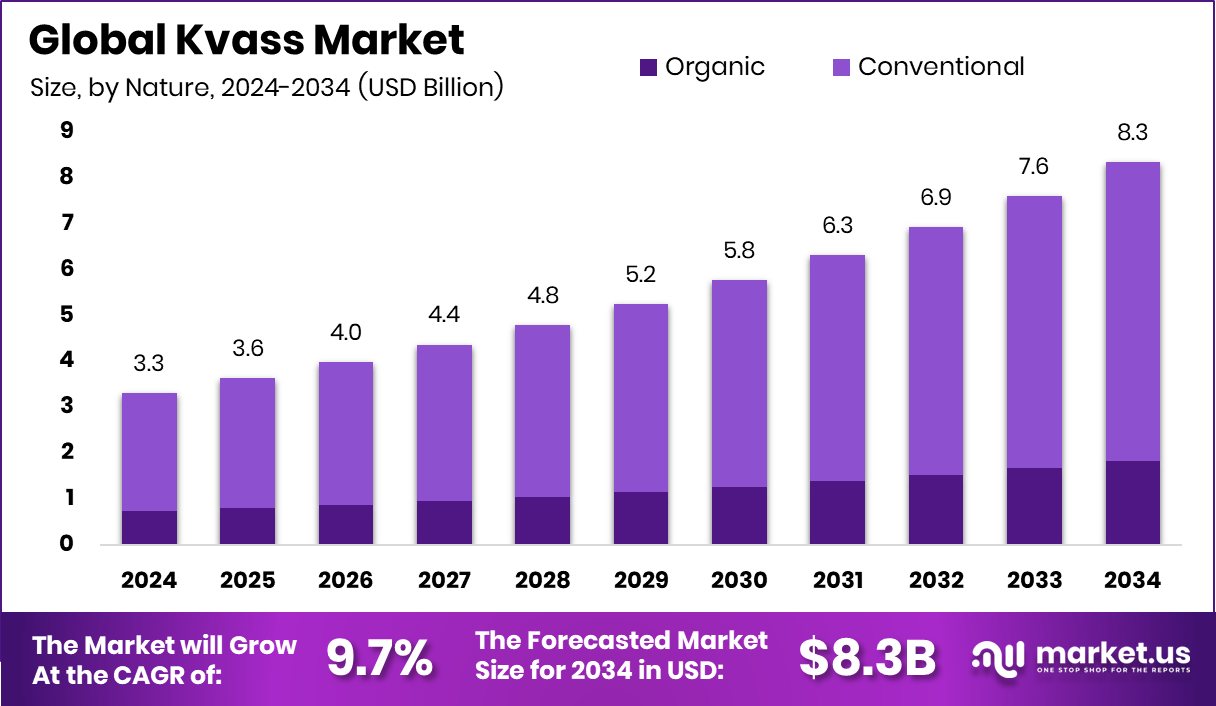
New York, NY – February 09, 2026 – The Global Kvass Market is set to reach USD 8.3 billion by 2034, rising from USD 3.3 billion in 2024 at a strong 9.7% CAGR. Europe remains a major hub, generating USD 1.4 billion and accounting for 43.90% of the market. Kvass, made through natural fermentation of rye bread and water, is valued for its mild flavor, low alcohol content, and cultural significance, making it a preferred everyday drink. Its appeal aligns with rising consumer demand for natural, traditional, and minimally processed beverages.
Market growth is reinforced by broader investments in natural and high-quality food production. Funding developments—such as Fragaria Fruits raising $2 million to expand premium berry farming in India and Oishii securing $16 million to grow luxury strawberries—reflect rising consumer support for authenticity and clean-label products. Efficiency-driven advancements like TRIC Robotics, raising $5.5 million for UV automation in sustainable farming, highlight increasing emphasis on resource efficiency, especially as proposed $600 million budget cuts pressure major water-related projects.
Opportunities emerge through innovation and premium positioning. New developments, such as Strawberry raising $6 million for an AI-powered browser and Oishii’s $134 million Series B focused on quality, signal a broader shift toward craftsmanship and upgraded consumer experiences. This environment positions kvass to scale through improved quality, flavor diversity, and thoughtful global expansion.
➤ Click the sample report link for complete industry insights: https://market.us/report/global-kvass-market/request-sample/
Key Takeaways
- The Global Kvass Market is expected to be worth around USD 8.3 billion by 2034, up from USD 3.3 billion in 2024, and is projected to grow at a CAGR of 9.7% from 2025 to 2034.
- Conventional kvass dominates the Kvass Market by nature, holding 78.3% share due to affordability globally.
- Apple flavor leads the Kvass Market by flavour with 21.7% share, driven by taste preference.
- Supermarkets dominate Kvass Market sales channels, capturing 41.9% share through wide availability and consumer trust.
- In 2024, Europe accounts for USD 1.4 Bn, holding 43.90% of the Kvass Market.
➤ Directly purchase a copy of the report – https://market.us/purchase-report/?report_id=172360
Report Scope
| Report Features | Description |
|---|---|
| Market Value (2024) | USD 3.3 Billion |
| Forecast Revenue (2034) | USD 8.3 Billion |
| CAGR (2025-2034) | 9.7% |
| Segments Covered | By Nature (Organic, Conventional), By Flavour (Apple, Beets, Bird cherry, Lemon, Cherry, Cranberry, Mint, Strawberry), By Sales Channel (Supermarket, Convenience Store, E-Commerce, Food service, Others) |
| Competitive Landscape | Baltika Breweries, Krasny Vostok, Biokvass, Gubernija, Coca-Cola Company, Bryanskpivo, Carlsberg Group, All Stars Beverages, Piebalgas Alus, Kvass Beverages Llc |
Key Market Segments
By Nature
The Kvass Market in 2024 was strongly dominated by conventional kvass, which held an impressive 78.3% global share. This leadership is driven by the drink’s deep cultural roots, especially across Eastern Europe, where consumers prefer familiar bread-based fermentation processes and time-tested recipes. Conventional kvass remains the most accessible and affordable option, supported by established supply chains and production systems that do not require costly organic certification. This ensures lower prices, making it highly appealing to cost-conscious buyers while maintaining its authentic taste.
Foodservice operators and bulk purchasers also favor conventional kvass because of its consistent quality, reliable output, and longer shelf life. Although consumer interest in organic beverages continues to rise, the market’s core momentum still comes from traditional kvass, reinforced by strong cultural loyalty, widespread retail presence, and trusted local production. As a result, conventional kvass remains the backbone of global demand.
By Flavour
In the Kvass Market, apple flavor led consumer preferences in 2024, capturing 21.7% of total flavor share. Apple-flavored kvass stands out for its balanced taste, combining the classic fermented profile of kvass with a mild fruity sweetness that appeals to both traditional drinkers and new consumers. Its familiarity helps ease first-time buyers into the category, particularly younger audiences seeking refreshing, naturally inspired beverages. Apple performs exceptionally well in domestic and export markets due to its broad acceptance and association with natural energy and digestive wellness.
Producers also favor apples because of their stable supply, consistent pricing, and compatibility with fermentation processes, ensuring scalable production. As global taste preferences shift toward fruit-forward and functional beverages, apple-flavored kvass continues to act as a key differentiator for brands. Its versatility and mass appeal make it a central driver of flavor-based innovation and volume growth in the industry.
By Sales Channel
Supermarkets dominated the Kvass Market’s distribution landscape in 2024, holding a substantial 41.9% share of total sales. Their leadership stems from strong product visibility, wide brand variety, and competitive pricing, which together drive higher consumer engagement and repeat purchases. Supermarkets allow shoppers to compare traditional and flavored kvass options in one place, often supported by promotions, in-store tastings, and seasonal discounts that boost trial rates. For brands, supermarket placement ensures nationwide reach, consistent sales volume, and higher credibility compared to smaller stores.
In urban regions, supermarkets benefit from heavy foot traffic and evolving shopping habits that favor convenience and immediate product availability. Even with online grocery adoption increasing, supermarkets retain dominance because fermented beverages like kvass require controlled storage and quick access. This channel remains fundamental to expanding market penetration, increasing brand exposure, and supporting long-term growth across both established and emerging kvass producers.
Regional Analysis
In 2024, Europe dominated the global Kvass Market with 43.90% share and USD 1.4 billion in value, driven by strong cultural loyalty, everyday consumption habits, and broad retail penetration across Eastern and Central Europe. Kvass continues to be an essential household and foodservice beverage, reinforcing the region’s long-standing leadership.
North America represents a growing market, supported by rising interest in fermented drinks, gut-health trends, and exposure to ethnic beverages in major cities. The Asia Pacific region shows steady but niche-level adoption, as consumers increasingly explore probiotic and fermented options, though local traditional drinks still lead preferences.
In the Middle East & Africa, demand remains limited but slowly emerging, primarily through specialty stores and expatriate communities familiar with kvass. Latin America also reflects an early-stage market, where interest in natural beverages is rising but overall awareness of kvass remains comparatively low.
Top Use Cases
- Gut Health Drink: Kvass is rich in probiotics — good bacteria that help support a healthy digestive system, making digestion smoother and improving gut balance. This can help your body absorb nutrients better and support immunity.
- Refreshing Daily Beverage: Traditionally served cold, kvass quenches thirst and refreshes, especially in hot weather. It offers a fizzy, tangy taste that’s lighter and less acidic than many soft drinks, yet still satisfying.
- Natural Nutrient Source: Kvass contains vitamins (like B and C), minerals, and amino acids due to fermentation. These nutrients support energy metabolism, nervous system function, and overall wellness.
- Ingredient in Traditional Foods: In Eastern European cooking, kvass is used as a base for cold soups, like okroshka, adding flavor and depth to dishes beyond just drinking it.
- Detox and Liver Support: Certain styles of kvass, especially beet kvass, are believed to help support liver detoxification and improve circulation thanks to natural compounds in beets.
- Home Fermentation Experiment: People often make kvass at home using stale bread, fruit scraps, or vegetables — turning leftovers into a fermented drink. This makes it a fun and sustainable DIY project as well as a tasty beverage.
Recent Developments
- In August 2025, Gubernija opened its first new-format brand store called “Beer Chronicles. Gubernija” in Šiauliai, Lithuania. The store sells a variety of drinks (including non-alcoholic beverages) and snacks and also shares the brewery’s history with visitors. This is part of Gubernija’s effort to connect more directly with customers and promote its brand experience.
- In December 2024, the Carlsberg Group completed the sale of its ownership stake in Baltika Breweries. This ended Carlsberg’s long-running involvement with the company. While not a kvass-specific change, it is a major corporate development that could influence Baltika’s future product strategies, including its non-beer offerings.
Conclusion
The Kvass Market continues to grow steadily as consumers rediscover fermented and traditional beverages with simple, natural ingredients. Kvass stands out for its cultural authenticity, refreshing taste, and suitability as an everyday drink rather than an occasional specialty product.
Rising interest in gut-friendly and minimally processed drinks also supports its appeal across different age groups. Innovative flavors, wider retail availability, and renewed attention to heritage foods are helping kvass move beyond its traditional regions. As producers strengthen quality and expand distribution, kvass is positioned to gain more visibility in global beverage trends, supported by its balance of tradition and modern wellness appeal.
Discuss your needs with our analyst
Please share your requirements with more details so our analyst can check if they can solve your problem(s)