Table of Contents
Overview
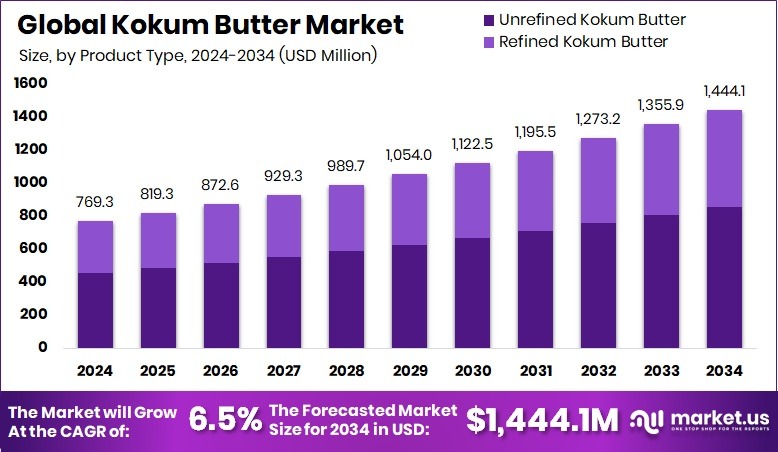
New York, NY – January 14, 2026 – The global kokum butter market is moving steadily upward, driven by rising demand for natural and plant-based ingredients. The market is projected to grow from USD 769.3 million in 2024 to around USD 1,444.1 million by 2034, expanding at a 6.5% CAGR between 2025 and 2034. North America plays a leading role, holding a 37.9% share, equivalent to USD 291.5 million, supported by strong consumer interest in clean-label and naturally sourced fats.
Kokum butter is extracted from kokum seeds and is valued for its firm structure, long shelf life, and non-greasy texture. It remains solid at room temperature, blends easily, and provides stability without heavy processing. These properties make it suitable for applications where consistency, natural origin, and formulation strength are important, from small artisanal production to organized manufacturing.
Growth is closely linked to the shift toward organic and plant-based production systems. This trend is supported by €1.1 million in funding aimed at promoting organic production, helping improve cleaner sourcing practices. At the same time, challenges remain uneven globally, as nearly USD 1 billion in funding dried up across six African countries, affecting raw material ecosystems.
Investment activity across natural fat categories further reinforces demand. All Things Butter raised £2.2 million, while Sid’s Farm secured USD 10 million in Series A funding, highlighting strong investor confidence. Additional signals include a USD 10 million organic fertilizer plant investment in California and premium ghee priced at Rs 2,495 per 500 ml, showing consumers are willing to pay for natural, value-driven products.
➤ Click the sample report link for complete industry insights: https://market.us/report/global-kokum-butter-market/request-sample/
Key Takeaways
- The Global Kokum Butter Market is expected to be worth around USD 1,444.1 million by 2034, up from USD 769.3 million in 2024, and is projected to grow at a CAGR of 6.5% from 2025 to 2034.
- Unrefined kokum butter led the Kokum Butter Market with 59.4% share, driven by skincare demand.
- Conventional products dominated the Kokum Butter Market at 69.3%, supported by established supply chains globally.
- Mechanical extraction held 66.9% in the Kokum Butter Market due to cost efficiency and scalability.
- Cosmetics and personal care applications captured 47.4% of the Kokum Butter Market consumption worldwide growth.
- The North America Kokum Butter Market reached USD 291.5 Mn, holding 37.9% of the regional share.
➤ Directly purchase a copy of the report – https://market.us/purchase-report/?report_id=170650
Report Scope
| Report Features | Description |
|---|---|
| Market Value (2024) | USD 769.3 Million |
| Forecast Revenue (2034) | USD 1,444.1 Million |
| CAGR (2025-2034) | 6.5% |
| Segments Covered | By Product Type (Unrefined Kokum Butter, Refined Kokum Butter), By Nature (Organic, Conventional), By Extraction Method (Solvent Extraction, Mechanical Extraction), By Application (Cosmetics and Personal Care, Food Processing, Confectionery, Pharmaceuticals, Others) |
| Competitive Landscape | AAK, Wilmar International, Fuji Oil, Cargill, Mewah Group, Manorama Group, Felda Iffco |
Key Market Segments
By Product Type Analysis
In the Kokum Butter Market, unrefined kokum butter leads the product type segment with a 59.4% share in 2024, reflecting strong buyer preference for minimally processed ingredients. This segment benefits from its natural fatty acid profile, original aroma, and firm texture, which remain intact due to limited processing. Buyers associate unrefined variants with authenticity, purity, and dependable functional performance, especially in applications where natural composition is critical.
Its solid structure at room temperature and long shelf life further support consistent usage across manufacturing processes. Manufacturers favor unrefined kokum butter for its compatibility with formulation needs and stable quality outcomes. As demand continues for ingredients that preserve traditional characteristics while delivering reliable performance, unrefined kokum butter remains a central product choice, reinforcing its leadership within the overall market structure.
By Nature Analysis
The conventional nature segment dominates the Kokum Butter Market, accounting for a 69.3% share in 2024. This leadership highlights continued dependence on conventional production systems that offer predictable supply volumes and stable quality. Market participants prioritize conventional kokum butter due to its cost efficiency and well-established sourcing and trade networks. These systems support large-scale manufacturing requirements, ensuring uninterrupted availability across commercial channels.
Buyers value the reliability and uniformity of conventional products, which simplify procurement and production planning. The dominance of this segment reflects practical purchasing decisions focused on scalability and consistency rather than premium positioning. As manufacturers continue to emphasize supply security and standardized inputs, conventional kokum butter remains the backbone of the market’s supply framework.
By Extraction Method Analysis
Mechanical extraction leads the Kokum Butter Market by extraction method, holding a 66.9% share in 2024. This method is widely preferred because it preserves the butter’s natural structure while delivering efficient and repeatable yields. Mechanical extraction avoids heavy chemical intervention, helping maintain texture, stability, and natural characteristics that buyers expect. Its straightforward processing approach supports consistent quality, which is essential for downstream formulation and product performance.
Manufacturers rely on this method for its operational efficiency and predictable outcomes, reducing variability across production batches. The balance between quality preservation and process efficiency makes mechanical extraction the dominant choice across supply chains. As demand remains steady for naturally processed yet scalable solutions, this extraction method continues to anchor market production practices.
By Application Analysis
The cosmetics and personal care segment is the leading application area in the Kokum Butter Market, capturing a 47.4% share in 2024. This dominance is driven by the butter’s non-greasy feel, firm consistency, and stable emollient properties, which suit personal care formulations requiring smooth application and structural stability. Manufacturers consistently integrate kokum butter into routine product lines where performance reliability is essential.
Its compatibility with diverse formulations supports broad usage across creams, balms, and personal care bases. Steady demand from this segment reflects its functional dependability rather than trend-driven use. As product developers continue to prioritize texture control and formulation stability, cosmetics and personal care remain the primary demand driver within the kokum butter market.
Regional Analysis
North America leads the Kokum Butter Market with a 37.9% share valued at USD 291.5 million, driven by strong commercial adoption and well-developed demand channels. The region benefits from structured manufacturing environments where consistency, quality control, and reliable supply are key priorities, supporting steady usage across applications.
Europe represents a mature market, characterized by stable consumption and long-standing industry practices. Kokum butter is gradually incorporated into established formulations, sustaining demand without sharp fluctuations. Asia Pacific shows growing momentum, supported by its proximity to raw material sources and traditional familiarity with kokum-based products. This regional advantage strengthens internal consumption and supports regional trade flows.
The Middle East & Africa hold a developing position, where awareness is increasing but application remains selective, resulting in moderate demand growth. Latin America reflects an emerging landscape, marked by niche adoption and slow integration into localized uses. Overall, regional demand patterns highlight a mix of mature stability and gradual expansion across global markets.
Top Use Cases
- Moisturizer for Dry Skin: Kokum butter is rich in fatty acids and vitamin E, which help deeply hydrate and soften dry skin without leaving a greasy feel. It gets absorbed quickly and restores moisture, making skin smooth and nourished.
- Ingredient in Lotions & Creams: bIts light texture and regenerative properties make it a good base for body lotions, face creams, and anti-aging formulations. It helps skin stay elastic and refreshed.
- Lip Balm and Lip Care: Because kokum butter doesn’t clog pores and melts gently on contact, it’s often used in lip balms and glosses to keep lips soft, nourished, and protected from cracking.
- Hair & Scalp Nourishment: It helps moisturize the scalp and strengthen hair roots, keeping hair soft and reducing dryness or dandruff when applied as part of a hair mask or conditioner.
- Soap & Body Balm Thickener: Kokum butter’s firm structure makes it useful in handmade soaps and balms, where it helps create a stable, creamy texture and supports the product’s consistency.
- Soothing Irritated Skin: With antioxidant and anti-inflammatory properties, kokum butter can calm irritated or inflamed skin, helping soothe minor burns, redness, and dry patches.
Recent Developments
- In June 2025, Wilmar International agreed to buy the remaining 50% stake in PZ Wilmar, its joint venture with UK company PZ Cussons, for about US$70 million.
- In April 2025, Fuji Oil restarted its core business as a new corporate structure after shifting to a business holding company setup. This change is meant to help the company grow faster and create new value with customers.
- In February 2024, Cargill became the first global edible oils supplier whose entire oil portfolio meets the World Health Organization’s best practice for eliminating industrial trans-fatty acids in fats and oils.
Conclusion
Kokum butter stands out as a reliable natural fat valued for its stable texture, long shelf life, and clean sensory feel. Its solid nature at room temperature, easy blending behavior, and non-greasy performance make it suitable for a wide range of formulations. Growing interest in plant-based and minimally processed ingredients continues to support its acceptance across industries.
Consistent quality, compatibility with manufacturing processes, and traditional familiarity further strengthen its position. While sourcing and awareness vary by region, kokum butter’s functional advantages and natural origin keep it relevant. Overall, it remains a dependable ingredient choice where structure, purity, and performance are essential.
Discuss your needs with our analyst
Please share your requirements with more details so our analyst can check if they can solve your problem(s)