Table of Contents
Overview
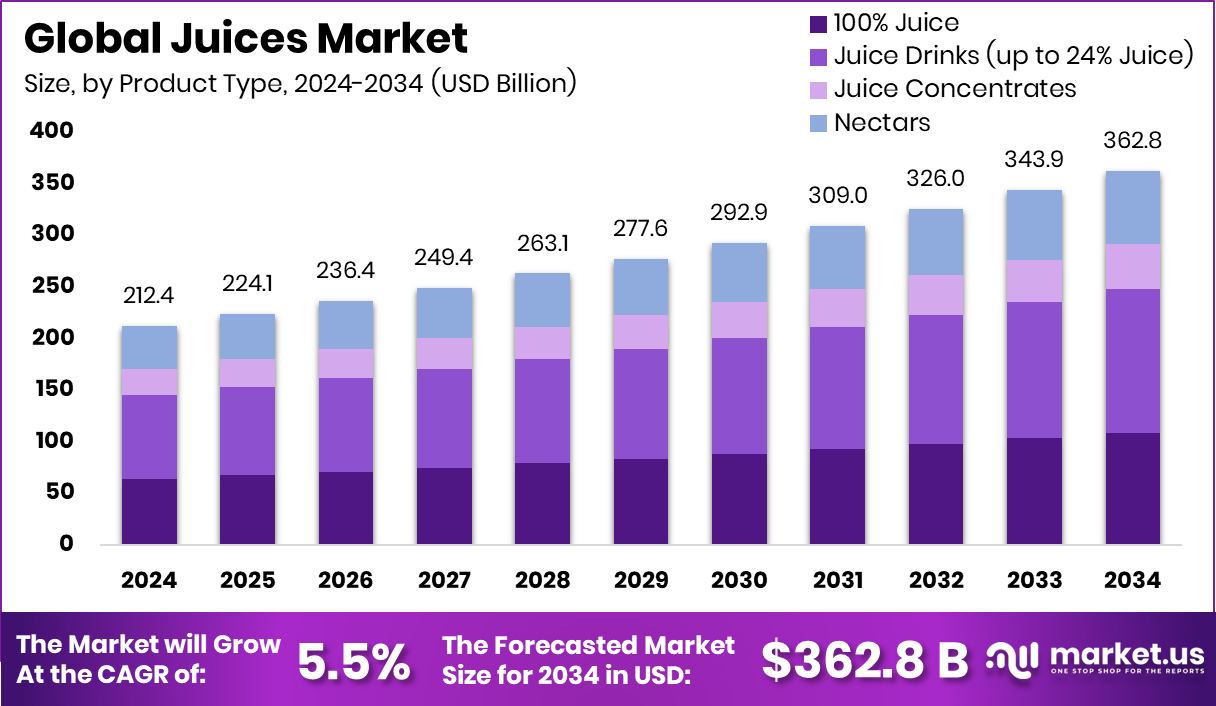
New York, NY – March 09, 2026 – The global juices market is projected to reach USD 362.8 billion by 2034, growing from USD 212.4 billion in 2024 at a 5.5% CAGR between 2025 and 2034. Asia Pacific leads the market with 38.9% share, valued at USD 82.6 billion, driven by strong consumer demand across the region.
Juices are beverages produced by extracting liquid from fruits or vegetables, delivering natural flavor, hydration, and basic nutrients. They are consumed both fresh and in packaged forms and are commonly available in households, workplaces, and foodservice outlets. Depending on consumer preferences and pricing, juices may be pure, blended, or diluted. Their popularity stems from convenience, diverse flavors, and everyday consumption across different age groups.
The juices market covers the production, packaging, distribution, and sale of fruit- and vegetable-based beverages across retail and foodservice channels, including fresh juices, packaged variants, and ready-to-drink formats. Urbanization, evolving lifestyles, and the demand for convenient beverages support market growth. Infrastructure improvements also contribute, such as the NSW government granting Grove Juice USD 2.5 million to establish a new bottling line and increase supply capacity.
Investment activity highlights industry momentum. Alienkind raised USD 1.2 million, Nomva secured USD 3 million, and Raw Pressery obtained USD 4.5 million to expand operations. In Southeast Asia, Being Juice raised USD 1 million, while another founder-led juice brand also secured USD 1 million for expansion.
Broader financial ecosystems are also supporting the sector. Juice raised €29.4 million, another Juice secured £25 million, and Creative Juice launched a USD 50 million fund along with a USD 15 million Series A, helping brands access capital for scaling, marketing, and product innovation.
➤ Click the sample report link for complete industry insights: https://market.us/report/juices-market/request-sample/
Key Takeaways
- The Global Juices Market is expected to be worth around USD 362.8 billion by 2034, up from USD 212.4 billion in 2024, and is projected to grow at a CAGR of 5.5% from 2025 to 2034.
- In the Juices Market, juice drinks up to 24% juice lead types with 38.4% share.
- Aseptic packages dominate packaging preferences in the Juices Market, accounting for a strong 37.10% share.
- Conventional offerings remain dominant in the Juices Market, representing 83.5% of total category consumption globally.
- Off-trade channels lead Juices Market distribution, capturing 79.3% share through retail-led consumer purchasing behavior trends.
- In Asia Pacific, Juices Market reached USD 82.6 Bn, accounting for 38.9% globally.
➤ Directly purchase a copy of the report – https://market.us/purchase-report/?report_id=174052
Market Segments
By Product Type Analysis
In 2024, juice drinks containing up to 24% juice held a 38.4% share of the Juices Market, reflecting strong demand for affordable, flavored beverages. These products attract urban consumers and younger demographics who prefer convenient, ready-to-drink options with consistent taste and longer shelf life. Their relatively lower fruit content allows manufacturers to maintain competitive pricing while offering diverse flavors.
Companies focused on flavor innovation, fortification, and value pricing to expand sales. Retailers also promoted multipacks and value deals to encourage volume purchases. The segment benefited from growing on-the-go consumption, along with demand from schools and workplaces. Increasing consumer acceptance of blended and lightly fruit-based beverages across both developed and emerging markets further strengthened the popularity of this product category.
By Packaging Type Analysis
In 2024, aseptic packaging dominated the Juices Market with a 37.10% share, largely due to its ability to maintain product freshness without refrigeration or preservatives. This packaging technology extends shelf life, reduces food waste, and improves distribution efficiency. Its lightweight design helps lower transportation costs and carbon emissions, aligning with sustainability goals for manufacturers and retailers.
Consumers favor aseptic packs for their convenience, portability, and perceived safety. In addition, the packaging allows brands to use high-quality printing on cartons, improving shelf appeal and communicating nutritional or health-related claims effectively. These advantages have driven widespread adoption of aseptic packaging across global retail channels, making it a preferred choice for packaged juice products.
By Category Analysis
In 2024, the conventional category dominated the Juices Market with an 83.5% share, reflecting strong consumer reliance on widely available and cost-effective juice products. Conventional juices benefit from well-established supply chains, consistent fruit sourcing, and lower production costs compared with organic alternatives. Price sensitivity in many regions encourages consumers to choose these products, particularly in mass retail environments.
Instead of shifting entirely to organic production, many manufacturers focused on incremental improvements such as vitamin enrichment, flavor variety, and reduced-sugar formulations. This approach helps maintain affordability while addressing evolving health preferences. The dominance of conventional juices highlights the balance consumers seek between accessibility, price, and familiarity in everyday beverage choices.
By Distribution Channel Analysis
In 2024, off-trade channels accounted for 79.3% of total juice sales, making them the primary distribution route in the Juices Market. Supermarkets, hypermarkets, convenience stores, and online retail platforms played a major role in driving sales. Consumers prefer these outlets because they offer wider product variety, competitive pricing, and opportunities for bulk purchasing. Retailers strengthened this channel by expanding private-label juice offerings and promoting discounts or bundled deals.
Growth in e-commerce grocery platforms also supported off-trade sales by providing convenient home delivery and subscription services. The dominance of off-trade channels reflects changing consumer shopping habits, increasing at-home consumption, and the growing importance of organized retail and digital grocery platforms.
Regional Analysis
The Juices Market shows notable regional differences influenced by consumer habits, retail development, and product accessibility across North America, Europe, Asia Pacific, the Middle East & Africa, and Latin America.
Asia Pacific leads the market with a 38.9% share, valued at USD 82.6 billion, supported by large populations, rapid urbanization, and strong demand for affordable packaged juices. High household penetration and frequent off-trade purchases sustain growth across both developed and emerging economies.
North America represents a mature market with stable consumption and strong demand for packaged ready-to-drink products sold through organized retail. Europe maintains steady demand due to a long-standing juice consumption culture and widespread retail availability.
Meanwhile, the Middle East & Africa and Latin America show gradual growth supported by expanding retail networks, fruit availability, and traditional household juice consumption patterns.
Top Use Cases
- Daily Hydration Drink: Juices are widely used as a refreshing drink to keep the body hydrated. Many fruits such as oranges, watermelon, and grapes contain high water content, which helps replace fluids lost during the day. People often drink juice during hot weather or after physical activity to rehydrate and feel refreshed. Juices also provide natural electrolytes and nutrients that support normal body functions.
- Quick Energy Boost: Juices are often consumed for a quick energy boost because fruits contain natural sugars like fructose. These sugars provide fast energy to the body without needing heavy digestion. Many people drink juice in the morning, during work breaks, or before workouts to feel more active and alert. Natural fruit sugars give energy faster than many processed snacks.
- Nutrient and Vitamin Intake: Juices are used as an easy way to get vitamins and minerals from fruits and vegetables. Many juices contain vitamin C, potassium, antioxidants, and other nutrients that support immunity, heart health, and skin health. Drinking a small amount of juice can help people increase their fruit intake when they do not eat enough whole fruits.
- Digestive Support: Some juices are used to help digestion and gut health. Fruits like papaya, pineapple, and apples contain enzymes and nutrients that help break down food and reduce bloating. Certain juices, such as prune juice, are commonly used to relieve constipation because they help soften stools and support bowel movement.
- Ingredient in Cooking and Beverages: Juices are also used as ingredients in many recipes. They are added to smoothies, mocktails, sauces, desserts, and marinades to enhance flavor and add natural sweetness. Restaurants and cafés often use fresh or cold-pressed juices to prepare cocktails, fruit bowls, breakfast drinks, or refreshing beverages.
- Healthy Snack or Meal Companion: Many people drink juice as a light snack between meals or with breakfast. It is easy to consume and provides nutrients quickly without heavy preparation. Juices are commonly served with breakfast foods, salads, or light meals because they add flavor and nutritional value. However, experts suggest drinking moderate amounts because juices contain natural sugars.
Notable Company Developments
- In April 2025, The Coca-Cola Company launched a new marketing and brand platform called “Bring the Juice” for its Minute Maid juice brand. The company partnered with WWE to promote the brand globally and attract younger consumers. This campaign helps strengthen the visibility of its juice drinks and highlights the fun and energetic image of the Minute Maid product range.
- In February 2025, Keurig Dr Pepper announced new beverage innovations across its cold-drink portfolio, including updates and new flavors under brands such as Snapple, which is known for tea and juice-based drinks. The launch aimed to expand flavor choices and attract consumers looking for new fruit-flavored beverage options in the ready-to-drink category.
- In September 2024, PepsiCo launched DRIPS by Pepsi, a new crafted beverage concept featuring drinks made using PepsiCo ingredients such as fruit syrups, berries, and other flavor mix-ins. The drinks were first introduced through special pop-up events in New York. The concept focuses on creative beverage recipes and mixology, including fruit-based flavors that can be used in juice-style drinks and mocktails.
- In June 2024, Suntory Holdings partnered with the French agricultural research organization CIRAD to address a global disease affecting orange crops. The project focuses on research and experiments to reduce the impact of the disease and protect the supply of oranges used in beverages and juice products. This initiative helps secure long-term raw materials for Suntory’s fruit-based drinks and supports farmers in the citrus supply chain.
- In January 2024, Tropicana introduced a limited-edition packaging called “Tropcn.” The brand temporarily removed the letters “AI” from its logo to highlight that its Pure Premium orange juice contains nothing artificial. The campaign aimed to reinforce the natural quality of the juice and attract consumer attention through creative packaging and marketing.
Conclusion
The juices market continues to grow as consumers increasingly choose convenient and refreshing beverage options. Changing lifestyles, urban living, and busy daily routines encourage people to prefer ready-to-drink products that offer both taste and basic nutrition. Companies are focusing on flavor innovation, healthier formulations, and attractive packaging to meet evolving consumer preferences. Improvements in distribution networks and retail availability also support wider product access.
In addition, brands are exploring new ingredients, reduced sugar options, and sustainable packaging to stay competitive. Overall, the market is shaped by strong everyday consumption, product variety, and continuous innovation that helps maintain consumer interest across different regions and age groups.
Discuss your needs with our analyst
Please share your requirements with more details so our analyst can check if they can solve your problem(s)