Table of Contents
Market Overview
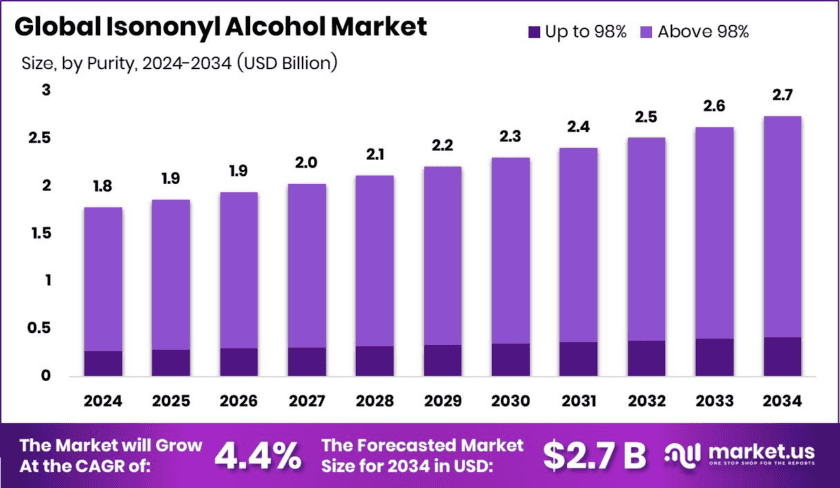
In 2024, the Global Isononyl Alcohol Market reached a value of USD 1.8 billion. Market analysts project a CAGR of 4.4% from 2025 to 2034. Consequently, the market will likely reach about USD 2.7 billion by the end of the forecast period.
Isononyl alcohol (INA) functions as a colorless, flammable liquid with a mild floral scent. Industries rely on this chemical as a crucial raw material for many products. Moreover, producers typically create INA through the hydroformylation of octenes derived from butenes.
The plasticizer industry serves as the primary driver for this chemical market. Manufacturers use INA as a precursor to produce diisononyl phthalate (DINP). These plasticizers make polyvinyl chloride (PVC) flexible and durable for various applications.
Environmental and regulatory concerns present major challenges for the market. Specifically, phthalate-based plasticizers face increasing scrutiny from agencies like the European Chemicals Agency. Consequently, the market is shifting toward sustainable alternatives such as DINCH (Diisononyl Cyclohexane Dicarboxylate).
Interestingly, DINCH is also an isononyl alcohol based plasticizer. This development creates new opportunities despite regulatory pressures. Additionally, INA is gaining traction from the fragrance, lubricants, and surfactants industries due to its chemical properties.
Key Takeaways
- The Global Isononyl Alcohol Market was valued at USD 1.8 billion in 2024 and is projected to grow at a CAGR of 4.4% and is estimated to reach USD 2.7 billion by 2034.
- Isononyl alcohol, which is more than 98% pure, dominated the market in 2024, comprising about 84.9% share of the total global market.
- Plasticizers led the market, encompassing about 68.6% share of the total global market.
- Asia Pacific was at the forefront in the isononyl alcohol in 2024, comprising roughly 44.8% of the total global consumption.
➤ Download Exclusive Sample Of This Premium Report (Including Full TOC, Table & Figures)- https://market.us/report/global-isononyl-alcohol-market/request-sample/
Market Segmentation Overview
Purity Analysis
Isononyl alcohol with purity exceeding 98% dominated the market with an 84.9% share in 2024. High-purity INA ensures better chemical stability and fewer impurities. This quality proves critical for sensitive industries like plasticizers, lubricants, and cosmetics.
High-purity alcohol leads to improved plasticizer performance, including better flexibility and lower volatility. In lubricants and personal care products, impurities can compromise product quality and safety. Therefore, manufacturers prefer above 98% purity INA to meet stringent regulatory requirements.
Application Analysis
The plasticizers sector dominated the isononyl alcohol market with a 68.6% share in 2024. Most of the produced INA serves as a key raw material for DINP manufacturing. DINP ranks among the most widely used plasticizers for flexible PVC applications.
The plasticizer industry demands large INA volumes due to extensive flexible PVC use in construction and automotive sectors. In contrast, surfactants, lubricants, emollients, and fragrances require smaller quantities. These sectors focus on performance-specific uses where INA acts as an additive rather than a bulk raw material.
Drivers
Isononyl alcohol plays a critical role in the plasticizer industry as a key raw material for DINP production. This plasticizer offers high compatibility with PVC resins combined with low volatility. Moreover, excellent weather resistance makes it ideal for wire insulation, flooring, and automotive interiors.
The automotive industry uses flexible PVC components containing DINP for interior trims and under-the-hood applications. Vinyl flooring also benefits from improved thermal stability and low migration properties. Consequently, continued demand for durable, flexible plastic products sustains high INA consumption across the construction and automotive sectors.
Use Cases
In the lubricants sector, manufacturers use isononyl alcohol to synthesize esters that enhance synthetic lubricant performance. These esters improve thermal stability, viscosity, and biodegradability. Such properties prove essential for automotive engines and industrial machinery where high-performance lubricants are critical for operations.
The fragrance industry uses isononyl alcohol as a key intermediate for producing aroma compounds. Its pleasant, mild odor and good solvency make it valuable for personal care products and perfumes. Additionally, low volatility and compatibility with other fragrance ingredients position INA as a desirable component in scent formulations.
Major Challenges
Environmental concerns significantly challenge the isononyl alcohol market growth due to its use in phthalate-based plasticizers. Regulatory agencies like the European Chemicals Agency have raised concerns about potential endocrine-disrupting effects. Consequently, stricter regulations on phthalate usage in consumer goods continue to emerge across multiple regions.
A study by the United Nations Environment Programme (UNEP) found that plastic additives, including certain phthalates, were present in over 90% of sampled marine litter. This finding raises serious concerns about long-term ecological impacts. Therefore, as sustainability becomes a global priority, these pressures could hinder traditional INA demand.
Business Opportunities
The shift toward non-phthalate plasticizers creates significant opportunities for isononyl alcohol manufacturers. INA is increasingly used to produce DINCH, a safer alternative offering similar performance without health risks. According to BASF, Hexamoll DINCH demonstrates lower migration and toxicity levels compared to traditional phthalates, making it a preferred substitute.
Asia Pacific offers substantial growth opportunities with its robust manufacturing base and rapid industrialization. China alone accounts for a significant share of global PVC production using DINP as a plasticizer. Additionally, the region’s growing middle class and urbanization fuel demand for consumer goods and vehicles, further boosting INA consumption.
Regional Analysis
Asia Pacific held the major share of the global isononyl alcohol market valued at approximately USD 797.6 million in 2024. This region commanded an estimated 44.8% of the total revenue share. Countries including China, India, South Korea, Japan, Taiwan, and Vietnam are major consumers due to expansive plastics and automotive industries.
Asia Pacific’s access to raw materials and competitive production costs strengthens its market position. The region’s increasing domestic consumption of PVC products such as wires, cables, synthetic leather, and flooring drives demand. Therefore, Asia Pacific remains at the forefront of the global isononyl alcohol market.
Top Key Players in the Market
- Evonik Industries AG
- KH Neochem Co., Ltd.
- Unilong Industry Co., Ltd.
- NAN YA PLASTICS CORPORATION
- PETRONAS Chemicals Group Berhad
- ChemicalBull
- Alfa Chemical Co., Ltd.
- Ensince Industry Co., Ltd.
- Haihang Industry Co., Ltd.
- Exxon Mobil Corporation
- Other Key Players
Conclusion
The global isononyl alcohol market, environmental regulations, and phthalate concerns are reshaping market dynamics toward safer alternatives. Manufacturers who adapt to the shift toward non-phthalate plasticizers like DINCH will capture emerging opportunities. Asia Pacific continues to lead global consumption, driven by industrial growth and urbanization. Consequently, strategic investments in high-purity INA production and regional supply chains will prove essential for market success.
Discuss your needs with our analyst
Please share your requirements with more details so our analyst can check if they can solve your problem(s)