Table of Contents
Overview
New York, NY – March 10, 2026 – The infrastructure construction sector involves planning, building, and expanding the essential systems that support economic and social activities. These systems include transportation networks, housing projects, utilities, water systems, and public facilities. The goal of infrastructure construction is to create long-lasting, safe, and well-connected structures that allow communities to grow while maintaining reliable access to basic services and mobility.
This market represents the organized economic activity associated with developing and upgrading these critical assets. Both public and private projects play a role in improving living standards, enabling trade, and strengthening regional resilience. Infrastructure investment is closely tied to population growth, rapid urbanization, and government policies designed to modernize aging facilities and address development gaps.
Recent funding initiatives are significantly driving construction activity. Governments and institutions have committed substantial resources, including $212 million for affordable rental housing, £26 million for affordable homes, £20 million for new housing developments, and a €400 million extension of a housing funding programme. Additional investments, such as nearly $1 billion allocated for housing and transportation initiatives, $23.15 million for a mixed-use housing project, and £33.8 million secured for new homes, further reinforce demand.
Future growth opportunities are also supported by innovation and regional development funding. Programs include €20 million for modern construction methods, €45 million for a new expressway, and $725,000 dedicated to housing projects, encouraging faster, more efficient infrastructure development.
➤ Click the sample report link for complete industry insights: https://market.us/report/global-infrastructure-construction-market/request-sample/
Key Takeaways
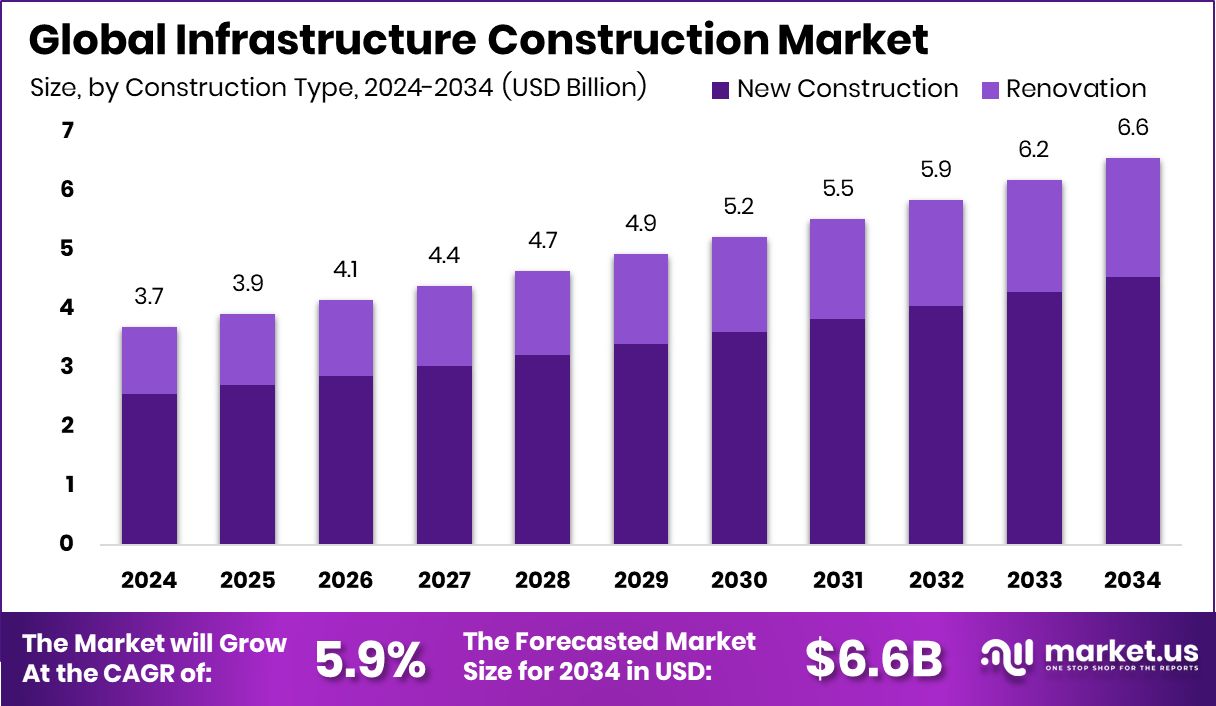
- The Global Infrastructure Construction Market is expected to be worth around USD 6.6 billion by 2034, up from USD 3.7 billion in 2024, and is projected to grow at a CAGR of 5.9% from 2025 to 2034.
- Transportation infrastructure dominates the infrastructure construction market with 39.7% share, driven by urban mobility expansion.
- New construction leads the infrastructure construction market with 69.2%, supported by large-scale development projects globally.
- Public investment accounts for 69.1% of infrastructure construction market funding, reflecting strong government spending priorities.
- Asia Pacific dominated regional infrastructure spending at 44.9%, valued at USD 1.66 Bn.
➤ Directly purchase a copy of the report – https://market.us/purchase-report/?report_id=174139
Market Segments
By Infrastructure Analysis
Transportation infrastructure held the largest share of the infrastructure construction market in 2024, accounting for 39.7% of global investment. Growth was driven by strong spending on roads, highways, railways, bridges, and urban transit networks across both developed and developing regions. Governments prioritized transport upgrades to ease traffic congestion, strengthen logistics efficiency, and support economic development.
Major highway expansion programs, metro rail systems, and airport modernization projects significantly increased construction activity. The rapid rise of e-commerce and international trade also created greater demand for efficient and reliable transport networks. Because of its role in enabling mobility and trade, transportation infrastructure continued to receive consistent funding, long-term planning support, and strong collaboration between public authorities and private sector partners.
By Construction Type Analysis
New construction represented the dominant construction type in 2024, accounting for 69.2% of infrastructure construction activity. This trend reflects the growing global emphasis on building new infrastructure rather than focusing mainly on repair or renovation projects. Rapid urbanization, population growth, and expanding industrial activity increased the need for new roads, ports, energy facilities, water systems, and public buildings.
Many emerging economies prioritized developing foundational infrastructure to stimulate economic progress, while developed regions focused on building smart cities and advanced transport networks. Improvements in construction technologies, project planning tools, and standardized building methods also helped accelerate project timelines. These factors made new construction the preferred approach for large-scale infrastructure development worldwide.
By Investment Source Analysis
Public investment remained the leading funding source in the infrastructure construction market in 2024, contributing 69.1% of total project investment. Governments continued to finance major infrastructure initiatives due to their long-term returns and essential public service functions. National infrastructure strategies, economic stimulus programs, and long-term development plans supported spending on transportation, energy, water management, and social infrastructure.
Public funding was particularly important in regions where private investors remained cautious because of economic uncertainties or regulatory challenges. Support from multilateral development banks and government-backed financial institutions also strengthened funding capacity. Strong public sector involvement ensured project continuity, improved regional connectivity, and helped promote balanced economic growth across both urban and rural areas.
Regional Analysis
In 2024, Asia Pacific led the infrastructure construction market with a 44.9% share, valued at USD 1.66 billion. The region’s dominance is driven by strong construction activity across transportation systems, urban infrastructure, and essential public assets. Rapid urbanization, expanding industrial capacity, and continuous development in both major and secondary cities support sustained infrastructure growth.
North America shows stable activity, mainly supported by infrastructure upgrades, rehabilitation projects, and replacement of aging systems. Europe is a mature market with steady demand because of structured planning, stable regulations, and regular construction cycles.
Meanwhile, the Middle East & Africa experience selective growth focused on connectivity and urban development, while Latin America maintains moderate activity through gradual expansion of transportation and utility infrastructure.
Top Use Cases
- Transportation Networks (Roads, Bridges, Railways): Infrastructure construction is widely used to build roads, bridges, railways, airports, and highways that connect cities and regions. These projects make it easier for people to travel and for goods to move between places. Better transport networks reduce travel time, improve trade, and support economic growth. For example, new highways and bridges help connect remote areas to major cities and markets.
- Water Supply and Sanitation Systems: Infrastructure construction is used to create water pipelines, dams, reservoirs, and treatment plants that provide clean drinking water and sanitation services. These systems help protect public health and ensure communities have reliable water. Proper water infrastructure also supports agriculture and industry by supplying water where it is needed.
- Urban Development and Smart Cities: Infrastructure construction supports city development by building housing areas, public facilities, roads, drainage systems, and digital networks. These projects help cities manage population growth and improve the quality of life for residents. Well-planned infrastructure allows cities to expand while maintaining efficient services.
- Energy Infrastructure (Power Plants and Grids): Infrastructure construction is also used to build power plants, electricity grids, and renewable energy systems. These facilities supply electricity to homes, industries, and businesses. Reliable energy infrastructure helps economic development because industries depend on stable power to operate efficiently.
- Public Services Infrastructure (Schools, Hospitals, Utilities): Infrastructure construction also includes building schools, hospitals, government buildings, and utility networks. These facilities support essential services such as healthcare, education, electricity, and waste management. Such infrastructure improves living standards and supports the daily functioning of society.
Notable Company Developments
- In December 2025, Skanska signed a contract with a repeat client to build a new data center in the United States. The project is valued at USD 263 million (about SEK 2.6 billion) and will be included in the company’s order bookings for the fourth quarter of 2025.
- In July 2025, ACS Group, through its subsidiary Electren, acquired SEGADE SAELCO, a company that designs, builds, and maintains high-voltage power line infrastructure.
- In May 2025, Bechtel signed an agreement with King Salman International Airport Development Company to help deliver the expansion of King Salman International Airport in Riyadh. Bechtel will manage the construction of three new airport terminals, including a terminal for commercial airlines, a terminal for low-cost carriers, and a private aviation terminal.
- In February 2025, Larsen & Toubro acquired the remaining 26% stake in L&T Special Steels and Heavy Forgings Pvt. Ltd. from the Nuclear Power Corporation of India Limited (NPCIL) for about ₹170 crore.
- In January 2025, VINCI Construction completed the acquisition of FM Conway Limited, a major public works company in England. The company specializes in roadworks, civil engineering, asphalt production, and infrastructure maintenance.
Conclusion
The infrastructure construction market plays a vital role in supporting economic growth and improving everyday life. It focuses on building and upgrading essential systems such as transportation networks, housing, utilities, and public facilities that enable communities and industries to function efficiently. Growing urban populations, expanding cities, and the need for reliable connectivity continue to increase demand for modern infrastructure.
Governments and private organizations are working together to develop projects that improve mobility, access to services, and regional development. Advances in construction technologies and sustainable building practices are also shaping the future of the sector, helping deliver stronger, more efficient infrastructure that supports long-term social and economic progress.
Discuss your needs with our analyst
Please share your requirements with more details so our analyst can check if they can solve your problem(s)