Table of Contents
Overview
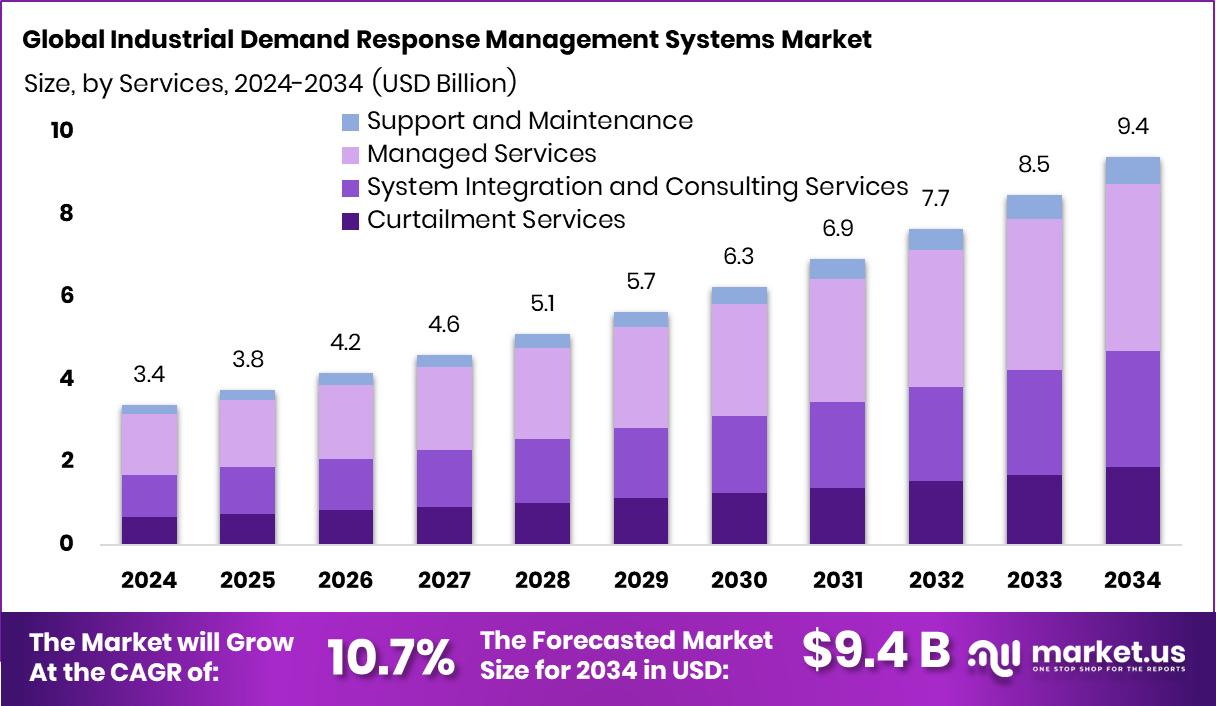
New York, NY – March 06, 2026 – The Industrial Demand Response Management Systems (DRMS) market is projected to reach USD 9.4 billion by 2034, rising from USD 3.4 billion in 2024, with a 10.7% CAGR from 2025 to 2034. North America dominates the market, accounting for 46.7% of the global share, valued at about USD 1.7 billion.
Industrial DRMS solutions are digital and automated control systems that allow factories and large industrial facilities to adjust their electricity usage during peak demand periods. These platforms help industries reduce, shift, or optimize energy consumption without disrupting essential operations. By responding to grid signals or electricity price changes, companies can lower operating costs, safeguard equipment, and contribute to grid reliability while maintaining steady production.
The market includes software platforms, energy control technologies, and managed services that connect industrial facilities with utilities and grid operators. As energy systems experience increasing pressure, these technologies are becoming essential for balancing electricity supply and demand.
Market growth is supported by infrastructure and policy developments. Indonesia’s proposed USD 150 billion transmission network project aims to distribute renewable energy more efficiently, increasing the importance of flexible industrial power usage. Additionally, global uncertainty—illustrated by over 1,000 companies scaling back operations in Russia—is encouraging industries to strengthen control over energy expenses and risks.
Government policy shifts are also influencing demand. In the United States, the Supreme Court is reviewing USD 8 billion in internet and phone subsidies, signaling potential reductions in public funding and pushing industries toward efficiency-focused energy strategies.
Investment in digital service ecosystems is creating further opportunities. For example, SuperOps secured USD 25 million in funding, highlighting growing investor interest in platforms that help managed service providers support industrial systems and enable more advanced demand response management.
➤ Click the sample report link for complete industry insights: https://market.us/report/industrial-demand-response-management-systems-market/request-sample/
Key Takeaways
- The Global Industrial Demand Response Management Systems Market is expected to be worth around USD 9.4 billion by 2034, up from USD 3.4 billion in 2024, and is projected to grow at a CAGR of 10.7% from 2025 to 2034.
- Automated Demand Response dominates the Industrial Demand Response Management Systems Market with 74.8%, enabling real-time load automation.
- Managed Services hold 43.2% share, supporting industries through continuous monitoring, optimization, and expert energy management.
- Manufacturing leads end-use with 56.9%, driven by high energy intensity and demand-side flexibility needs.
- North America leads the Demand Response Management Systems Market at 46.7%, USD 1.7 Bn.
➤ Directly purchase a copy of the report –https://market.us/purchase-report/?report_id=173923
Report Scope
| Report Features | Description |
|---|---|
| Market Value (2024) | USD 3.4 Billion |
| Forecast Revenue (2034) | USD 9.4 Billion |
| CAGR (2025-2034) | 10.7% |
| Segments Covered | By Technology (Conventional Demand Response, Automated Demand Response), By Services (Curtailment Services, System Integration and Consulting Services, Managed Services, Support and Maintenance), By End use (Manufacturing, Healthcare, Energy and Power, Others) |
| Competitive Landscape | Schneider Electric SE, Siemens AG, Hitachi Ltd, Mitsubishi Electric Corporation, ABB Ltd., Alstom SA, General Electric Company, Eaton Corporation PLC, Itron Inc, EnerNOC Inc., Uplight, Inc |
Key Market Segments
By Technology Analysis
In 2024, Automated Demand Response (ADR) captured 74.8% of the Industrial Demand Response Management Systems Market, highlighting its strong adoption among energy-intensive industries. ADR enables automated, rule-based adjustments in electricity consumption without requiring manual action. Industrial facilities benefit from systems that instantly react to grid signals, peak pricing, or utility requests, helping reduce demand charges and maintain operational stability.
Sectors such as manufacturing, refineries, and processing plants favor ADR because it integrates easily with existing energy management and industrial control systems. It also supports compliance with utility demand response programs and grid reliability requirements. As electricity price volatility and grid congestion increase, automated technologies remain the preferred option for industries seeking predictable savings, rapid response capabilities, and minimal disruption to production activities.
By Services Analysis
In 2024, Managed Services held a leading 43.2% share in the Industrial Demand Response Management Systems Market. Many industrial organizations lack dedicated energy management expertise, making outsourced services valuable for monitoring markets, managing utility participation, and optimizing demand response strategies.
Managed service providers oversee system configuration, event coordination, compliance reporting, and performance monitoring for industrial clients. This approach helps companies reduce operational risks while maximizing financial returns from demand response programs.
For large industrial operators with multiple facilities, managed services provide centralized oversight and consistent operational performance. As energy markets grow more complex and penalties for non-performance increase, industries are increasingly relying on specialized providers to maintain reliability, ensure regulatory compliance, and achieve long-term energy cost control.
By End Use Analysis
In 2024, the Manufacturing sector dominated the Industrial Demand Response Management Systems Market with a 56.9% share globally. Manufacturing facilities operate with large and continuous electricity demand, making them well-suited for participation in demand response programs. Industries such as metal processing, chemical production, food manufacturing, and automotive assembly can shift or adjust certain energy-intensive processes during peak demand periods without compromising product quality.
By optimizing energy use, manufacturers reduce electricity costs and help stabilize grid performance. Rising energy prices and increasing pressure on profit margins further encourage factories to adopt demand response systems. Additionally, manufacturers are aligning these solutions with sustainability initiatives, using them to reduce emissions, integrate renewable energy sources, and maintain resilient, efficient production operations.
Regional Analysis
The Industrial Demand Response Management Systems Market is regionally led by North America, which holds a 46.7% share valued at USD 1.7 billion. The region benefits from advanced industrial automation, well-established utility demand response programs, and strong awareness of peak-load cost management. Energy-intensive manufacturing clusters widely adopt these systems to reduce electricity expenses and enhance grid reliability.
Europe shows steady market growth supported by strong industrial efficiency practices and coordinated electricity market operations, with industries using demand response to manage peak demand and improve system flexibility.
Asia Pacific is gaining momentum as rapid industrial expansion increases electricity consumption, encouraging structured load management strategies. The Middle East & Africa remain an emerging market, while Latin America is at an early adoption stage as industries seek solutions to control rising energy costs.
Top Use Cases
- Peak Electricity Cost Reduction in Factories: Industrial facilities use demand response systems to reduce electricity use during peak price hours. For example, factories may slow down certain machines or delay non-critical production tasks when electricity prices rise. This helps companies avoid expensive peak energy charges while keeping essential production running. Many utilities reward businesses financially for lowering power consumption during these periods.
- Supporting Grid Stability During High Demand: Demand response systems allow industries to quickly lower energy consumption when the grid is overloaded, helping prevent power outages. Large energy users, such as factories and data centers, can temporarily reduce their electricity demand when grid operators issue signals. This flexibility helps balance electricity supply and demand.
- Integrating Renewable Energy Into Industrial Operations: Demand response helps industries adjust energy use based on the availability of renewable energy, like wind or solar. When renewable power production increases, factories can run energy-intensive processes, and when it decreases, they can reduce consumption. This flexibility helps power systems integrate clean energy more effectively.
- Industrial Production Scheduling Optimization: Industries can use demand response software to schedule energy-intensive production processes at cheaper times of the day. For example, metal casting or chemical processes can be shifted to off-peak hours when electricity prices are lower. This improves operational efficiency and reduces energy costs.
- Participation in Utility Demand Response Programs: Industrial companies often enroll in utility demand response programs, agreeing to reduce power usage during specific events. In return, utilities provide incentives, rebates, or lower electricity rates. These programs help utilities manage energy demand without building new power plants.
- Data Centers Managing Power During Peak Demand: Large technology data centers also use demand response systems. Companies can temporarily reduce computing workloads or delay certain processes to lower electricity consumption when the grid is stressed. This helps utilities manage rising energy demand from digital infrastructure.
Recent Developments
- In July 2025, Schneider Electric announced it would acquire the remaining 35% stake in Schneider Electric India Private Limited from Temasek. This move gives the company full ownership of its Indian operations, strengthening its presence in energy management and industrial automation solutions across the region. The acquisition helps Schneider Electric expand its ability to deliver digital energy platforms, automation systems, and demand-side energy optimization services for industrial customers.
- In February 2024, Siemens launched Gridscale X, a digital grid-management software platform. The solution helps utilities and large energy users monitor distributed energy resources and manage electricity demand more efficiently. It supports autonomous grid operations, improves visibility of energy resources, and allows grid operators to increase network capacity while maintaining stability. This kind of software supports demand response strategies by enabling flexible control of electricity loads.
Conclusion
The Industrial Demand Response Management Systems market is becoming increasingly important as industries seek smarter ways to manage energy use and reduce operational costs. These systems help factories and large facilities adjust electricity consumption during high-demand periods while maintaining production stability. Growing pressure on power grids, rising energy costs, and the expansion of renewable energy sources are encouraging industries to adopt flexible energy management solutions.
Digital platforms, automation, and managed services are making demand response easier to implement across industrial operations. As energy systems continue to evolve, industrial demand response solutions will play a key role in improving efficiency, supporting grid stability, and helping industries operate more sustainably.
Discuss your needs with our analyst
Please share your requirements with more details so our analyst can check if they can solve your problem(s)