Table of Contents
Market Overview
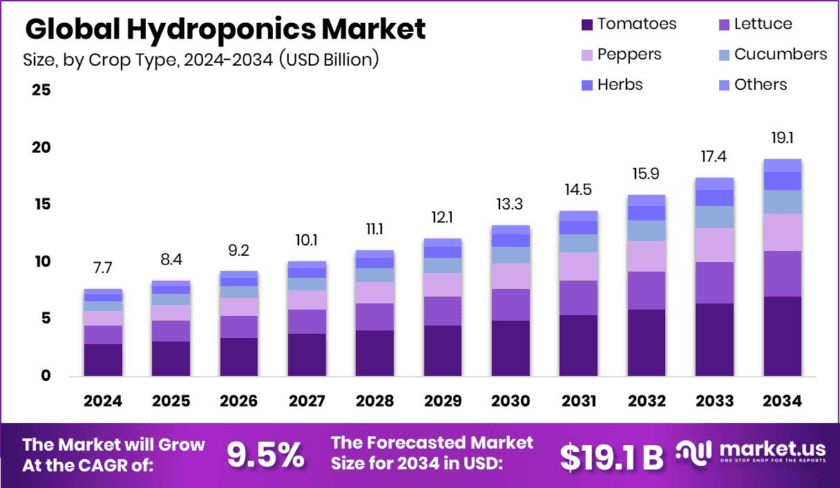
The Global Hydroponics Market reached a value of USD 7.7 billion in 2024. The market will grow to approximately USD 19.1 billion by 2034. This growth represents a compound annual growth rate of 9.5% from 2025 to 2034.
Hydroponics allows farmers to grow crops without soil using nutrient-rich water solutions. This method delivers essential minerals directly to plant roots, enhancing growth efficiency significantly. Consequently, growers can produce food in regions with poor soil conditions or limited arable land.
Urban agriculture and greenhouse operators widely adopt this system for its resource efficiency. Hydroponics saves water, accelerates plant growth, and reduces the need for chemical pesticides. Moreover, this approach supports consistent crop production regardless of outdoor weather conditions.
Rising awareness about food security pushes governments and startups to fund hydroponic projects. For example, a USD 240,000 grant supports agricultural innovation in California’s Imperial Valley. Additionally, Saudi AgriTech startup Arable secured USD 2.55 million in funding for hydroponic expansion.
Changing consumer diets and the preference for fresh, chemical-free produce fuel market demand. Hydroponics enables year-round crop production in urban centers close to consumers. Therefore, as people prioritize quality food with fewer resources, market adoption will continue rising steadily.
Key Takeaways
- The Global Hydroponics Market is expected to be worth around USD 19.1 billion by 2034, up from USD 7.7 billion in 2024, and is projected to grow at a CAGR of 9.5% from 2025 to 2034.
- The Hydroponics Market by type shows Aggregate Systems holding 31.2%, reflecting growing adoption across growers.
- The tomatoes at 36.8% driven by steady consumer demand globally.
- The Hydroponics Market shows dominance of 1000–50000 sq.ft. farms, capturing 56.3%.
- Equipment analysis in the Hydroponics Market indicates LED grow lights leading with a 31.2% share adoption.
- By farming method, the Hydroponics Market strongly favors indoor farming, holding 73.4% of the share.
- Asia Pacific, holding a 38.30% share, generated USD 2.9 billion in revenue in the Hydroponics Market 2024.
➤ Download Exclusive Sample Of This Premium Report (Including Full TOC, Table & Figures)- https://market.us/report/hydroponics-market/request-sample/
Market Segmentation Overview
By Type Analysis
Aggregate Systems led the hydroponics market by type with a 31.2% share in 2024. This system uses inert growing media like perlite, rock wool, and clay pellets for root support. Farmers prefer aggregate systems because they offer cost-effectiveness, ease of use, and suitability for both large-scale and small greenhouse farming.
By Crop Type Analysis
Tomatoes dominated the crop type segment, holding a 36.8% market share in 2024. High consumer demand and consistent worldwide consumption drive this leadership position. Hydroponic systems enable growers to achieve higher yields, better quality, and year-round tomato production compared to traditional soil farming.
By Crop Area Analysis
Farms sized between 1000–50000 sq.ft. captured a dominant 56.3% share in 2024. Commercial growers and mid-scale greenhouse operators prefer this range because it balances production efficiency with manageable operating costs. This segment benefits directly from rising investments in urban and peri-urban farming initiatives.
By Equipment Analysis
LED grow lights secured a 31.2% share of the hydroponics equipment market in 2024. Their energy efficiency, long lifespan, and tailored light spectrums make them ideal for indoor and greenhouse farming. Growers choose LED technology because it reduces energy consumption while supporting optimal photosynthesis and year-round crop quality.
By Farming Method Analysis
Indoor farming dominated the market by method with a commanding 73.4% share in 2024. This method provides complete control over temperature, humidity, and lighting regardless of external climate conditions. Urban areas with limited arable land particularly benefit from indoor hydroponics, especially when combined with vertical farming techniques.
Drivers
Rising Food Demand and Limited Arable Land: Rising global food demand, combined with shrinking arable land, drives hydroponics adoption significantly. Traditional farming depends on fertile soil and favorable weather, both becoming harder to rely on due to climate change and urbanization. Consequently, hydroponics offers a smart solution that uses less space and water while producing higher yields reliably.
Consumer Preference for Fresh, Chemical-Free Produce: Changing consumer diets and the growing preference for fresh, pesticide-free vegetables accelerate market growth. Hydroponics enables year-round crop production in urban setups close to consumption centers. Therefore, as consumers prioritize quality food grown with fewer resources, demand for hydroponically grown crops will continue rising steadily.
Use Cases
Urban Food Production in Limited Spaces: City planners and real estate developers use hydroponics to transform unused indoor spaces into productive farms. High-rise buildings, warehouses, and basements can house vertical hydroponic systems that grow fresh vegetables year-round. This approach reduces transportation distances significantly while ensuring local food security for dense urban populations.
Commercial Greenhouse Operations for High-Value Crops: Commercial growers adopt hydroponic systems to produce high-value crops like tomatoes, peppers, and herbs consistently. Greenhouse operators achieve higher yields and better quality control compared to traditional soil-based methods. Moreover, hydroponic greenhouses operate independently of seasonal changes, ensuring a steady supply to supermarkets and restaurants throughout the year.
Major Challenges
High Initial Setup and Maintenance Investment Costs: High initial setup and ongoing maintenance costs restrain hydroponics market growth significantly. Hydroponic systems require advanced equipment, including grow lights, pumps, nutrient delivery systems, and climate control units. This upfront financial commitment often discourages small-scale farmers and startups with limited budgets from entering the market.
Need for Skilled Labor and Technical Expertise: Hydroponic farming demands skilled labor and technical expertise for successful operation. Growers must monitor nutrient balances, water quality, pH levels, and environmental conditions constantly. Even after installation, operational expenses remain high due to the need for trained personnel, which limits adoption in developing regions with limited access to technical training.
Business Opportunities
Expanding Urban Farming and Vertical Agriculture: Expanding urban farming and vertical agriculture presents a major growth opportunity for hydroponics companies. Cities face rising demand for fresh, local, and pesticide-free food as populations increase. Hydroponics allows growers to turn high-rise buildings and warehouses into productive farms, maximizing yield per square foot through multi-layer vertical systems.
Integration of Smart Technologies and Automation: Integrating smart technologies like IoT sensors, AI analytics, and automated control systems creates significant business opportunities. Farmers increasingly adopt real-time monitoring tools to track water quality, nutrient levels, light intensity, and temperature. Companies that develop user-friendly automation platforms can help growers reduce human error, cut resource waste, and optimize growth cycles profitably.
Regional Analysis
Asia Pacific dominated the hydroponics market in 2024 with a 38.3% share, generating USD 2.9 billion in revenue. Rapid urbanization, limited arable land, and strong government backing for modern farming drive this leadership. Countries like China, Japan, and India invest heavily in hydroponic technology to secure food supply for densely populated cities.
North America follows Asia Pacific closely, with the increasing adoption of controlled environment agriculture. Technological advancements and consumer awareness about sustainable produce fuel market expansion in the United States and Canada. Europe maintains steady growth due to stringent food safety regulations and growing preference for locally sourced, pesticide-free products.
Top Key Players in the Market
- AeroFarms
- AmHydro
- Argus Control Systems Limited
- Emirates Hydroponics Farms
- Freight Farms, Inc.
- BrightFarms.
- Heliospectra
- Signify Holding
- Nutrifresh India
- UrbanKisaan
Conclusion
The global hydroponics market stands at a critical growth stage, driven by rising food demand and shrinking arable land. High initial costs and the need for skilled labor remain significant challenges for market expansion. However, urban farming, vertical agriculture, and smart technology integration offer substantial business opportunities. Companies that develop cost-effective automation solutions will likely capture significant market share as adoption accelerates globally.
Discuss your needs with our analyst
Please share your requirements with more details so our analyst can check if they can solve your problem(s)