Table of Contents
Overview
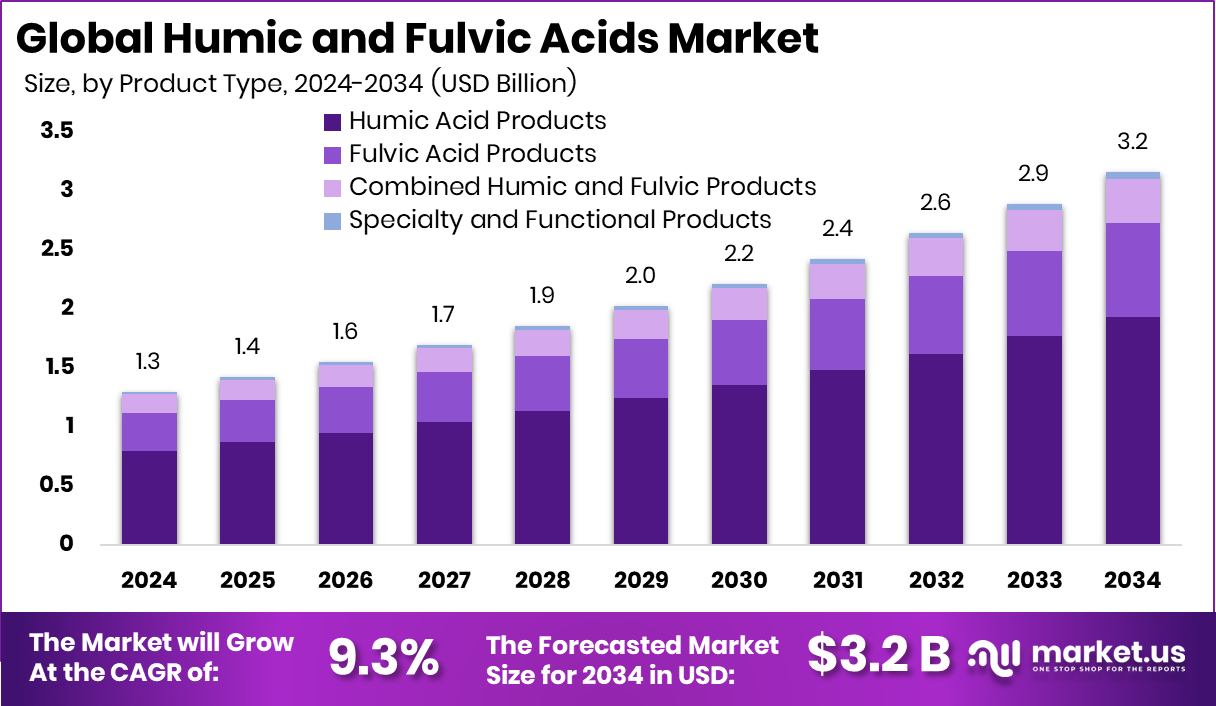
New York, NY – March 24, 2026 – The global humic and fulvic acids market is projected to grow significantly, rising from USD 1.3 billion in 2024 to approximately USD 3.2 billion by 2034, at a CAGR of 9.3%. North America leads the market, holding a 39.9% share and generating about USD 0.5 billion in value.
Humic and fulvic acids are naturally occurring organic compounds formed through the decomposition of plant and microbial matter. They play a vital role in improving soil structure, enhancing nutrient uptake, and increasing water retention, making them essential for sustainable agriculture. As farmers increasingly move away from heavy reliance on chemical fertilizers, the demand for these natural soil enhancers continues to grow, particularly in regions facing declining organic soil content.
These substances are commonly derived from sources such as peat, leonardite, and compost, and are widely used in agriculture, gardening, and land restoration to boost root development and improve plant resilience.
Market growth is driven by the rising adoption of regenerative farming practices. Insights like Dr. Satya Prakash Verma’s example of generating Rs 30,000 from 1 kg of cow dung highlight the growing value of organic inputs. Additionally, expanded mapping of peatlands—now found to cover 13% more area—supports increased raw material availability. Large conservation areas, such as Minnesota’s 6+ million acres of wilderness, further emphasise the importance of soil health and ecological restoration.
➤ Click the sample report link for complete industry insights:https://market.us/report/global-humic-and-fulvic-acids-market/request-sample/
Key Takeaways
- The Global Humic and Fulvic Acids Market is expected to be worth around USD 3.2 billion by 2034, up from USD 1.3 billion in 2024, and is projected to grow at a CAGR of 9.3% from 2025 to 2034.
- In the Humic and Fulvic Acids Market, humic acid products dominate the product type with a 61.2% share globally.
- Within the Humic and Fulvic Acids Market, leonardite and coal-derived sources lead the supply with 59.4% share globally.
- In the Humic and Fulvic Acids Market, field crop applications remain the dominant application segment, holding 54.5% share.
- In North America, the market achieved USD 0.5 Bn with a strong 39.9% share.
➤ Directly purchase a copy of the report – https://market.us/purchase-report/?report_id=174631
Market Segments
By Product Type Analysis
Humic Acid Products dominated the Humic and Fulvic Acids Market with a leading 61.2% share in 2024. Their strong position is driven by widespread use in soil conditioning, nutrient efficiency, and plant stress tolerance. Farmers increasingly prefer humic-based solutions for their ability to improve moisture retention, reduce fertiliser loss, and enhance root growth. Their compatibility with fertigation systems and proven impact on crop yield, especially in large-scale farming, has reinforced their dominance across modern sustainable agriculture practices globally.
By Source Material Analysis
Leonardite and coal-derived sources dominated the Humic and Fulvic Acids Market with a 59.4% share in 2024. These materials are preferred due to their high humic content, reliable extraction quality, and cost-efficient processing. Their consistent supply and purity enable large-scale production of both liquid and granular formulations. As demand rises for carbon-rich and biologically active soil enhancers, manufacturers increasingly rely on Leonardite, making it the primary raw material supporting product consistency, soil fertility improvement, and efficient nutrient absorption worldwide.
By Application Analysis
Field Crop Applications dominated the Humic and Fulvic Acids Market, accounting for 54.5% share in 2024. Their leadership is driven by extensive use in cereals, pulses, oilseeds, and forage crops, where improving soil structure and nutrient-use efficiency is critical. Farmers adopt humic and fulvic inputs to combat declining soil health and rising input costs. These compounds enhance root strength, microbial activity, and stress resistance, making them essential in fertility programs, seed treatments, and foliar applications, thereby securing field crops as the market’s largest segment.
Regional Analysis
North America dominated the Humic and Fulvic Acids Market with a 39.9% share, reaching USD 0.5 billion, driven by strong adoption of bio-stimulants and sustainable farming inputs. Europe maintained steady growth due to expanding organic farming and strict soil regeneration regulations. Asia Pacific showed consistent expansion as farmers increasingly used natural soil conditioners to enhance nutrient efficiency and support intensive agriculture.
The Middle East & Africa experienced gradual adoption, focusing on improving soil structure in arid regions. Meanwhile, Latin America held a stable position, with farmers integrating humic-based products to boost soil fertility and ensure long-term agricultural productivity.
Top Use Cases
- Improving Soil Quality: Humic and fulvic acids are widely used to make soil healthier. They improve soil structure, increase air spaces, and help soil hold more water. This makes it easier for roots to grow and absorb nutrients. They also support beneficial microbes in the soil.
- Better Nutrient Absorption in Plants: Fulvic acid helps plants absorb nutrients more easily by converting minerals into forms plants can use. This reduces fertilizer waste and improves plant growth. It also helps nutrients move inside the plant efficiently.
- Increasing Crop Growth and Yield: Farmers use these acids to boost plant growth and increase crop yield. They support root development, improve plant height, and enhance overall productivity in crops like cereals and vegetables.
- Helping Plants Handle Stress: Humic and fulvic acids help plants survive difficult conditions like drought, heat, and poor soil. They improve plant resistance and help crops stay healthy even under stress.
- Soil Restoration and Land Recovery: These acids are used to restore damaged or poor-quality soils. They improve fertility, reduce soil salinity, and help bring life back to degraded land.
- Reducing Toxins and Heavy Metals in Soil: Fulvic acid can bind harmful substances like heavy metals and toxins, preventing plants from absorbing them. This leads to healthier crops and safer food production.
Notable Company Developments
- In 2024, Bio Huma Netics strengthened its innovation efforts by appointing Dr. Richard Lamar to lead its humic research team. This move helps the company improve product development in soil microbiology, pollution treatment, and humic chemistry. It shows BHN’s focus on advancing science-based solutions for better soil and crop performance.
- In 2024, Grow More, Inc. continued focusing on innovation in agricultural products, especially improving environmentally safe and efficient plant nutrition solutions. The company emphasized developing science-based formulations that support soil health and better crop performance, including products used in sustainable farming systems
- In December 2024, Black Earth Humic LP was acquired by WestMET Group. This deal included Black Earth’s manufacturing facilities and helped combine raw material extraction with finished product production. The goal is to improve product quality, ensure stable supply, and expand humic-based solutions for agriculture and other industries.
Conclusion
The Humic and Fulvic Acids Market is growing steadily as agriculture shifts toward sustainable and soil-friendly practices. These natural compounds play a key role in improving soil health, boosting nutrient efficiency, and supporting stronger crop growth. Increasing awareness about soil degradation and the need for organic inputs is driving their adoption across global farming systems. Strong demand from field crops, reliable raw material sources like leonardite, and regional growth led by North America further support expansion. As regenerative agriculture gains importance, humic and fulvic acids are expected to remain essential for long-term soil fertility and environmentally responsible crop production.
Discuss your needs with our analyst
Please share your requirements with more details so our analyst can check if they can solve your problem(s)