Table of Contents
Market Overview
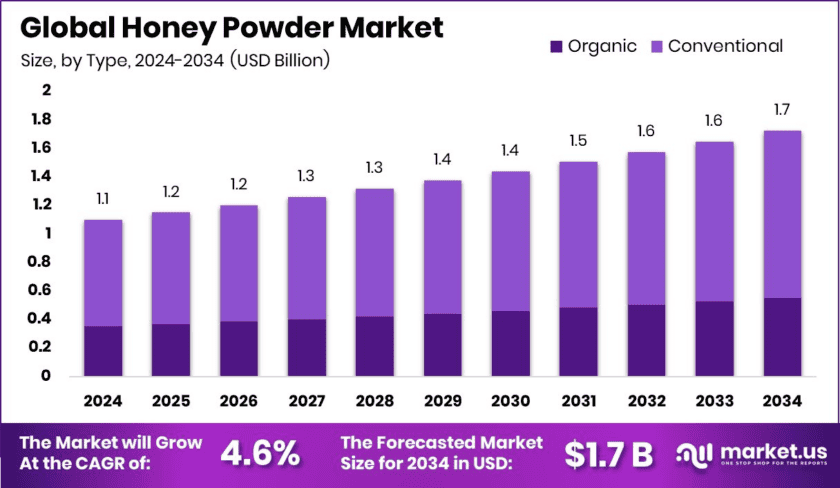
The Global Honey Powder Market continues to expand as food manufacturers seek natural sweeteners. The industry value will rise from USD 1.1 billion in 2024 to USD 1.7 billion by 2034. This growth represents a CAGR of 4.6% from 2025 to 2034. Honey powder consists of dehydrated honey, typically spray-dried onto a carrier material. This process transforms liquid honey into a free-flowing, non-sticky powder that retains honey’s natural flavor.
Global honey production provides a stable supply foundation for this market. The Food and Agriculture Organization reports worldwide honey production of approximately 1.87 million tonnes. Asia contributes about 44 percent of this total, while Europe accounts for roughly 44 percent.
The pollination value chain further supports honey’s market visibility. According to the United States Department of Agriculture, pollinators add approximately USD 18 billion annually to American crop revenue. This economic impact reinforces honey’s importance as both an agricultural product and a food ingredient.
Food, beverage, bakery, confectionery, nutraceutical, and personal care companies represent the primary buyers of honey powder. These manufacturers value the ingredient’s natural sweetness and label-friendly profile. Moreover, honey powder eliminates the handling challenges associated with liquid honey in production environments.
Key Takeaways
- The Global Honey Powder Market will grow from USD 1.1 billion in 2024 to USD 1.7 billion by 2034, reflecting a CAGR of 4.6%.
- Conventional honey powder dominates the market with a 67.9% share, demonstrating strong consumer preference for traditional sources.
- Polarized category products capture 58.3% of the market, indicating growing awareness of specialized honey powder applications.
- Food and beverages lead all applications with a 54.1% share, highlighting honey powder’s nutritional versatility.
- Offline distribution remains dominant at 78.2%, showing consumer reliance on traditional retail channels.
- North America holds a 49.3% market share, valued at USD 0.5 billion in 2024.
➤ Download Exclusive Sample Of This Premium Report – https://market.us/report/honey-powder-market/request-sample/
Market Segmentation Overview
By Type Analysis
Conventional honey powder held a dominant market position in 2024, capturing 67.9% of the total share. This leadership reflects strong consumer preference for traditional honey sources that remain cost-effective compared to organic options. Food and beverage manufacturers favor conventional honey powder for its stable pricing and consistent supply chain.
Large-scale production capabilities enable manufacturers to meet rising demand efficiently. Consequently, conventional honey powder maintains competitive market prices while serving bakery items, nutritional supplements, and other applications. The segment’s dominance continues through established production networks and widespread industrial acceptance.
By Category Analysis
Polarized category products achieved a dominant 58.3% market share in 2024. End users value polarized honey powder for its consistent quality, extended shelf life, and functional versatility across food applications. Manufacturers widely utilize this category in confectionery, bakery, beverages, and health products, where stability matters greatly.
The polarized segment’s growth stems from its ability to maintain honey’s natural sweetness and nutritional benefits. Easy storage and handling properties further reinforce its appeal. Broad industrial usage and reliable availability make polarized honey powder the preferred category across diverse application areas worldwide.
By Application Analysis
Food and beverages dominated the application segment in 2024 with a 54.1% share. Manufacturers extensively use honey powder as a natural sweetener and flavor enhancer in bakery products, confectionery items, beverages, and ready-to-eat meals. The ingredient’s easy blending properties and longer shelf life drive this widespread adoption.
Honey powder retains honey’s nutritional properties while offering superior handling characteristics. Growing consumer demand for clean-label and natural ingredients further supports this application segment’s strength. Therefore, food and beverage applications play a central role in driving overall market growth and meeting evolving consumer preferences.
By Distribution Channel Analysis
Offline channels dominated honey powder sales in 2024 with a 78.2% share. Supermarkets, hypermarkets, specialty stores, and retail outlets provide consumers with direct access to diverse honey powder products. These physical channels benefit from established distribution networks, ensuring a steady supply to end customers.
Consumer trust in physical product inspection and immediate availability strengthens offline channel performance. Attractive in-store promotions and bulk purchasing options further enhance its appeal to different buyer groups. Consequently, traditional retail formats remain highly relevant for purchasing honey powder and other nutritional products.
Drivers
Rising consumer demand for natural sweeteners drives honey powder market expansion. People increasingly avoid artificial sugar and chemical-based sweeteners, choosing honey powder for its health benefits and natural taste. Food manufacturers add honey powder to bakery items, cereals, drinks, and snacks to meet clean-label preferences.
The ingredient’s long shelf life and easy storage make it attractive for large-scale production environments. Supporting this trend, Honey Mama’s closed a USD 4.5 million Series A funding round led by Amberstone Ventures. This investment highlights growing confidence in natural and health-focused sweetener solutions across the food industry.
Major Challenges
High production costs limit broader honey powder market adoption across price-sensitive segments. Converting liquid honey into powder requires advanced technologies like spray drying or freeze drying, which demand significant energy and expensive equipment. Consequently, honey powder costs more than traditional sweeteners such as sugar or corn syrup.
Small food manufacturers and cost-conscious consumers often choose cheaper alternatives despite honey powder’s health benefits. Fluctuations in raw honey availability and prices add further pressure to production expenses. Therefore, high production costs remain a major hurdle for achieving wider market penetration in both developed and emerging economies.
Business Opportunities
Expanding use in health and nutritional products presents a major growth opportunity for honey powder manufacturers. As more people focus on wellness and natural diets, honey powder gains importance as a natural energy source and immune booster. Companies can add honey powder to protein bars, dietary supplements, herbal teas, and functional beverages.
The ingredient retains essential nutrients and antioxidants from natural honey in a more stable powder form. Convenient storage and easy blending into powders and capsules attract health product makers seeking functional ingredients. Consequently, rising consumer spending on nutrition opens strong opportunities for sustained market growth worldwide.
Regional Analysis
North America emerged as the leading honey powder market region in 2024, holding a dominant 49.3% share and generating USD 0.5 billion in revenue. Strong consumer awareness of natural and clean-label ingredients drives demand across food, beverage, and nutritional products. Major players leverage honey powder as a healthier alternative to refined sugar in bakery and supplement applications.
The convenience of powdered honey, including longer shelf life and easy blending, supports industrial and retail adoption. Europe continues expanding steadily with rising demand for functional and organic food products. The Asia Pacific region shows promising growth due to changing dietary habits and an expanding food processing sector across multiple countries.
Top Key Players in the Market
- ADM
- Norevo
- AmTech Ingredients
- Cargill, Incorporated
- Ingredion
- Great American Spice Company
- VedaOils
- Deli Foods
Conclusion
The global honey powder market demonstrates steady growth potential. North America currently leads with nearly half of the total market share, while Europe and the Asia Pacific show promising expansion opportunities. Conventional honey powder and polarized category products dominate their respective segments, reflecting established consumer preferences. Food and beverage applications drive most demand, supported by offline distribution channels that maintain strong consumer trust.
Discuss your needs with our analyst
Please share your requirements with more details so our analyst can check if they can solve your problem(s)