Table of Contents
Overview
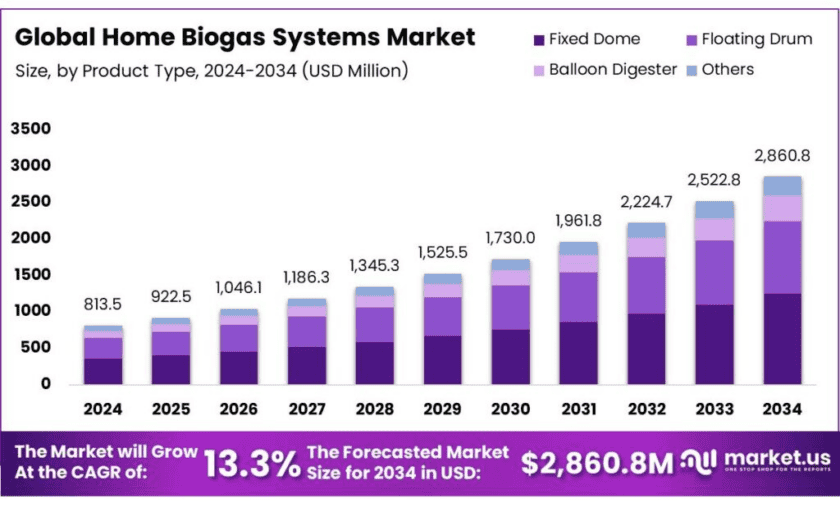
New York, NY – Dec 01, 2025 – The global home biogas systems market is projected to grow from USD 813.5 million in 2024 to USD 2,860.8 million by 2034, registering a CAGR of 13.3% during the forecast period from 2025 to 2034. Asia-Pacific leads the regional market with a 43.8% share, supported by industrial expansion and increasing energy production. Home biogas systems are compact anaerobic digesters designed for households or small farms that convert organic waste into renewable biogas and nutrient-rich digestate. These systems provide a decentralized, circular waste-to-energy solution by reducing organic waste, generating on-site energy, and producing biofertilizer, thereby closing the loop at household or community levels.
The market is fragmented, driven primarily by local and regional suppliers, NGOs, social enterprises, and specialized technology providers. Adoption is strongest in regions with high organic waste production, limited access to clean cooking fuels, strong agricultural linkages, and favorable policy frameworks. China has historically led adoption, with nearly 42 million household digesters installed by 2015 under government programs. In India, the Ministry of New and Renewable Energy (MNRE) launched the National Bioenergy Programme (2021–2026) with an outlay of ₹858 crore, alongside a supplementary budget of ₹140 crore, including ₹50 crore specifically for biogas projects.
Globally, the biogas and biomethane sector shows growing potential, with the International Energy Agency (IEA) estimating that sustainably usable feedstocks could generate nearly 1 trillion cubic metres of natural gas per year without competing with food systems. China continues to dominate in numbers of household and industrial plants, with around 40 million household digesters and over 100,000 large and medium biogas plants, while in energy terms, Germany produces approximately 87 TWh/year and China about 81 TWh/year from biogas. These figures highlight the significant scale of biogas in global energy systems, positioning home biogas systems as complementary solutions to larger industrial plants.
Key Takeaways
- Home Biogas Systems Market size is expected to be worth around USD 2860.8 Million by 2034, from USD 813.5 Million in 2024, growing at a CAGR of 13.3%.
- Fixed Dome held a dominant market position, capturing more than a 43.7% share of the home biogas systems market.
- Animal Manure held a dominant market position, capturing more than a 38.5% share of the home biogas systems market.
- 2–6 Cubic Meters held a dominant market position, capturing more than a 48.2% share of the home biogas systems market.
- Energy Generation held a dominant market position, capturing more than a 34.9% share of the home biogas systems market.
- Asia Pacific region held a dominant position in the home biogas systems market, capturing more than a 47.9% share, valued at approximately USD 389.6 million.
➤ For a deeper understanding, click on the sample report link: https://market.us/report/home-biogas-systems-market/free-sample/
Report Scope
| Market Value (2024) | USD 813.5 Mn |
| Forecast Revenue (2034) | USD 2860.8 Mn |
| CAGR (2025-2034) | 13.3% |
| Segments Covered | By Product Type (Fixed Dome, Floating Drum, Balloon Digester, Others), By Feedstock (Animal Manure, Food Waste, Agricultural Waste, Others), By Capacity (Up to 2 Cubic Meters, 2–6 Cubic Meters, Above 6 Cubic Meters), By Application (Energy Generation, Cooking Fuel, Fertilizer, Residential, Small Farms, Others) |
| Competitive Landscape | HomeBiogas Ltd., Sistema.bio, Flexi Biogas, Puxin Technology Co., Ltd., SEaB Energy Ltd., Green Elephant Engineering Pvt. Ltd., Acr Energy Ltd., Biotech Renewable Energy Pvt. Ltd., True Eco Tech, Agama Biogas, Kingdom Bioenergy Ltd. |
➤ Directly purchase a copy of the report – https://market.us/purchase-report/?report_id=161035
Key Market Segments
By Product Type Analysis: Fixed Dome dominates with 43.7% share in 2024 due to its reliability and long-term usage.
In 2024, Fixed Dome systems held a leading position in the home biogas systems market, accounting for over 43.7% of the total share. This preference is driven by the system’s durable construction, low maintenance requirements, and ability to continuously handle organic waste for biogas production. Fixed Dome digesters are widely installed in rural and semi-urban households, where long-term reliability is essential. The segment is expected to retain its leadership in 2025, supported by government initiatives promoting clean cooking fuels and rural energy access, along with advancements in biogas storage and efficiency.
By Feedstock Analysis: Animal Manure leads with 38.5% share in 2024 due to its high availability and efficiency.
In 2024, animal manure accounted for over 38.5% of the home biogas systems market, emerging as the dominant feedstock. Its widespread availability in rural and semi-urban areas makes it a cost-effective and reliable source for biogas production. Animal manure provides high biogas yield and consistent performance, appealing to households and small farms. The segment’s growth is further encouraged by government programs supporting organic waste utilization and renewable energy generation. It is expected to maintain prominence in 2025 as sustainable energy adoption rises.
By Capacity Analysis: 2–6 Cubic Meters capacity leads with 48.2% share in 2024 due to its optimal size for household use.
In 2024, home biogas systems with 2–6 cubic meters capacity held the largest market share at 48.2%, as this size balances gas output with space requirements, making it ideal for households and small farms. These units efficiently process organic waste, including animal manure and kitchen scraps, producing sufficient biogas for daily cooking and energy needs without excessive investment. Continued government support for household renewable energy initiatives is expected to sustain the segment’s leadership in 2025.
By Application Analysis: Energy Generation dominates with 34.9% share in 2024 due to efficient and sustainable use.
In 2024, the energy generation application segment captured over 34.9% of the home biogas systems market. This segment is driven by the need for clean and reliable energy at household and small farm levels, where organic waste such as kitchen scraps and animal manure is converted into biogas for cooking, heating, and small-scale electricity production. Government programs promoting renewable energy and reducing dependence on conventional fuels support adoption. The segment is expected to maintain its strong position in 2025 as more households embrace sustainable energy solutions.
List of Segments
By Product Type
- Fixed Dome
- Floating Drum
- Balloon Digester
- Others
By Feedstock
- Animal Manure
- Food Waste
- Agricultural Waste
- Others
By Capacity
- Up to 2 Cubic Meters
- 2–6 Cubic Meters
- Above 6 Cubic Meters
By Application
- Energy Generation
- Cooking Fuel
- Fertilizer
- Residential
- Small Farms
- Others
Regional Analysis
Asia-Pacific leads with 47.9% share in 2024, valued at USD 389.6 million, supported by rapid urban growth and rising health awareness.
In 2024, the Asia-Pacific region dominated the home biogas systems market, accounting for 47.9% of the global share, with an estimated market value of USD 389.6 million. This leadership is driven by high rural population density, widespread small-scale farming, and growing organic waste generation, which collectively support biogas adoption. Key countries such as India, China, and Thailand have implemented supportive policies and initiatives to promote renewable energy and waste-to-energy solutions.
In India, the Ministry of New and Renewable Energy (MNRE) launched the Biogas Programme to establish plants for clean cooking fuel, lighting, and small-scale power, reducing greenhouse gas emissions and improving sanitation. Furthermore, the SATAT initiative has encouraged entrepreneurs to set up 80 Compressed Bio Gas (CBG) plants as of November 30, 2024, supplying CBG to Oil Marketing Companies. These measures are expected to continue driving growth in the home biogas systems market across the region.
Top Use Cases
Sustainable Cooking Fuel: Home biogas systems are primarily used to convert organic waste into biogas, which can then be used as cooking fuel. In rural areas, where access to clean cooking fuel can be limited, biogas provides an affordable and eco-friendly alternative. For example, China has supported the installation of biogas plants in rural households for over 40 million homes, providing clean cooking solutions while reducing reliance on traditional, polluting fuels like wood or coal. This is especially important as the World Health Organization (WHO) estimates that indoor air pollution from cooking with solid fuels contributes to over 4 million premature deaths annually.
Waste Management and Reduction: Another key use case is in organic waste management. Home biogas systems convert kitchen waste, animal manure, and agricultural by-products into biogas, reducing the volume of waste sent to landfills. In India, the Ministry of New and Renewable Energy (MNRE) has launched initiatives to reduce organic waste in urban and rural areas, with the target of setting up biogas plants in more than 100,000 homes by 2026. This not only reduces waste but also helps divert organic matter from landfills, where it would otherwise contribute to methane emissions.
On-site Renewable Energy Generation: Home biogas systems are an effective solution for on-site renewable energy generation. Small farms and households can use the biogas for lighting, heating, and even electricity production. In Thailand, biogas systems are being used on small farms to generate electricity for off-grid households, helping communities that are not connected to the national power grid. This has led to reduced energy poverty and increased access to clean energy in rural areas.
Government and Institutional Support for Rural Areas: Governments and international organizations are increasingly supporting home biogas systems, especially in developing countries, to promote clean cooking and renewable energy adoption. For example, the Indian Government’s Biogas Programme and the SATAT initiative have set ambitious targets for biogas adoption, aiming to reduce greenhouse gas emissions and improve rural sanitation. As of 2024, more than 80 Compressed Bio Gas (CBG) plants have been set up in India under the SATAT scheme, producing CBG from organic waste for sale to Oil Marketing Companies.
Carbon Offset and Environmental Benefits: Home biogas systems help reduce greenhouse gas emissions by capturing methane that would otherwise escape into the atmosphere from decomposing organic waste. By using biogas as a renewable energy source instead of fossil fuels, these systems contribute to global decarbonization goals. According to the International Energy Agency (IEA), biogas and biomethane production could offset nearly 1 trillion cubic meters of natural gas per year globally, significantly reducing the need for fossil-based energy sources.
Recent Developments
HomeBiogas Ltd. is a leading provider of home biogas systems, specializing in compact and efficient biogas digesters that convert organic waste into biogas for household use. In 2024, the company continues to expand its global reach, with installations across multiple countries. Their systems are designed to provide sustainable energy solutions for households, particularly in rural or off-grid areas, by converting kitchen waste and agricultural byproducts into biogas for cooking and lighting. The company is focused on promoting clean cooking solutions and reducing carbon footprints by providing a decentralized renewable energy source.
Sistema.bio is a global leader in biogas technology, specializing in the design and installation of modular biogas systems. In 2024, Sistema.bio has made significant strides in emerging markets, particularly in Latin America, Africa, and Asia. The company’s systems are designed for smallholder farmers, allowing them to convert organic waste into renewable energy and organic fertilizer. Sistema.bio’s biogas systems contribute to improved energy access, waste management, and soil health. Their goal is to provide affordable, sustainable energy to underserved communities while promoting a circular economy.
Flexi Biogas specializes in providing modular, scalable biogas systems for households and small businesses. In 2024, Flexi Biogas has expanded its presence in regions such as Asia and Africa, where the demand for affordable, sustainable energy solutions is growing. The company offers flexible and compact units that can be installed easily, turning organic waste into biogas for cooking and energy use. Flexi Biogas’ solutions contribute to cleaner energy access in off-grid communities, promoting sustainability and reducing waste. Their systems have been instrumental in reducing reliance on traditional fuels in rural areas.
Puxin Technology Co., Ltd. is a Chinese company specializing in the development of biogas systems for both urban and rural settings. In 2024, Puxin has continued to grow its market share by offering affordable and efficient biogas solutions that cater to households, farms, and small businesses. Their modular systems convert organic waste into biogas, providing an on-site renewable energy solution. Puxin’s focus on user-friendly technology and the integration of IoT features in their biogas systems has helped position them as a key player in the home biogas market.
SEaB Energy Ltd. specializes in providing small-scale biogas systems for households and commercial applications. In 2024, the company continued to innovate by offering modular, easy-to-install biogas systems that convert organic waste into biogas for cooking and heating. Their technology is designed to be compact and efficient, ideal for urban and rural homes with limited access to renewable energy. The company’s focus on sustainability and waste-to-energy solutions has helped it grow its customer base globally, particularly in regions seeking alternatives to conventional energy sources.
Green Elephant Engineering is a company focused on providing biogas solutions for households and small enterprises. In 2024, the company emphasized environmentally friendly technologies that convert organic waste into biogas, offering an affordable alternative to traditional cooking fuels. Their products are designed to provide reliable, renewable energy while promoting waste management at the household level. Green Elephant Engineering’s solutions are gaining traction, especially in areas with agricultural activities, where waste by-products are abundant and can be effectively converted into energy for cooking and heating.
Acr Energy is a company focused on delivering sustainable energy solutions through biogas technologies. In 2024, Acr Energy continues to develop compact and modular home biogas systems that convert organic waste into biogas for cooking and other energy needs. Their systems are designed for both residential and small commercial applications, providing an affordable and eco-friendly energy alternative. Acr Energy’s products have gained traction in regions with abundant organic waste, promoting waste-to-energy practices and reducing reliance on traditional fossil fuels.
Biotech Renewable Energy specializes in renewable energy solutions using biogas technology. In 2024, the company is expanding its reach by offering biogas systems that process agricultural waste and organic matter to produce clean energy for households and small farms. Biotech’s focus on sustainable energy solutions is helping to meet the energy needs of rural communities, especially those with limited access to conventional power sources. By converting waste into energy, the company plays a role in reducing environmental pollution while providing a renewable source of energy.
Conclusion
Home biogas systems are expected to see significant growth in the coming years, driven by increasing demand for sustainable, decentralized waste-to-energy solutions. The market’s expansion is supported by the growing awareness of renewable energy options, government incentives, and technological advancements in biogas production. Regions with high organic waste generation, such as Asia-Pacific, will continue to lead the market due to favorable policies and large-scale adoption.
As households and small farms seek alternative energy sources, home biogas systems are set to play a key role in enhancing energy security, reducing waste, and contributing to environmental sustainability. Continued governmental and institutional support, combined with improved system efficiency and affordability, will ensure strong growth for this sector in the years ahead.
Discuss your needs with our analyst
Please share your requirements with more details so our analyst can check if they can solve your problem(s)