Table of Contents
Overview
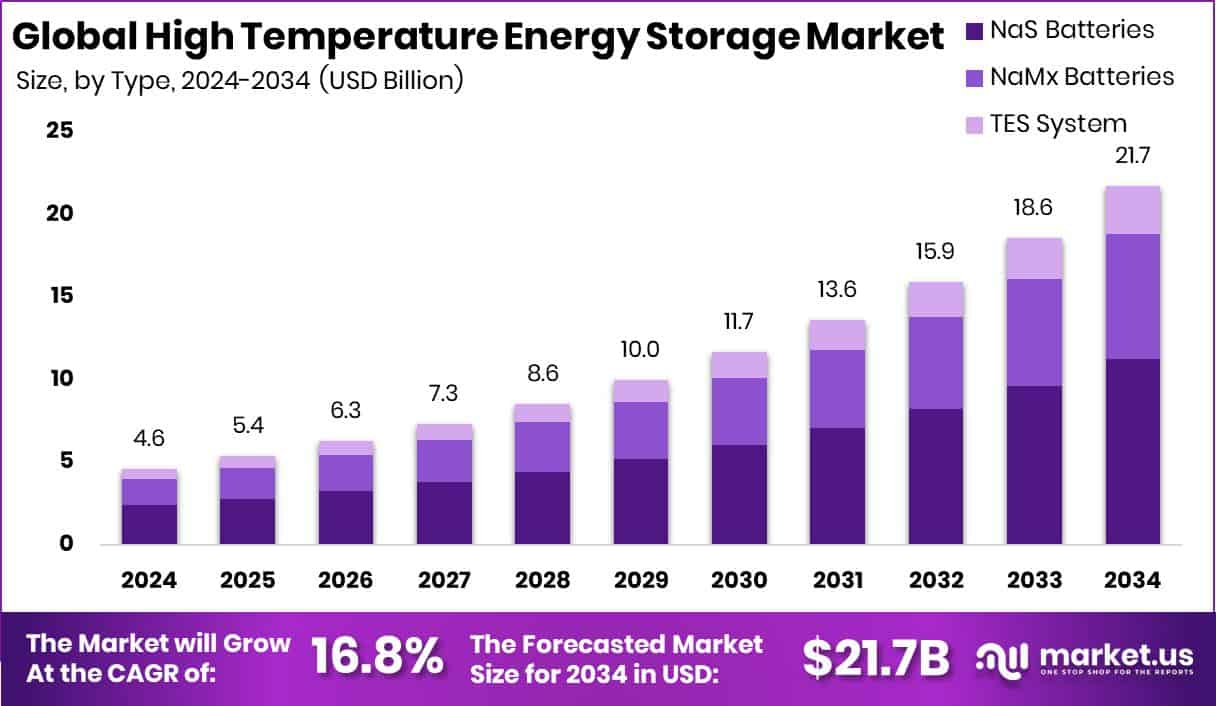
New York, NY – Dec 04, 2025 – The Global High Temperature Energy Storage (HTES) Market is on a strong growth path, projected to reach USD 21.7 billion by 2034, rising from USD 4.6 billion in 2024 and expanding at a 16.8% CAGR between 2025 and 2034. North America leads the market with a 38.9% share, representing about USD 1.7 billion, supported by early adoption of industrial energy storage and clean-energy infrastructure.
HTES systems store energy at very high temperatures using materials such as molten salts, ceramics, thermal oils, and liquid metals. These systems capture surplus heat or electricity and discharge it later as usable thermal or electrical power. They are particularly valuable in applications requiring continuous high-grade heat, including concentrated solar power, steel production, chemical processing, and district heating.
Market momentum is increasing as industries seek reliable alternatives to fossil-fuel-based heat sources. HTES supports energy storage above 500°C, enabling long-duration storage that balances renewable energy variability while supporting low-carbon industrial operations. Molten-salt and thermochemical storage systems are gaining attention due to their scalability and cost efficiency.
Investor confidence is growing, highlighted by Nordic Salt Cycle’s €3.5 million funding, $3 million seed funding for Molten Salt Solutions, and a $2.5 million award for a molten-salt testing facility. These investments accelerate technology validation and commercialization.
Overall, HTES offers efficiency, reliability, and flexibility, making it a practical solution for industries that are hard to abate as they transition toward cleaner energy systems.
➤ Click the sample report link for complete industry insights: https://market.us/report/global-high-temperature-energy-storage-market/request-sample/
Key Takeaways
- The Global High Temperature Energy Storage Market is expected to be worth around USD 21.7 billion by 2034, up from USD 4.6 billion in 2024, and is projected to grow at a CAGR of 16.8% from 2025 to 2034.
- The High Temperature Energy Storage Market benefits from NaS batteries, holding 51.7% due to reliability.
- The High Temperature Energy Storage Market sees molten salt dominating with a 56.2% share globally.
- The High Temperature Energy Storage Market relies on grid load leveling, holding a 35.9% share today.
- In 2024, North America held 38.9% market share worth USD 1.7 Bn.
➤ Directly purchase a copy of the report – https://market.us/purchase-report/?report_id=167088
Report Scope
| Report Features | Description |
|---|---|
| Market Value (2024) | USD 4.6 Billion |
| Forecast Revenue (2034) | USD 21.7 Billion |
| CAGR (2025-2034) | 16.8% |
| Segments Covered | By Type (NaS Batteries, NaMx Batteries, TES System), By Storage Medium (Molten Salt, Sand, Crushed Rocks, Concrete, Others), By Application (Grid Load Leveling, Stationary Storage, Concentrated Solar Power (CSP), District Heating, Others) |
| Competitive Landscape | ABENGOA SOLAR, Siemens, SolarReserve, Bright Source, NGK Insulators, TSK Flagsol, Idhelio, Sunhome |
Key Market Segments
By Type Analysis
In 2024, NaS batteries led the By Type segment of the High Temperature Energy Storage Market, capturing a dominant 51.7% market share. This leadership was driven by their proven ability to function consistently in high-temperature conditions while delivering long-duration energy storage suited for both industrial operations and power grid support. NaS batteries maintained stable output over extended discharge periods, which made them especially effective in regions dealing with variable renewable energy supply.
Their long-standing deployment in demanding thermal environments increased trust among energy-intensive users who require uninterrupted and predictable power. Industries such as manufacturing and grid infrastructure favored NaS systems because they can handle large energy loads without performance degradation at elevated temperatures. The continued reliance on these systems underscores industry confidence in thermal-based electrochemical storage solutions.
By Storage Medium Analysis
In 2024, molten salt emerged as the leading storage medium in the High Temperature Energy Storage Market, accounting for a clear 56.2% market share in the By Storage Medium segment. This dominance was largely due to its ability to safely retain heat at extremely high temperatures while remaining thermally stable for extended storage periods. Molten salt systems proved reliable for applications that require continuous and high-grade heat output.
Industries adopted molten salt storage widely because it supports efficient charging and discharging cycles, helping balance energy supply from renewable sources such as solar power. Its suitability for round-the-clock industrial heat applications further strengthened its adoption across energy-intensive sectors.
The strong 56.2% share highlights industry confidence in molten salt as a dependable and economical thermal storage option. Its predictable thermal performance, long service life, and resistance to degradation under high temperatures positioned molten salt as the preferred and most trusted storage medium within the high-temperature storage landscape.
By Application Analysis
In 2024, grid load leveling led the By Application segment of the High Temperature Energy Storage Market, securing a 35.9% market share. This strong position was supported by the rising challenge of managing power grids affected by the growing share of variable renewable energy. High-temperature energy storage systems helped utilities capture surplus electricity during low-demand periods and release it when demand peaks, improving overall grid stability.
The 35.9% share signaled growing acceptance among grid operators looking for dependable tools to balance energy generation with real-time consumption. Grid load leveling gained preference because it enhanced operational flexibility, eased pressure on transmission infrastructure, and reduced the risk of power imbalances.
By enabling smoother integration of intermittent energy sources, high-temperature storage solutions played a key role in strengthening utility networks. Overall, grid load leveling emerged in 2024 as the most widely adopted application, reflecting its importance in maintaining reliable and efficient power system performance.
Regional Analysis
In 2024, North America led the High Temperature Energy Storage Market, holding a dominant 38.9% regional share and reaching a market value of USD 1.7 billion. This leadership was driven by strong industrial demand in the U.S. and Canada for reliable, high-temperature heat storage systems that support clean energy adoption and flexible power management. Industries increasingly use these systems to improve energy security and optimize renewable energy use.
Europe followed with steady growth as manufacturers adopted thermal storage to enhance process heat efficiency and move away from conventional fuels, aligning with long-term decarbonization goals. Asia Pacific gained momentum as expanding heavy industries sought stable, high-grade heat solutions while preparing for renewable integration.
The Middle East & Africa saw selective adoption for heat-intensive applications, while Latin America progressed gradually through industrial modernization. Despite growing global interest, North America’s 38.9% share and USD 1.7 billion valuation clearly reinforced its market leadership.
Top Use Cases
- Around-the-clock electricity generation from solar power: HTES, especially using molten salt, is widely used in Concentrated Solar Power (CSP) plants. During sunny hours, solar energy heats a fluid (like molten salt), which stores the thermal energy. Later — after sunset or when clouds block sunlight — the stored heat is used to produce steam that drives turbines to generate electricity on demand.
- Seasonal or long-duration storage for renewables and grid balancing: HTES systems (often molten-salt tanks) have been demonstrated to store thermal energy for long periods — even months — with minimal heat losses when well-insulated.
- Industrial process heat — replacing fossil-fuel boilers: High-temperature storage can supply stable, high-grade heat (e.g. 300-600 °C or more) needed in industrial processes such as ceramic drying, mineral processing, chemical manufacturing, or food processing.
- Waste-heat recovery and reuse in heavy industries: In sectors where large amounts of waste heat are generated (steel, cement, chemical, etc.), HTES can capture excess heat and store it for later reuse. This reduces energy waste and lowers overall fuel needs.
- Grid load-leveling and peak-shaving support: HTES can absorb surplus electricity (converted to heat) when supply exceeds demand and discharge it (as electricity or heat) when demand spikes — helping to smooth out fluctuations.
- Flexibility for transition to low-carbon energy systems & hybrid setups: Because HTES can store high-temperature heat from renewables (solar or possibly nuclear) and give back that heat or electricity on demand, it enables hybrid energy systems. For example, combining renewables with long-term, dispatchable storage to offer reliable power or process heat — without relying on fossil fuels.
Recent Developments
- In October 2025, Siemens called for increased investment in power grids, digitalization, and resilience — part of a broader push to modernize energy infrastructure and support flexible storage and demand-side management.
- In May 2025, BrightSource announced a partnership with Doral Energy. Under this deal, BrightSource will deploy its OASES™ Energy Management System (EMS) across Doral’s solar PV + energy-storage projects to improve their overall performance, grid stability, and profitability.
Conclusion
The High Temperature Energy Storage market is gaining strong attention as industries and power systems look for reliable ways to manage heat and energy more efficiently. These systems support continuous operations by storing and releasing energy when needed, making them well suited for renewable integration and industrial heat use. Their ability to operate at very high temperatures helps reduce dependence on conventional fuels and supports cleaner production processes.
As interest in stable and dispatchable energy grows, high temperature storage is becoming an important tool for grid flexibility and energy security. With ongoing technological progress and rising focus on decarbonization, high temperature energy storage is expected to play a meaningful role in future industrial and energy transition strategies.
Discuss your needs with our analyst
Please share your requirements with more details so our analyst can check if they can solve your problem(s)