Table of Contents
Overview
New York, NY – March 09, 2026 – The fruits and vegetables processing sector involves activities such as cleaning, sorting, cutting, freezing, drying, canning, and packaging fresh produce to extend shelf life and improve convenience. These processes help reduce food waste, maintain safety standards, and ensure that fruits and vegetables remain available year-round for households and foodservice providers.
The market surrounding these activities includes processing plants, cold storage facilities, logistics networks, and distribution systems that support the movement and preservation of produce. Government support has played a role in maintaining food availability. For example, Tennessee allocated $5 million in emergency food assistance during a government shutdown that disrupted SNAP benefits, helping maintain access to processed and preserved foods.
Infrastructure investments also highlight the importance of processing capacity. The USDA allocated over $25 million to projects in Iowa to strengthen local processing and storage capabilities. Conversely, funding reductions left a Camden food pantry with 200,000 fewer pounds of food, underscoring how critical reliable processing and supply systems are during disruptions.
Changing dietary habits and demand for convenient, healthy options are also driving interest in processed fruit and vegetable products. Startups and food brands are investing heavily in this area, including $4.65 million raised by Frizata for flexitarian frozen meals and $10 million secured by Kidfresh, with 75% dedicated to brand marketing.
Further opportunities are emerging through financing and innovation. Del Monte Pacific borrowed $500 million to support a food business acquisition, HUNDY! raised $350,000 for frozen fruit products, and Pasarnow secured $3.3 million to modernize Indonesia’s fresh food supply chain and distribution network.
➤ Click the sample report link for complete industry insights: https://market.us/report/fruits-and-vegetables-processing-market/request-sample/
Key Takeaways
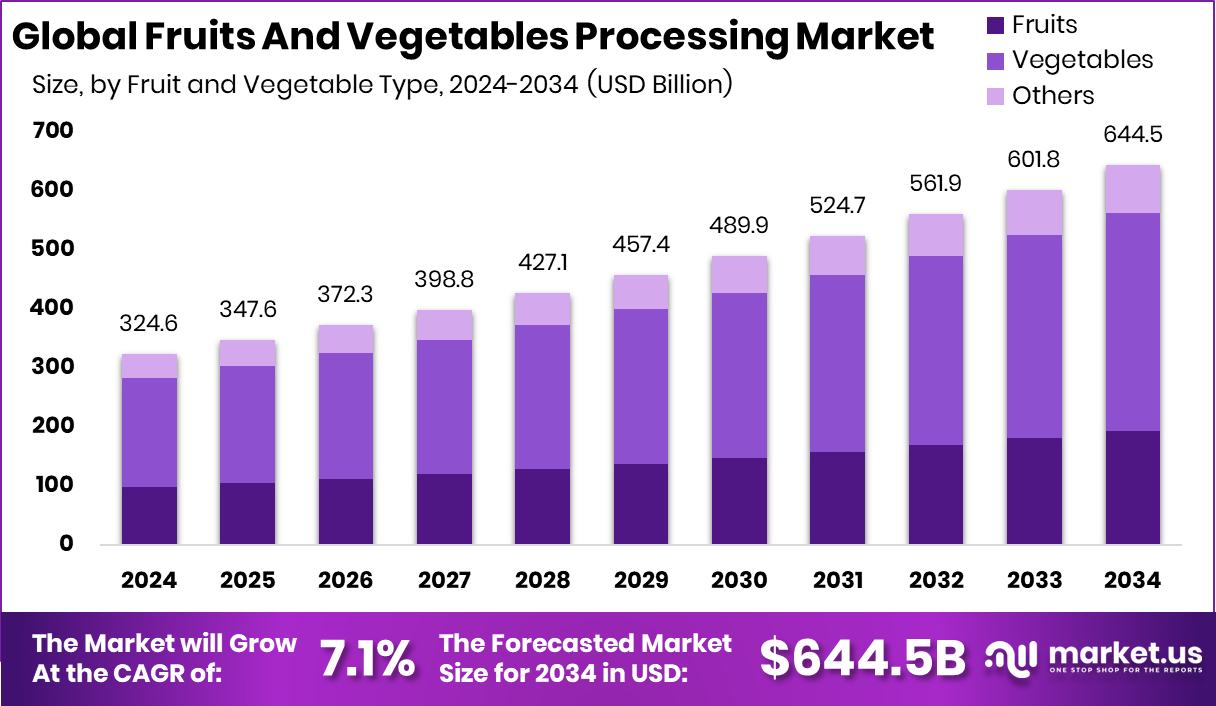
- The Global Fruits And Vegetables Processing Market is expected to be worth around USD 644.5 billion by 2034, up from USD 324.6 billion in 2024, and is projected to grow at a CAGR of 7.1% from 2025 to 2034.
- Vegetables dominate the fruits and vegetables processing market with 57.3% share due to consumption volumes.
- Frozen products hold 27.5% share in fruits and vegetables processing market driven by convenience demand.
- Washing and dewatering equipment leads with 32.7% share, ensuring hygiene and quality compliance standards globally.
- Automatic operation dominates with 67.2% share as processors seek efficiency, labor savings, consistency, and scalability.
- Intermediate scale processing systems account for 67.9% share, balancing capacity investment flexibility for growing processors.
- Asia Pacific dominated Fruits Vegetables Processing Market with 43.6% share USD 142.4 Bn.
➤ Directly purchase a copy of the report – https://market.us/purchase-report/?report_id=174013
Market Segments
By Fruit and Vegetable Type
In 2024, vegetables held a 57.3% share of the Fruits and Vegetables Processing Market, reflecting their strong presence in everyday diets and industrial food production. Vegetables are widely processed into frozen items, ready meals, soups, sauces, and foodservice products due to their short shelf life in fresh form. Increasing urbanization and busy lifestyles boosted demand for pre-cleaned, cut, blanched, and packaged vegetables. Processors expanded efficient production lines for crops such as potatoes, peas, carrots, onions, and leafy greens to reduce post-harvest waste.
Government initiatives supporting cold-chain infrastructure and food processing parks also encouraged higher vegetable processing volumes. Their dominance highlights growing demand for affordable nutrition, year-round availability, and convenient meal solutions for households and foodservice operators.
By Product Type
Frozen products accounted for 27.5% of the Fruits and Vegetables Processing Market in 2024, making them the leading product segment. Freezing helps preserve the texture, color, and nutritional value of produce while significantly extending shelf life without the need for chemical preservatives. This preservation method gained popularity among households, restaurants, and foodservice businesses because it simplifies storage and reduces food waste.
Quick-service restaurants and cloud kitchens increasingly depend on frozen fruits and vegetables for consistent quality and cost control. Technological improvements such as individual quick freezing, have enhanced product quality and minimized freezer burn. Additionally, growing exports of frozen produce supported new processing investments, while urban consumers increasingly rely on frozen products as practical alternatives to fresh produce.
By Equipment Type
Washing and dewatering equipment represented 32.7% of the Fruits and Vegetables Processing Market by equipment type in 2024. This stage is essential because it directly affects hygiene, safety, and final product quality. Processing facilities prioritize removing soil, pesticide residues, and other contaminants before further steps such as cutting or packaging. Modern equipment, including automated washers, bubble washing systems, and centrifugal dewatering machines, helps processors reduce water consumption and labor requirements.
Increasingly strict food safety regulations encouraged companies to upgrade sanitation and cleaning systems across processing lines. Small and medium-sized processors also adopted modular washing equipment to meet compliance standards. The segment’s strong share highlights how proper cleaning and moisture control remain critical for reducing spoilage and maintaining product shelf life.
By Mode of Operation
Automatic processing systems dominated the market in 2024 with a 67.2% share, reflecting the industry’s move toward higher efficiency and reduced labor dependency. Automation allows processors to increase production speed, improve product consistency, and enhance traceability throughout the processing line. Automated systems for sorting, washing, cutting, and packaging reduce direct human handling, supporting stronger hygiene standards and lowering contamination risks.
Although automation requires a higher initial investment, companies benefit from long-term savings through reduced labor costs and lower operational errors. In addition, automated systems integrate with digital monitoring and quality control technologies, helping processors maintain uniform standards. This shift toward automation demonstrates the industry’s effort to scale production while meeting growing domestic consumption and export demand.
By Processing System
Intermediate-scale processing systems accounted for 67.9% of the Fruits and Vegetables Processing Market in 2024, highlighting the importance of mid-sized processing facilities. These systems offer a balance between production capacity, operational flexibility, and cost efficiency, making them suitable for regional processors, cooperatives, and contract manufacturers. Intermediate facilities support diverse product lines, including frozen, dried, and minimally processed fruits and vegetables.
Governments and financial institutions often support this scale through food processing clusters and rural development programs that promote value addition near farming regions. Compared to large industrial plants, intermediate-scale units allow faster setup and easier adaptation to market changes. Their strong presence reflects growing demand for scalable processing solutions that strengthen regional supply chains and distribution networks.
Regional Analysis
Asia Pacific led the Fruits and Vegetables Processing Market with a 43.6% share, valued at USD 142.4 billion, driven by its large population, strong agricultural production, and rising demand for processed foods in urban and semi-urban areas. Expanding cold storage infrastructure and increasing consumption of frozen and minimally processed fruits and vegetables further supported regional growth.
North America represents a mature market supported by advanced processing facilities, strict food safety regulations, and steady demand from foodservice and retail industries. Europe also holds a significant position due to well-organized supply chains, strong quality standards, and consistent demand for packaged produce.
Meanwhile, the Middle East & Africa show gradual growth due to reliance on processed foods where climate affects fresh produce availability, while Latin America benefits from abundant agricultural raw materials supporting processing activities.
Top Use Cases
- Making Frozen Fruits and Vegetables: Frozen processing is widely used to keep fruits and vegetables fresh for a long time. After washing and cutting, they are frozen quickly to slow down microbial growth and chemical changes. This helps preserve the color, taste, and nutrients of the food while extending shelf life. Frozen vegetables like peas, corn, and carrots are commonly used by households and restaurants because they are easy to store and reduce food waste.
- Producing Juices, Pulp, and Puree: Many fruits are processed into products like juices, pulp, puree, jams, and beverages. This helps convert fresh fruits into ready-to-consume items and reduces spoilage during transportation or storage. Fruit pulp and puree are also used by other food industries, such as ice cream, bakery, and confectionery manufacturers. Processing also allows seasonal fruits to be used throughout the year.
- Drying and Dehydrated Products: Drying removes water from fruits and vegetables, which prevents spoilage and microbial growth. Products like raisins, dried mango, and dehydrated vegetables are lighter, easier to store, and have a longer shelf life. Dehydration can be done through sun drying or mechanical dryers and is one of the oldest preservation methods used in food processing.
- Canning for Long-Term Storage: Canning is a process where fruits or vegetables are sealed in containers and heated to kill harmful microorganisms. This method allows foods such as canned tomatoes, beans, or fruits to stay safe and edible for long periods without refrigeration. Canning helps transport produce globally and makes seasonal foods available year-round.
- Improving Food Safety and Shelf Life: Processing techniques like pasteurization, high-pressure processing, and blanching help destroy harmful bacteria and enzymes that cause food spoilage. These methods keep fruits and vegetables safe to eat and maintain their flavor and texture for a longer time. For example, blanching before freezing helps maintain color and quality.
- Reducing Food Waste and Preserving Seasonal Produce: Fruit and vegetable processing helps reduce food waste by preserving surplus produce that might otherwise spoil. Methods such as freezing, drying, or canning allow seasonal harvests to be stored and consumed later. This helps ensure a consistent food supply and reduces losses in the food chain.
Notable Company Developments
- In February 2025, Alfa Laval announced plans to acquire UK-based company NRG Marine, which specializes in ultrasonic anti-fouling technology. This technology uses ultrasonic waves to prevent the buildup of biological materials and deposits on industrial surfaces. By adding this solution to its portfolio, Alfa Laval aims to improve equipment efficiency, reduce maintenance costs, and support more sustainable industrial operations.
- In December 2024, JBT received the final regulatory approvals required to proceed with its acquisition of Marel, a company known for advanced food-processing equipment. The approvals enabled the takeover to proceed, with most Marel shareholders supporting the deal. The merger was designed to strengthen JBT’s global presence in food processing technologies.
- In October 2024, GEA sold its North American mechanical freezing business to Danish company DSI Dantech. The deal included freezer technology, intellectual property, and related services for customers in the region. DSI Dantech also integrated several GEA employees into its operations. The move allows GEA to streamline its business while DSI Dantech expands its freezing technology portfolio used in food processing.
- In October 2024, Syntegon officially completed the acquisition of Telstar after receiving regulatory approval. Telstar’s workforce and technology were integrated into Syntegon’s operations. The combination helps Syntegon offer broader technology solutions and strengthen its position as a global engineering partner for advanced processing and packaging systems.
- In September 2024, Bühler acquired Esau & Hueber, a German company known for hygienic processes and fermentation technology. The acquisition helps Bühler expand its capabilities in food and beverage processing technologies. Esau & Hueber develops advanced processing systems and automation used in fermentation and ingredient production. By integrating this technology, Bühler aims to provide more advanced processing solutions to food manufacturers and strengthen its global technology network.
Conclusion
The fruits and vegetables processing market plays an important role in improving food availability, reducing spoilage, and supporting convenient consumption. Processing methods such as freezing, drying, and packaging help maintain quality while extending shelf life. Growing urban lifestyles and changing eating habits are increasing the demand for ready-to-use and preserved produce. Technological improvements in processing equipment and cold storage systems are also helping companies improve efficiency and maintain food safety standards.
In addition, investments in supply chains and processing infrastructure are strengthening the industry. As consumers continue to seek convenient and nutritious food options, the fruits and vegetables processing sector is expected to remain a key part of the global food system.
Discuss your needs with our analyst
Please share your requirements with more details so our analyst can check if they can solve your problem(s)