Table of Contents
Market Overview
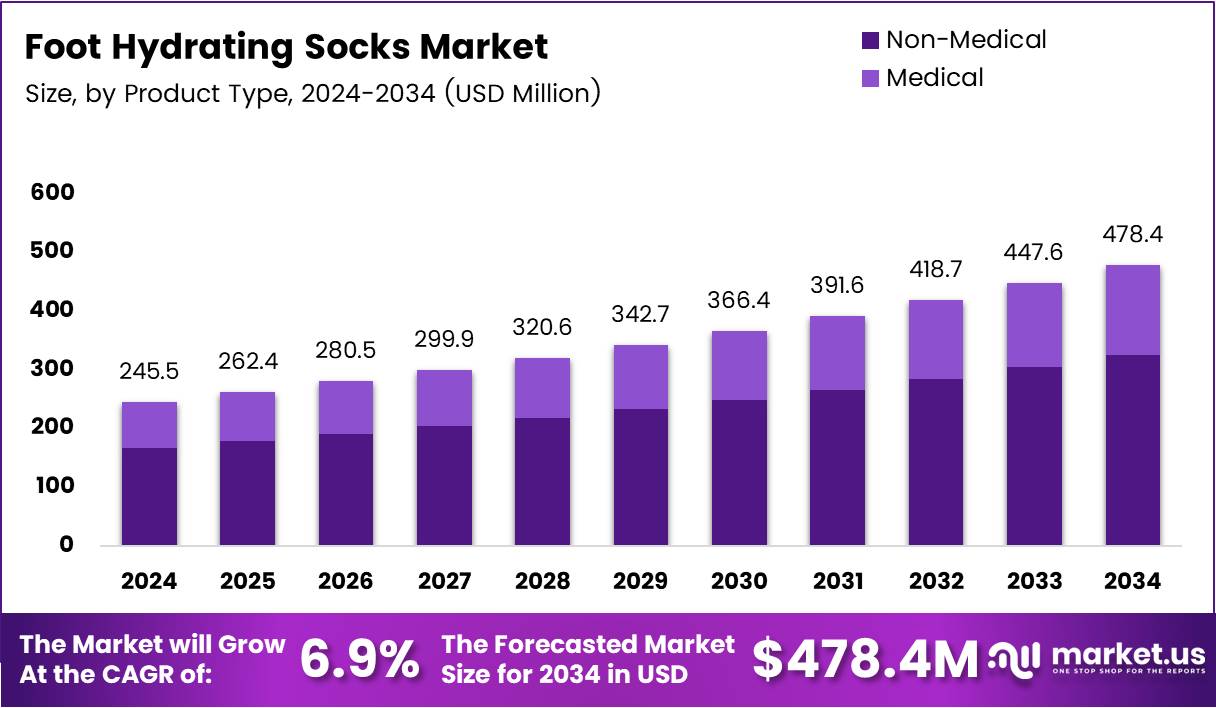
The global foot hydrating socks market is valued at USD 245.5 million in 2024 and is projected to reach USD 478.4 million by 2034. This growth reflects a compound annual growth rate of 6.9% across the forecast period from 2025 to 2034. Rising consumer demand for convenient at-home wellness solutions and growing preventive foot care awareness drive this sustained expansion.
Foot hydrating socks represent an innovative intersection between skincare science and functional textile technology. These products feature gel-lined or serum-infused fabrics that deliver intensive moisture therapy directly to foot skin during wear. They address widespread concerns including cracked heels, calluses, and compromised skin barrier function. Both single-use and reusable formats serve cosmetic and therapeutic consumer needs across retail and clinical channels.
Multiple healthcare and consumer sectors actively drive foot hydrating sock adoption across demographic groups. Diabetic patients use them as preventive care tools recommended by healthcare providers to reduce ulcer and infection risk. Wellness-oriented consumers integrate them into at-home spa-style self-care routines as extensions of broader skincare regimens. Beauty specialty retailers, pharmacies, and e-commerce platforms collectively ensure wide product accessibility across mainstream and premium market segments.
Data-Driven Insights for Smarter Business Decisions: Explore the Full Report
Ingredient and textile innovation continues to reshape product performance and consumer appeal. Manufacturers infuse socks with hyaluronic acid, ceramides, shea butter, and botanical extracts for enhanced moisturizing efficacy. Gel-lined and silicone-based occlusive technologies prevent moisture evaporation during extended overnight wear. These advances support premiumization, enabling brands to justify higher price points with clinically substantiated performance outcomes.
E-commerce transformation has fundamentally democratized access to specialized foot care solutions beyond traditional retail channels. Direct-to-consumer brands use digital marketing, influencer partnerships, and subscription models to educate consumers and drive repeat purchasing. Online platforms provide usage tutorials, peer reviews, and detailed ingredient information that physical retail cannot replicate. This digital infrastructure accelerates consumer discovery and trial, particularly among younger wellness-oriented demographics.
Consumer research confirms the scale of demand driving this market’s commercial opportunity. According to Beauty Matter, 82% of Americans consider wellness a top priority in daily routines. Bread Financial research shows 74% of US consumers prioritize self-care and wellness within their beauty routines. Additionally, a survey of 2,000 US respondents found that 44% feel self-conscious about their feet, creating substantial demand for corrective foot care solutions.
Key Takeaways
- The global foot hydrating socks market will grow from USD 245.5 million in 2024 to USD 478.4 million by 2034, at a 6.9% CAGR.
- North America leads all regions with 43.80% market share, valued at USD 107.5 million in 2024.
- Non-Medical products dominate the product type segment with 74.7% share, driven by broad consumer adoption for cosmetic and preventive foot care.
- Full Length/Knee Length socks lead the length segment with 49.9% share due to superior coverage and enhanced moisture retention during overnight use.
- Women account for 69.5% of the end user segment, reflecting higher beauty and personal care product engagement.
- Retail Stores and Specialty Stores lead distribution with 32.6% share, supported by expert guidance and experiential shopping environments.
- Asia Pacific is the fastest-growing region, powered by K-beauty influence, rising middle-class affluence, and e-commerce dominance.
Market Segmentation Overview
Non-Medical products dominate the product type segment with 74.7% share in 2024. These consumer-oriented products are accessible across retail channels without prescriptions and market primarily on cosmetic benefits including skin hydration, heel softening, and foot aesthetics. Formulations featuring shea butter, vitamin E, and essential oils address everyday dryness and preventive care needs. Consequently, non-medical variants reach the broadest consumer base through mainstream beauty and personal care retail.
The Medical segment serves clinical applications targeting diabetic foot complications, severe dryness, and compromised skin barrier restoration. These pharmaceutical-grade products often require healthcare provider recommendations and undergo rigorous safety testing. Healthcare institutions increasingly adopt them as complementary therapies for patients with circulation or dermatological conditions. Reimbursement policies in select markets support clinical adoption, though higher price points and pharmacy-dependent distribution limit mass-market penetration.
Full Length/Knee Length socks lead the length segment with 49.9% share by providing comprehensive foot and lower-leg coverage that maximizes treatment surface area and moisture retention. Their secure fit prevents slipping during overnight wear and protects bedding from residual product. Ankle Length variants serve daytime users and warmer climates with targeted heel and sole treatment in a compact travel-friendly format. Specialized formats including heel sleeves and toe separators address niche anatomical concerns, driving incremental product differentiation.
Women account for 69.5% of the end user segment, reflecting higher engagement with skincare routines and greater proactive foot care maintenance driven by footwear aesthetics and seasonal visibility concerns. Men represent an emerging growth segment as evolving grooming attitudes encourage comprehensive personal care beyond traditional routines. Athletic and professional male consumers particularly recognize foot health’s connection to performance, recovery, and comfort. Brands increasingly use functional and performance-driven messaging to accelerate male segment adoption.
Retail Stores and Specialty Stores lead distribution at 32.6% through expert staff guidance, product sampling programs, and experiential retail environments that validate product efficacy. Supermarkets and Hypermarkets capture price-sensitive mainstream shoppers through competitive pricing and high-traffic impulse placement. Online channels are growing rapidly, eliminating geographic barriers and enabling discreet purchasing for self-conscious consumers. Pharmacy and clinic channels add therapeutic credibility, particularly for medical-grade variants prescribed for diabetic and elderly patients.
Drivers
The consumer shift toward preventive at-home wellness routines directly fuels foot hydrating sock demand across age groups and demographics. Busy professionals value treatments that fit overnight or relaxation periods without scheduling salon appointments. Home-based foot care delivers salon-comparable results at reduced cost and greater convenience. This behavioral shift aligns with the broader wellness movement where 82% of Americans now consider wellness a top daily priority, according to Beauty Matter.
Growing awareness of foot health among diabetic and aging populations creates sustained and medically supported demand. Healthcare providers actively recommend preventive foot maintenance products to reduce ulcer, infection, and mobility complication risks. Aging demographics worldwide recognize proper foot care as essential to quality of life and mobility preservation. Therefore, both clinical recommendation channels and consumer self-education pathways contribute structurally to long-term market demand growth.
Use Cases
Overnight intensive foot hydration represents the market’s highest-demand consumer application. Users wear full-length gel-infused socks during sleep, allowing active ingredients like hyaluronic acid and ceramides to penetrate deeply without daily routine disruption. Clinical trial data from ZenToes showed 93% of users reported improvement in dry heels following consistent use. This sleep-time application format drives strong repeat purchasing as consumers seek rapid, visible results for persistent cracked heel and dryness conditions.
Additionally, diabetic and elderly patient foot care represents a clinically critical and growing application segment. Medical-grade hydrating socks help prevent skin breakdown, ulcer formation, and infection in patients with compromised circulation and reduced skin integrity. Healthcare institutions and pharmacy channels recommend these products as accessible daily prevention tools. Siren’s USD 9.5 million funding raise in January 2025 — including USD 8 million from Mölnlycke Health Care — underscores the growing investment in technology-enhanced diabetic foot care solutions.
Major Challenges
Limited reusability and the single-use or limited-use nature of many hydrating sock formats create a significant perceived value barrier. Frequent replacement generates higher cumulative costs compared to conventional moisturizing creams applied daily from a single long-lasting container. Budget-conscious consumers in price-sensitive segments often default to established and familiar foot care alternatives. Manufacturers developing washable, multi-use designs can address this concern, but consumer awareness of reusable options remains low across mainstream markets.
However, the extensive availability of substitute foot care solutions creates strong competitive substitution pressure throughout the category. Traditional moisturizing creams, foot masks, and professional pedicure services are well-established alternatives with high consumer familiarity and trusted outcomes. Salon treatments additionally offer experiential and social benefits that functional sock products cannot replicate. Therefore, brands must invest in demonstrable efficacy differentiation and consumer education to motivate switching from deeply habitual foot care behaviors.
Business Opportunities
Advanced ingredient innovation incorporating CBD, botanical actives, retinol, and clinically validated dermatological formulations creates strong premiumization opportunities. Quality-conscious consumers willingly pay higher prices for products that combine luxury spa-grade positioning with measurable, evidence-backed skin improvement outcomes. Brands that achieve dermatologist-tested certifications and publish clinical efficacy data can command significant price premiums. This premium positioning also attracts distribution in specialty beauty retail and pharmacy channels that reinforce therapeutic credibility.
Moreover, growing male grooming adoption substantially expands the addressable consumer base beyond the traditional female-dominant demographic. Younger men and sports enthusiasts increasingly embrace comprehensive personal care routines that include specialized foot treatments. Brands targeting athletic performance, recovery, and functional comfort rather than cosmetic beauty messaging can unlock this nascent segment at scale. Additionally, corporate wellness programs and hotel amenity distribution represent emerging institutional channels that expose new consumer segments to the category for the first time.
Regional Analysis
North America leads the global foot hydrating socks market with 43.80% share and revenues of USD 107.5 million in 2024. High disposable incomes, a mature self-care culture, and extensive beauty retail and e-commerce infrastructure underpin this regional dominance. American consumers demonstrate strong early adoption of innovative personal care products and respond actively to influencer-driven foot care content. Healthcare provider recommendations for diabetic and aging patient populations further support sustained clinical and consumer demand.
Asia Pacific is emerging as the fastest-growing regional market, propelled by K-beauty and J-beauty innovation in textile technology and skincare ingredient delivery. Rising middle-class affluence in China, India, and South Korea accelerates adoption of premium at-home foot care solutions. E-commerce dominance in these markets enables rapid brand scaling and direct consumer education at national scale. Additionally, growing awareness of foot aesthetics and increasing adoption of multi-step beauty routines position Asia Pacific as the most dynamic expansion opportunity through 2034.
Recent Developments
- October 2025 — Curél (Kao Corporation) launched the Curel Boosting Heel Care Socks, expanding its dermatological skincare portfolio into specialized foot care textile solutions targeting dry and compromised heel skin conditions.
- November 2025 — ZenToes Moisturizing Socks featured in a retail promotion backed by clinical trial data showing 93% of users reported improvement in dry heels, reinforcing strong product performance in foot hydration and cracked heel relief.
- June 2025 — ZenToes introduced next-generation compression socks in multiple styles including Basic, Anti-Slip, and Gel versions, expanding innovation within the foot care and comfort sock segment.
- January 2025 — Siren, a US medical technology company, secured USD 9.5 million in funding, including an USD 8 million strategic investment from Mölnlycke Health Care, to advance development and adoption of its temperature-sensing diabetic foot ulcer prevention socks.
Conclusion
The global foot hydrating socks market is on a well-supported growth path driven by preventive wellness culture, aging demographics, and continuous product innovation. A 6.9% CAGR through 2034 reflects durable structural demand across both consumer and clinical market segments. The intersection of advanced textile technology and evidence-backed skincare science continues to strengthen this category’s competitive position within the broader personal care industry.
Non-medical products and full-length sock formats dominate their segments, reflecting strong consumer preference for convenient, comprehensive overnight treatments. North America maintains regional market leadership at 43.80% share and USD 107.5 million in revenues. Asia Pacific adds the greatest forward growth momentum as K-beauty influence, rising incomes, and e-commerce infrastructure combine to accelerate category adoption across emerging economies.
Brands that invest in clinically validated premium formulations, sustainable reusable formats, and male-targeted product lines will capture the greatest share of untapped market opportunity. Closing the consumer education gap through digital content, healthcare provider partnerships, and influencer marketing will accelerate trial and category conversion. The market is projected to reach USD 478.4 million by 2034, and companies that act strategically on these priorities today will define the category’s next decade of growth.
Looking for data tailored to your specific market, region, or business need? Request a custom report or consultation — write to us at sales@market.us
Discuss your needs with our analyst
Please share your requirements with more details so our analyst can check if they can solve your problem(s)