Table of Contents
Overview
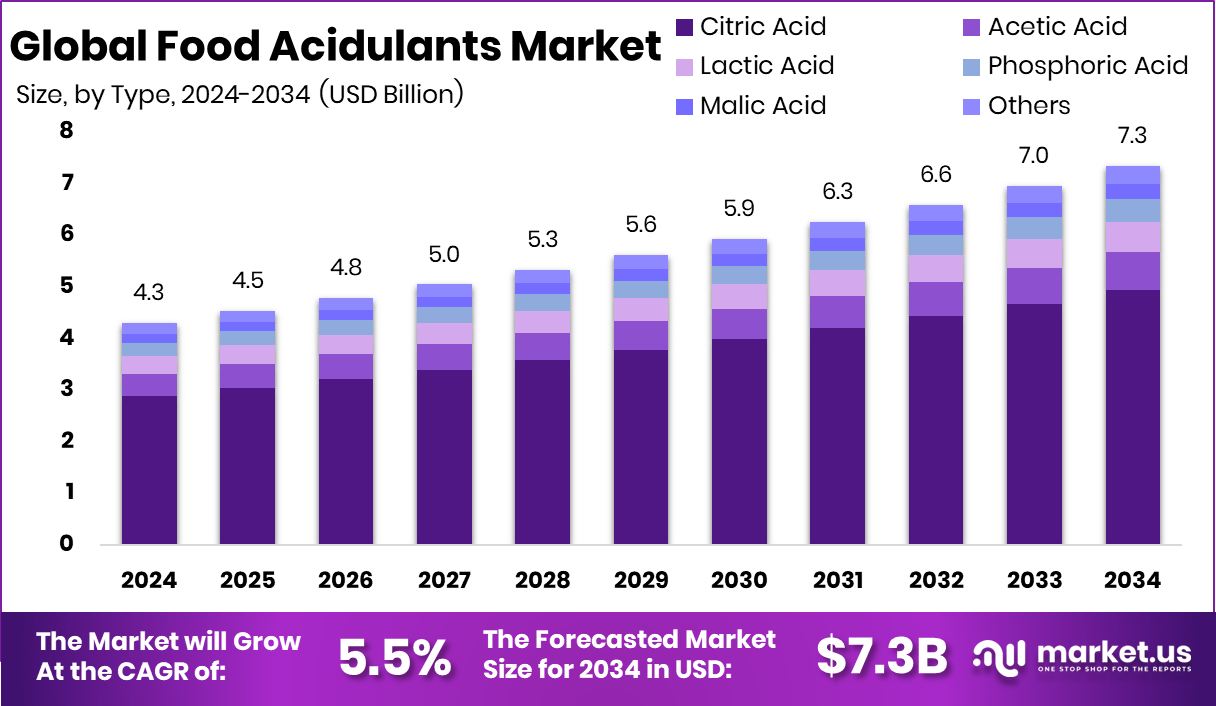
New York, NY – March 03, 2026 – The Global Food Acidulants Market, valued at USD 4.3 billion in 2024, is set to reach USD 7.3 billion by 2034 at a 5.5% CAGR, supported by rising food processing and evolving taste preferences. Asia Pacific, holding a 37.8% share worth USD 1.6 billion, remains the strongest regional contributor due to its fast-growing packaged food and beverage sector. Food acidulants—key for adding tanginess, balancing flavors, and extending shelf life—are now essential across beverages, bakery, confectionery, dairy, and plant-based foods.
Growth is strongly linked to innovations in clean-label and alternative protein foods. Funding activity underscores this momentum: Matr Foods’ USD 23 million investment to scale clean-label mycelium meat shows how modern protein products rely on precise acidity control for taste and safety. Likewise, Nxtfood’s USD 58 million round in 2025 accelerates plant-based meat production, where acidulants help recreate familiar flavors. The cultivated protein segment adds to the opportunity, supported by BSF Enterprise’s USD 20 million raise to scale cultured meat and leather.
Capacity expansion is another catalyst. The Better Meat Co.’s tenfold scale-up through Series A and the sector’s consolidation, such as Fork & Good acquiring Orbillion Bio, highlight strong industry momentum. Together, these advancements create steady and expanding demand for food acidulants across next-generation food categories.
➤ Click the sample report link for complete industry insights: https://market.us/report/global-food-acidulants-market/request-sample/
Key Takeaways
- The Global Food Acidulants Market is expected to be worth around USD 7.3 billion by 2034, up from USD 4.3 billion in 2024, and is projected to grow at a CAGR of 5.5% from 2025 to 2034.
- In the Food Acidulants Market, citric acid dominates by type, holding a 67.2% share globally.
- Powder form leads the Food Acidulants Market, accounting for 69.1% due to easy handling worldwide.
- As a function, flavor enhancer applications command a 49.6% share in the Food Acidulants Market overall.
- Beverages remain the largest application, representing 41.9% of total demand in the Food Acidulants Market globally.
- In Asia Pacific Food Acidulants Market achieved 37.80% dominance, valued at USD 1.6 Bn.
➤ Directly purchase a copy of the report – https://market.us/purchase-report/?report_id=173658
Report Scope
| Report Features | Description |
|---|---|
| Market Value (2024) | USD 4.3 Billion |
| Forecast Revenue (2034) | USD 7.3 Billion |
| CAGR (2025-2034) | 5.5% |
| Segments Covered | By Type (Citric Acid, Acetic Acid, Lactic Acid, Phosphoric Acid, Malic Acid, Others), By Form (Liquid, Powder), By Function (Flavor Enhancer, Microbial Control, pH Control, Preservative, Others),By Application (Bakery and Confectionery, Beverages, Dairy and Frozen Desserts, Meat Industry, Others) |
| Competitive Landscape | Tate & Lyle, Brenntag North America, Inc., Univar Solutions LLC, ADM, Jungbunzlauer Suisse AG, Cargill, Incorporated, Hawkins Watts Ltd., Corbion, Bartek Ingredients Inc., FBC Industries |
Key Market Segments
By Type
Citric acid remained the clear leader in 2024, capturing 67.2% of the food acidulants market thanks to its natural origin, safety, and versatility. It is widely used to balance flavor, extend shelf life, and stabilize formulations across beverages, bakery goods, dairy items, and confectionery. Its strong alignment with clean-label and plant-based trends has further boosted adoption, as brands look for familiar, consumer-friendly ingredients.
Citric acid is also cost-effective and easy to source at scale, making it the preferred choice for both global manufacturers and mid-sized processors. With rising consumption of packaged foods, ready-to-drink beverages, and processed snacks, citric acid continues to dominate acidulant demand worldwide.
By Form
The powder segment held a 69.1% share in 2024, leading the market due to its convenience and long shelf life. Powdered acidulants are favored because they are simple to store, transport, and accurately measure during food manufacturing. They blend smoothly with dry mixes and dissolve easily, which helps improve processing efficiency.
Powder formats also reduce moisture-related spoilage, making them ideal for high-volume production lines. Their extensive use spans bakery mixes, instant drinks, seasoning blends, and confectionery formulations. As companies prioritize operational consistency, reduced waste, and stable ingredient performance, the powder form continues to be the most practical and widely used format in the global food acidulants market.
By Function
Flavor enhancement remained the top function in 2024, accounting for 49.6% of total acidulant use worldwide. Acidulants help manufacturers create sharp, refreshing, and balanced flavor profiles by moderating sweetness, saltiness, and bitterness. This role is increasingly important as brands cut back on sugar and artificial additives while still needing strong taste appeal.
Acidulants also ensure consistent flavor from batch to batch, supporting product reliability for large consumer brands. Their importance is especially high in beverages, confectionery, and savory snacks, where taste directly influences repeat purchases. With the growing demand for flavorful low-sugar drinks and functional foods, flavor enhancement continues to drive global usage.
By Application
Beverages held the dominant 41.9% share of the market in 2024, driven by strong global consumption of soft drinks, juices, energy drinks, and flavored hydration products. Acidulants are essential in beverage formulations because they control pH, enhance tartness, and maintain product stability throughout shelf life. They help preserve freshness, inhibit microbial growth, and deliver the crisp mouthfeel consumers expect.
The rapid rise of ready-to-drink formats, fortified juices, and functional beverages has further strengthened demand for acidulants. As consumers look for refreshing, well-balanced, and better-for-you drink options, acidulants remain a core ingredient supporting flavor, safety, and innovation across the beverage industry.
Regional Analysis
Asia Pacific led the Food Acidulants Market in 2024 with 37.80% share and a value of USD 1.6 billion, driven by strong packaged food consumption, a rapidly expanding processing industry, and rising urban populations. North America maintained steady demand due to its mature food manufacturing base and high usage of acidulants in beverages, bakery, and processed foods. Europe continued to grow with its long-standing processing traditions and strict food-quality regulations.
The Middle East & Africa showed gradual expansion supported by increasing urbanization and retail growth. Latin America also saw rising adoption, fueled by higher consumption of flavored beverages and processed foods. Overall, Asia Pacific remained the dominant region while others exhibited stable, application-led demand.
Top Use Cases
- Balancing Flavor in Beverages and Foods: Food acidulants like citric, malic, and phosphoric acids are added to soft drinks, juices, sauces, and candies to create a tangy, refreshing taste that balances sweetness and improves overall flavor. This helps products taste consistent and appealing to consumers.
- Natural Food Preservation: Acidulants lower pH levels in foods, making the environment less friendly to spoilage bacteria and fungi. This helps extend freshness in products like pickles, processed meats, and ready-to-eat foods without relying solely on artificial preservatives.
- Controlling Acidity (pH Regulation): In many recipes—especially beverages, dairy products, and baked goods—acidulants are used to adjust and stabilize acidity so that the product has the proper texture, taste, and safety level during storage and consumption.
- Enhancing Texture and Processing: Some acidulants can help improve the texture of foods. For example, in meat processing they can tenderize muscle fibers and help proteins bind properly, while in doughs they contribute to proper rise and consistency.
- Supporting Fermented Foods: Lactic acid and similar acids are central to fermented foods like yogurt, sauerkraut, and sourdough. They are produced naturally during fermentation and give these foods their characteristic tang while also helping preserve them.
- Sour Coatings & Snacks: In confectionery and snack products, acidulants (such as malic or citric acids) are used in sour coatings and seasoning blends to create intense tartness that makes sour candies, flavored chips, or snack seasonings more exciting and enjoyable.
Recent Developments
- In November 2024, Tate & Lyle completed the purchase of CP Kelco, a company that makes pectin, specialty gums, and other nature-based food ingredients. This acquisition helps Tate & Lyle broaden its ingredient portfolio beyond sweeteners and acidulants, adding texture and mouthfeel solutions used in beverages, dairy, sauces, and baked goods. The combined business now has more than 5,000 employees and serves customers in over 120 countries.
- In July 2024, Brenntag strengthened its last-mile operations in North America by acquiring assets from Industrial Chemicals Corporation. This move helps Brenntag improve distribution and reach more customers with chemical and ingredient products across the region, especially in sectors like food, beverages, and industrial markets.
Conclusion
The Food Acidulants Market is moving forward steadily as manufacturers focus on better taste, longer freshness, and cleaner ingredient lists. Acidulants remain essential in creating well-balanced flavors across drinks, snacks, dairy, and bakery products while supporting safety and stability in modern food processing. Growing interest in plant-based and functional foods is expanding the use of natural and versatile acidulants in new product lines.
Regions with rising urban lifestyles and higher consumption of packaged foods continue to strengthen overall demand. With ongoing innovation in food ingredients and evolving consumer preferences, acidulants will remain an important part of global food formulation and product development.
Discuss your needs with our analyst
Please share your requirements with more details so our analyst can check if they can solve your problem(s)