Table of Contents
Overview
New York, NY – February 24, 2026 – The global ferrovanadium market, valued at USD 4.7 billion in 2024, is set for steady expansion and is projected to reach USD 8.0 billion by 2034, growing at a 5.4% CAGR. The Asia-Pacific region, holding 43.20% market share and worth USD 2.0 billion, remains the sector’s strongest contributor.
Ferrovanadium—an alloy of iron and vanadium—plays a critical role in strengthening steel used in construction, machinery, vehicles, and industrial infrastructure. As urban development accelerates and economies expand, demand for tougher, lighter, and wear-resistant steel continues to rise, reinforcing the importance of ferrovanadium in global manufacturing chains.
Market momentum is further supported by technological upgrades in steelmaking and greater interest in high-performance materials. The sector also mirrors broader investment trends that accelerate industrial innovation. Examples include Scintil Photonics securing $58M Series B funding to advance silicon photonics and Seemplicity raising $50M to scale its AI-focused platform, highlighting how capital flows toward efficiency-driven technologies indirectly benefit alloy markets.
Additionally, opportunities grow in sustainable production, especially through recycling vanadium-rich wastes. This aligns with larger financial initiatives like China polysilicon companies planning a $7B fund to restructure capacity and Journify raising $4M to expand digital tools. Together, these shifts position ferrovanadium producers for smarter, resource-efficient growth in the decade ahead.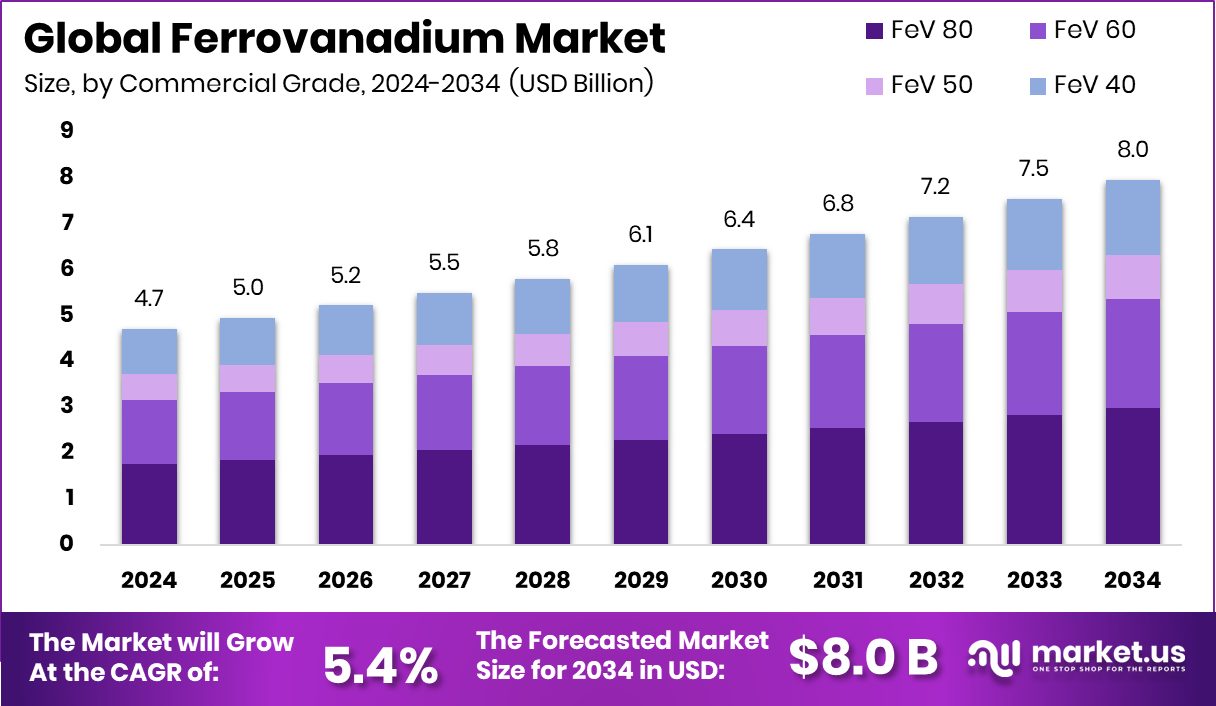
➤ Click the sample report link for complete industry insights: https://market.us/report/global-ferrovanadium-market/request-sample/
Key Takeaways
- The Global Ferrovanadium Market is expected to be worth around USD 8.0 billion by 2034, up from USD 4.7 billion in 2024, and is projected to grow at a CAGR of 5.4% from 2025 to 2034.
- In the Ferrovanadium market, commercial grade FeV 80 dominates demand, holding a 37.4% share globally.
- Within the Ferrovanadium market, aluminothermic reduction leads production processes, accounting for a dominant 67.2% share.
- Construction and rebar steel are the leading end-use segments in the ferrovanadium market, capturing 34.60% share.
- Asia Pacific leads the Ferrovanadium Market at 43.20%, generating USD 2.0 Bn revenue.
➤ Directly purchase a copy of the report – https://market.us/purchase-report/?report_id=173302
Report Scope
| Report Features | Description |
|---|---|
| Market Value (2024) | USD 4.7 Billion |
| Forecast Revenue (2034) | USD 8.0 Billion |
| CAGR (2025-2034) | 5.4% |
| Segments Covered | By Commercial Grade (FeV 80, FeV 60, FeV 50, FeV 40), By Production Process (Aluminothermic Reduction, Silicon Reduction, Others), By End Use (Construction and Rebar Steel, Energy and Pipelines, Automotive and Transportation Steels, Tools, Machinery and Engineering Steels, Aerospace and Defense Alloys, Other) |
| Competitive Landscape | AMG Vanadium, Treibacher Industrie AG, Bear Metallurgical Company, Bushveld’s Vanchem, JFE Materials, Others |
Key Market Segments
By Commercial Grade
FeV 80 held a 37.4% share in the Ferrovanadium Market in 2024, maintaining its lead due to its balanced vanadium content and strong performance in steelmaking. Steel manufacturers prefer this grade because it offers consistent alloying behavior, supports high-quality carbon, alloy, and microalloyed steel production, and improves strength, fatigue resistance, and wear properties. Its stable chemistry helps large steel plants meet strict standards while reducing melting losses and improving yield control.
With global growth in construction, manufacturing, and infrastructure, FeV 80 remains the most practical and cost-efficient commercial grade. Its versatility and reliable performance ensure continued strong demand across both developing and mature steel-producing regions.
By Production Process
Aluminothermic Reduction dominated the market with a 67.2% share in 2024, driven by its efficiency and ability to produce high-purity ferrovanadium. This process offers better control over chemical composition and vanadium recovery, making it ideal for steel applications requiring consistent quality. It is widely favored by medium and small-scale producers because it doesn’t depend heavily on electricity, making it cost-effective in regions with high energy prices.
The method also allows flexible raw material sourcing, especially vanadium pentoxide, while delivering low impurity levels and uniform output. Its proven operational reliability and suitability for diverse industrial needs reinforce its position as the preferred production route among ferrovanadium manufacturers.
By End Use
Construction and Rebar Steel led the ferrovanadium end-use market with 34.60% share in 2024, reflecting strong global infrastructure and urban development activity. Ferrovanadium is essential for strengthening rebar steel, enhancing tensile strength, durability, and load-bearing performance without adding significant weight. This makes it indispensable for high-rise buildings, bridges, transport networks, and seismic-resistant structures. Rebar producers also prefer vanadium because it is cost-efficient compared to alternative alloying elements.
Rising government spending on housing, roads, and public utilities continues to drive demand for high-strength, low-alloy steel. As global construction standards become more rigorous, vanadium-microalloyed steel remains a key material, securing this segment’s dominance in the ferrovanadium market.
Regional Analysis
Asia Pacific leads the global Ferrovanadium Market with 43.20% share, valued at USD 2.0 billion, largely due to its massive steel production base and strong demand for rebar and alloy steels used in rapid urbanization and infrastructure expansion. North America follows with steady consumption driven by replacement needs, strict quality requirements, and widespread use of microalloyed steels.
Europe maintains stable demand through advanced steelmaking technologies and a focus on high-performance structural applications, though growth is moderate. The Middle East & Africa continue to grow gradually, supported by construction and industrial development, while Latin America shows emerging demand tied to selective infrastructure activity.
Top Use Cases
- Making Stronger Steel for Buildings & Bridges: Ferrovanadium is added to steel during production to make the metal much stronger and tougher. This improved steel is used in construction projects like tall buildings, bridges and highway structures where strength and safety are critical.
- Tools & Machinery Parts: When ferrovanadium is added to tool steels, it makes cutting tools, drill bits, and machine parts last longer and resist wear. This means tools don’t break or wear out quickly during heavy use.
- Automobile Components: Car manufacturers use ferrovanadium-alloyed steel for parts such as axles, gears, and crankshafts. The alloy makes these parts stronger without adding much weight, helping vehicles perform better and use less fuel.
- Aircraft & Aerospace Parts: Vanadium-containing alloys are important in aircraft engines and structural parts because they are light yet able to withstand high stress and extreme temperatures.
- Industrial Tools & Heavy Equipment: Ferrovanadium is used to make steels for heavy machines, pump components, and gear systems because it increases resistance to wear and fatigue.
- Pipelines & Pressure-Equipment Steel: In oil, gas, and energy systems, ferrovanadium-enhanced steel helps pipelines, pressure vessels, and industrial equipment handle high pressure, heat, and corrosion, making them safer and more durable.
Recent Developments
- In March 2024, Treibacher Industrie AG marked a major step in building a new Recycling Plant 2 (RC2) at its Althofen site in Austria. Nearly €120 million was invested in this facility, which will recycle spent metal-containing catalysts (including vanadium and other metals). The plant will use waste heat to generate up to 15 % of its own electricity and is expected to begin operations by early 2025. This development supports circular economy goals and increases raw material recovery for ferrovanadium and other products.
- In February 2024, AMG Vanadium acquired a set of processing technologies and intellectual property from Transformation Technologies Inc. (TTI), a U.S. company that specializes in turning waste into reusable materials. This new technology helps AMG improve how it recycles spent refinery catalysts (which contain vanadium) and reduces carbon emissions in the process. The acquisition strengthens AMG Vanadium’s leadership in recycling and adds new know-how to its operations.
Conclusion
The ferrovanadium market continues to strengthen as global industries rely more on high-performance steels that offer better durability and efficiency. Its role in construction, automotive, machinery, and energy systems keeps demand stable across both developed and emerging regions. Growing interest in lightweight materials, cleaner production methods, and sustainable recycling further supports long-term adoption.
Improvements in steelmaking technology and expanding infrastructure projects also help maintain steady consumption. Although pricing can fluctuate with raw material availability, ferrovanadium remains essential for producing stronger, reliable steel. With ongoing industrial growth and rising quality standards, the market is expected to remain resilient and well-positioned for future expansion.
Discuss your needs with our analyst
Please share your requirements with more details so our analyst can check if they can solve your problem(s)