Table of Contents
Overview
New York, NY – March 27, 2026 – The global feed acidulants market is expanding as livestock producers increasingly prioritize safer, sustainable feed solutions. Acidulants—primarily organic acids—are widely used to improve feed hygiene, support animal health, and reduce reliance on antibiotics. This shift is reinforced by advancements in ingredient innovation and clean-label production technologies.
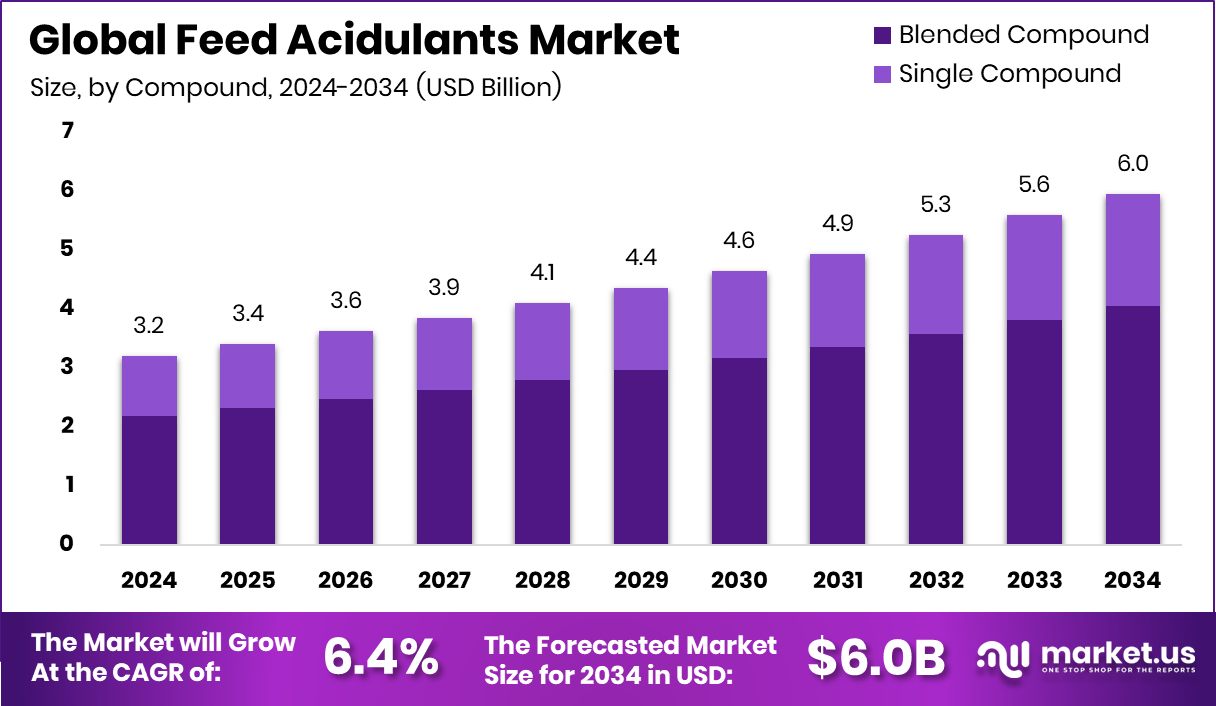
The Global Feed Acidulants Market is expected to be worth around USD 6.0 billion by 2034, up from USD 3.2 billion in 2024, and is projected to grow at a CAGR of 6.4% from 2025 to 2034. The Asia Pacific led with 49.7%, valuing the Feed Acidulants Market at USD 1.5 Bn.
Investment activity across the broader food and chemical sectors is playing a key role in supporting this growth. BioVeritas secured $65 million to advance fermented upcycled ingredients, while Gelesis received a $10.6 million grant to enhance manufacturing processes. These developments contribute to improved feed safety and quality, indirectly driving demand for acidulants.
Further opportunities are emerging through innovation-focused funding. Solidec raised $2 million in pre-seed funding, Avantium received a €3.5 million EU grant for CO₂ conversion, OCOchem secured $5 million for CO₂-based chemical recycling, and Hapi Drinks won a $100,000 PepsiCo grant. These investments show a rising trend towards using sustainable and efficient ingredients that help in the ongoing use of feed acidulants.
➤ Click the sample report link for complete industry insights: https://market.us/report/feed-acidulants-market/request-sample/
Key Takeaways
- The Global Feed Acidulants Market is expected to be worth around USD 6.0 billion by 2034, up from USD 3.2 billion in 2024, and is projected to grow at a CAGR of 6.4% from 2025 to 2034.
- The Feed Acidulants Market grows strongly as propionic acid leads with a dominant 39.6% share.
- In the Feed Acidulants Market, blended compounds hold significant demand, capturing a strong 68.1% portion.
- The Feed Acidulants Market favors dry-form products, which account for a notable 72.4% share.
- pH control remains essential in the feed acidulants market, representing a key 41.2% functional contribution.
- Poultry nutrition drives the Feed Acidulants Market forward, with this animal segment holding a 44.7% share.
- Asia Pacific maintained a 49.7% share, driving the feed acidulant market growth to USD 1.5 Bn.
➤ Directly purchase a copy of the report – https://market.us/purchase-report/?report_id=174891
Market Segments
By Type Analysis
Propionic acid led the feed acidulants market in 2024 with a 39.6% share, mainly due to its strong ability to inhibit mold and extend feed shelf life. It is widely used across poultry, swine, and ruminant diets, especially in humid conditions where spoilage risk is high. Its effectiveness in mycotoxin control, combined with regulatory approval and easy integration into feed formulations, makes it a dependable and cost-efficient choice for maintaining feed quality and safety.
By Compound Analysis
Blended compounds dominated the market by compound type, accounting for 68.1% of demand in 2024. These formulations combine multiple acids to deliver enhanced benefits such as better digestion, improved pathogen control, and greater feed stability. Their customizable nature allows adaptation to different livestock needs and regional conditions. Farmers favor blends for their balanced performance and reduced dosage requirements, making them both efficient and economical while supporting antibiotic-free feeding strategies.
By Form Analysis
Dry acidulants held a leading 72.4% market share in 2024, driven by their practicality in feed production. They are easy to handle, store, and transport, making them ideal for large-scale operations. Dry forms also ensure consistent mixing in compound feed and remain stable under varying temperatures. Additionally, they minimize equipment corrosion compared to liquid alternatives, reducing maintenance costs and improving operational efficiency for feed manufacturers and livestock producers.
By Function Analysis
pH control emerged as the leading function in 2024, capturing 41.2% of the market. Acidulants help maintain optimal digestive pH, which limits harmful bacteria growth and enhances nutrient absorption. This is especially beneficial for young animals with developing digestive systems. Improved gut health leads to better feed efficiency and animal performance. As the industry shifts toward reducing antibiotic use, pH control continues to play a vital role in preventive livestock nutrition.
By Animal Type Analysis
Poultry dominated the feed acidulants market in 2024 with a 44.7% share, supported by intensive farming practices and high feed consumption. Acidulants are essential in poultry diets for improving feed conversion and controlling pathogens like Salmonella. The sector’s fast production cycles demand consistent feed quality and effective gut health management. Increasing global demand for poultry meat and eggs further drives adoption, making acidulants a key component in modern poultry nutrition systems.
Regional Analysis
The Feed Acidulants Market was led by Asia Pacific with a 49.7% share, driven by strong livestock production and high feed demand, especially in poultry and swine. North America showed steady growth with increased focus on gut health, while Europe maintained demand due to strict safety regulations. Latin America expanded with rising poultry exports, and the Middle East & Africa saw gradual growth, supported by improving livestock sectors and the need for feed stability.
Top Use Cases
- Feed Preservation (Prevent Spoilage): Feed acidulants are widely used to keep animal feed fresh for longer. They inhibit the growth of mold, bacteria, and fungi, helping maintain feed quality during storage. This is especially important in humid conditions where feed spoils quickly.
- Control Harmful Bacteria (Improve Feed Safety): Acidulants reduce harmful pathogens like Salmonella and E. coli by lowering the pH of feed. This makes it difficult for dangerous microbes to survive, improving food safety for animals and ultimately humans.
- Improve Digestion in Animals: They help animals digest food better by creating the right acidic environment in the stomach. This activates digestive enzymes and improves nutrient absorption, especially in young animals like piglets and chicks.
- Boost Growth and Feed Efficiency: Animals grow faster and use feed more efficiently when acidulants are added. Better digestion and reduced disease mean animals gain more weight from the same amount of feed.
- Support Gut Health and Immunity: Acidulants promote good bacteria in the gut while reducing harmful ones. This improves gut balance, strengthens immunity, and reduces disease risk without using antibiotics.
- Reduce Antibiotic Use in Farming: Farmers use acidulants as a safer alternative to antibiotics. They help control infections naturally, supporting sustainable and responsible livestock farming practices.
Notable Company Developments
- In 2024, Yara focused on strengthening core operations and optimizing its product portfolio, including feed-related solutions, to improve efficiency and long-term growth.
- In June 2025, Eastman partnered with NutriQuest to expand the Enhanz™ feed additive, improving performance in poultry and swine.
Conclusion
The Feed Acidulants Market is steadily growing as livestock producers focus on safer, more efficient, and sustainable feed solutions. Acidulants play a key role in improving feed quality, controlling harmful bacteria, and supporting animal gut health, making them essential in modern animal nutrition. Rising awareness of feed safety and the shift away from antibiotics continue to drive adoption.
Additionally, advancements in ingredient technology and increasing demand for high-quality animal products support market expansion. With strong usage across poultry, swine, and ruminants, feed acidulants are expected to remain a vital component in enhancing productivity, ensuring food safety, and supporting sustainable livestock production systems globally.
Discuss your needs with our analyst
Please share your requirements with more details so our analyst can check if they can solve your problem(s)