Table of Contents
Market Overview
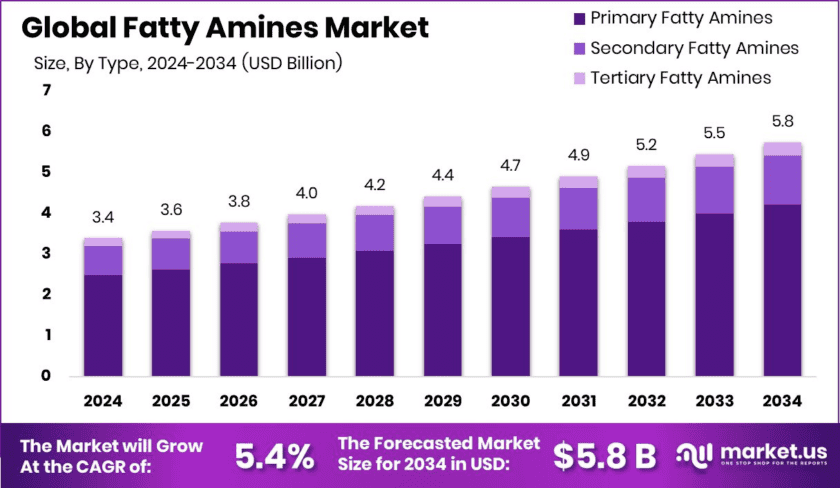
The Global Fatty Amines Market demonstrates strong growth potential. The industry will reach USD 5.8 billion by 2034. This represents a significant increase from USD 3.4 billion in 2024, with a projected CAGR of 5.4% from 2025 to 2034.
Fatty amines are nitrogen-based organic compounds. Manufacturers produce them by reacting natural or synthetic fatty acids with ammonia or alcohols. Their long hydrocarbon tail creates surface-active properties that work as cationic surfactants and emulsifiers across many industrial formulations.
These compounds serve as flotation aids, antistatic agents, corrosion inhibitors, and dispersants. Their versatility makes them essential in agrochemicals, oilfield chemicals, water treatment, personal care, coatings, and plastics. Consequently, demand continues to rise across multiple sectors simultaneously.
Government funding accelerates market expansion noticeably. The USDA’s Fertilizer Production Expansion Program now provides up to $900 million. Recent awards include $83 million in May 2024 and $116 million in December 2024, supporting domestic nutrient inputs.
Steady demand flows from crop protection adjuvants and fertilizer coatings. Moreover, oilfield demulsifiers and corrosion inhibitors, plus cationic coagulants in municipal water treatment, reinforce consistent consumption. The EPA’s Bipartisan Infrastructure Law allocates over $50 billion for water projects, with FY 2025 SRF allotments of $8.9 billion.
Key Takeaways
- The Global Fatty Amines Market is expected to be worth around USD 5.8 billion by 2034, up from USD 3.4 billion in 2024, and is projected to grow at a CAGR of 5.4% from 2025 to 2034.
- The Fatty Amines Market shows strong traction, with primary fatty amine holding a 48.3% share.
- Coco amine leads the product segment at 24.6%, highlighting its wide applications across multiple industries.
- Water softeners remain the top application, securing 26.9% of total market consumption worldwide.
- Agrochemicals dominate end-use demand at 38.5%, reflecting government-backed agricultural and crop protection initiatives.
- Strong demand from agriculture and water treatment boosted the Asia Pacific Fatty Amines Market to USD 1.1 billion.
➤ Download Exclusive Sample Of This Premium Report (Including Full TOC, Table & Figures) – https://market.us/report/global-fatty-amines-market/request-sample/
By Type Analysis
Primary fatty amines held a dominant market position in 2024. This segment captured a 48.3% share of the by-type category. Their extensive use in agrochemicals, water treatment, and oilfield chemicals drives this leadership position effectively.
Their cationic nature makes primary fatty amines effective as emulsifiers, flotation agents, and corrosion inhibitors. Moreover, government-backed funding for sustainable agricultural inputs and water treatment programs ensures reliable consumption levels. This funding support directly reinforces ongoing demand stability.
Versatile chemical properties combined with regulatory support position these amines as the preferred choice. Consequently, primary fatty amines maintain market leadership across multiple end-use industries. Their long-term relevance remains firmly established through consistent performance advantages.
By Product Analysis
Coco amine held a dominant market position in 2024. This product captured a 24.6% share of the by-product segment. Widespread application in water treatment, agrochemicals, and oilfield chemicals explains this leadership.
Coco amine performs effectively as a cationic surfactant and emulsifier. Its natural origin and ability to deliver conditioning, dispersing, and corrosion-inhibiting properties further strengthen adoption. Therefore, multiple industries rely on this specific product regularly.
Government initiatives in agriculture and water treatment funding support this segment’s growth. Consistent demand for efficient chemical solutions drives continued coco amine consumption. With strong end-user reliance and regulatory alignment, this product anchors its preferred position firmly.
By Application Analysis
Water softeners held a dominant market position in 2024. This application captured a 26.9% share of the by-application segment. Fatty amines produce effective softening agents that prevent scale formation and enhance detergent performance.
Increasing investment in municipal and industrial water treatment projects sustains this demand. Government funding programs aimed at upgrading water infrastructure directly support consumption. Consequently, water quality improvement remains a key priority globally.
Fatty amine-based water softeners ensure long-term equipment protection. They also reduce maintenance costs significantly for end users. Rising concerns over water quality, combined with regulatory backing, make this application a key growth driver for the market.
By End-use Analysis
Agrochemicals held a dominant market position in 2024. This end-use segment captured a 38.5% share of the by-end-use category. Fatty amines appear extensively in herbicide formulations, emulsifiers, and adjuvants that improve crop protection efficiency.
Government initiatives boost fertilizer and crop input production. The USDA’s Fertilizer Production Expansion Program reinforces demand for amine-based agricultural solutions. This funding directly supports continued market expansion in the agrochemical sector.
Fatty amines enhance nutrient uptake and improve soil interaction. They also ensure higher crop yields, making them indispensable in modern farming. Sustained support from agricultural funding and pressure to maximize food productivity keep agrochemicals as the leading end-use for fatty amines.
Drivers
Strong demand from the agrochemical sector drives fatty amines market growth. Fatty amines act as adjuvants and emulsifiers in herbicides, pesticides, and fertilizer formulations. Consequently, they improve efficiency and crop yields significantly for farmers worldwide.
Global population rise makes higher agricultural productivity a top priority. Farmers increasingly rely on advanced crop protection products to meet this demand. Government initiatives and funding programs in agriculture, including fertilizer production support, further strengthen consistent demand for fatty amines.
Major Challenges
Environmental concerns and strict regulations limit market expansion. Fatty amines can cause harmful effects if discharged untreated into soil or water. Many countries now enforce tighter rules on chemical usage and waste, increasing compliance costs for producers substantially.
Companies must invest more in cleaner technologies and eco-friendly formulations. Meeting regulatory standards slows immediate market growth despite long-term benefits. Therefore, these restrictions pose challenges for rapid expansion across all regions and applications simultaneously.
Business Opportunities
Expanding water treatment projects create strong growth opportunities. Fatty amines serve as coagulants, flocculants, and scale inhibitors in municipal and industrial water treatment. Rising concerns over clean drinking water and wastewater recycling drive government investment in water infrastructure.
Manufacturers can formulate low-residual, biodegradable amines for stringent discharge limits. The DOE’s Office of Fossil Energy and Carbon Management selected projects totaling nearly $8 million in April 2024 for produced-water treatment. Consequently, collaboration and scale-up paths for advanced amine systems now exist.
Regional Analysis
Asia Pacific dominated the fatty amines market in 2024. This region captured a 34.9% share, worth USD 1.1 billion. A strong agricultural base and expanding water treatment infrastructure drive this leadership position effectively. North America follows with steady consumption supported by advanced oilfield operations.
Europe demonstrates consistent growth owing to strict environmental regulations. The Middle East & Africa benefit from increasing oilfield chemical use, while Latin America shows gradual expansion backed by agricultural demand.
Top Key Players in the Market
- India Glycols Ltd
- Indo Amines Limited
- Global Amines Company Pte. Ltd.
- Huntsman International LLC.
- Solvay
- KLK OLEO
- Evonik
- PT. Ecogreen Oleochemicals
- Kao Corporation
- Nouryon
Conclusion
The global fatty amines market shows steady growth driven by agrochemicals and water treatment. Government funding programs, including USDA allocations and EPA water infrastructure investments, continue supporting market expansion. However, environmental regulations present ongoing challenges for manufacturers globally. Opportunities in biodegradable formulations and water treatment projects offer clear growth paths. Companies that invest in eco-friendly, plant-based fatty amines will likely capture emerging market share.
Discuss your needs with our analyst
Please share your requirements with more details so our analyst can check if they can solve your problem(s)