Table of Contents
Overview
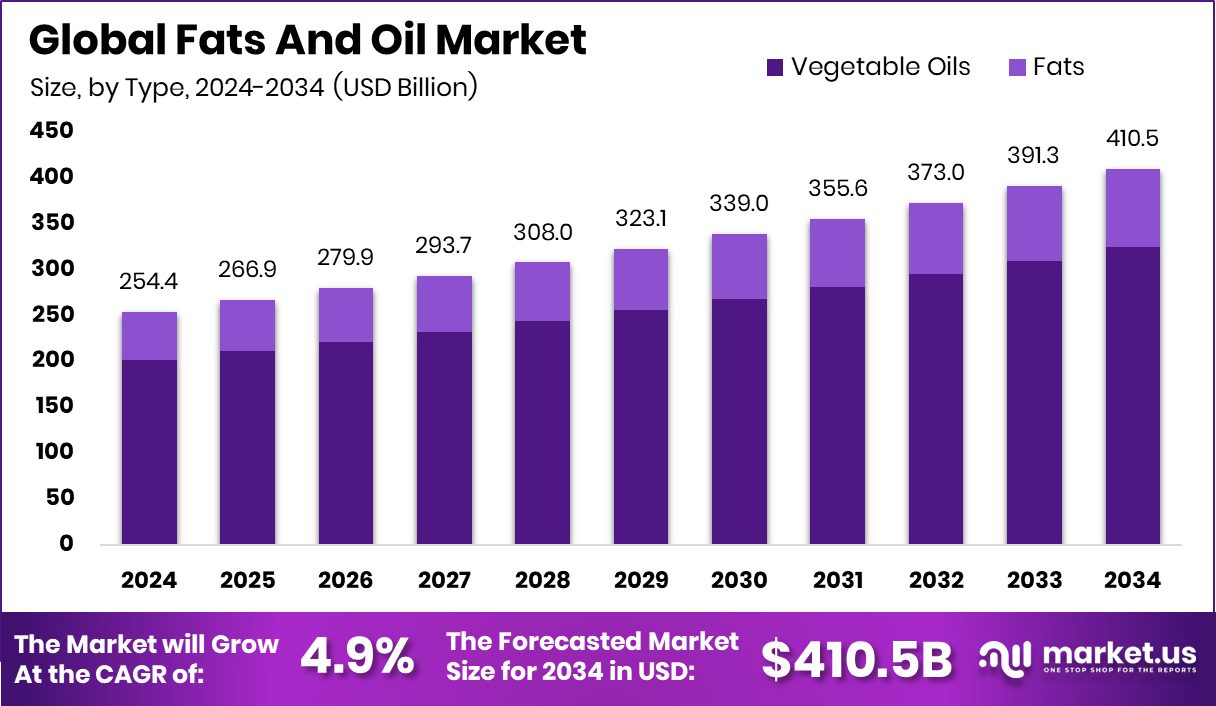
New York, NY – April 02, 2026 – The fats and oils market is expected to be worth around USD 410.5 billion by 2034, up from USD 254.4 billion in 2024, and is projected to grow at a CAGR of 4.9% from 2025 to 2034.
The global fats and oils industry is on a strong growth path, driven by expanding use across food, beauty, pharma, and industrial products. These lipids, sourced from plants such as sunflower, palm, soybean, canola, and coconut, as well as animal fats like butter, tallow, lard, and fish oil, remain essential for energy, nutrient absorption, and product functionality. Beyond cooking, they are increasingly valued as performance ingredients in supplements, cosmetics, and bio-based applications.
Market momentum is being shaped by rising demand for healthier, functional, and more sustainable fat solutions. Consumers are favoring better nutritional profiles, cleaner labels, and environmentally responsible sourcing, encouraging companies to innovate in alternative lipid development. New technologies in fermentation, precision production, and cultivated fats are accelerating this shift.
Investment activity highlights this transformation: Melt&Marble secured €7 million to expand lab-grown fats for skincare, Perfat Technologies raised €2.5 million for advanced food fat innovation, Insempra closed a $20 million Series A to scale sustainable lipid production, and Clean Food Group obtained £2.3 million to speed commercialization of its next-generation fats and oils platform. Together, these developments reflect a market evolving toward smarter, cleaner, and highly scalable fat solutions across multiple industries worldwide with long-term potential for mainstream adoption ahead.
➤ Click the sample report link for complete industry insights: https://market.us/report/fats-and-oil-market/request-sample/
Key Takeaways
- The Global Fats And Oil Market is expected to be worth around USD 410.5 billion by 2034, up from USD 254.4 billion in 2024, and is projected to grow at a CAGR of 4.9% from 2025 to 2034.
- Vegetable oils dominate the fats and oil market, capturing 79.2% due to strong global demand.
- Plant-based sources lead with 83.4% share, driven by rising health awareness and dietary preferences.
- Liquid forms account for 78.3% of market consumption, reflecting convenience and versatile usage trends.
- B2B distribution holds 67.1%, supported by large-scale food processors and industrial manufacturers worldwide.
- Food end-use segment commands 89.9%, making it the primary consumer of fats and oils globally.
- In the Asia Pacific, the market reached USD 108.6 Bn with a 42.70% share.
➤ Directly purchase a copy of the report – https://market.us/purchase-report/?report_id=175282
Market Segments
By Type
Vegetable oils remained the leading type in 2024, holding 79.2% share of the fats and oils market. Their dominance was fueled by strong demand for plant-derived options such as sunflower, soybean, palm, and canola oils. Consumers increasingly preferred these oils for their healthier unsaturated fat profiles, while vegan and plant-forward lifestyles further accelerated adoption. Food manufacturers also favored vegetable oils for packaged foods, bakery products, and ready meals because of their oxidative stability, clean-label compatibility, and cost efficiency. High production availability and broad use across homes, foodservice, and industrial processing solidified their position as the market’s most widely consumed category.
By Source
Plant-based sources led the market with an 83.4% share in 2024, reflecting global movement toward healthier and more sustainable consumption. Their popularity stems from lower saturated fat content and better omega-3 and omega-6 profiles compared with animal fats. Growing vegetarian, vegan, and flexitarian diets significantly boosted demand.
Food, personal care, and biodiesel manufacturers increasingly select plant-derived oils like palm, coconut, soy, and olive because of reliable sourcing, easier regulatory acceptance, and strong supply stability. Their flexibility across multiple applications, including bakery, cosmetics, confectionery, and renewable fuel production, further strengthened the leadership of plant-based fats and oils worldwide.
By Form
Liquid fats and oils dominated with a 78.3% share, driven by their extensive use in frying, cooking, salad dressings, and large-scale food production. Oils such as sunflower, soybean, and olive remained preferred due to easier storage, handling, and compatibility with industrial processing systems. Their role in ready meals, snack manufacturing, bakery formulations, and emulsifiers made them essential for food companies.
Beyond food, liquid oils also gained strong demand in pharmaceuticals and nutraceuticals because of superior absorption and functionality. Rising urban lifestyles and higher demand for bottled, packaged, and convenient cooking oils in retail channels further reinforced the segment’s global market leadership.
By Distribution Channel
The B2B channel captured 67.1% share in 2024, supported by strong demand from food processors, bakeries, restaurants, confectionery brands, and industrial buyers. Large-volume procurement of soybean, palm, and specialty oils increased as companies expanded output of packaged and convenience foods. Growth in the HoReCa sector also boosted demand for frying and cooking oils.
Businesses increasingly depended on long-term contracts with suppliers and distributors to manage price fluctuations and ensure uninterrupted availability. This channel remained crucial for large-scale production efficiency, standardized quality, and consistent supply across both food and non-food industries, making B2B the backbone of fats and oils distribution.
By End Use
Food remained the dominant end-use segment, accounting for 89.9% share of the market in 2024. Fats and oils are indispensable in bakery, confectionery, snacks, frying, cooking, and packaged food products, where they enhance texture, taste, and shelf life. Rising demand for ready-to-eat meals, frozen products, and fast food significantly strengthened this segment.
Household consumption in emerging markets and expanding modern retail networks also supported sustained growth. At the same time, increasing health awareness encouraged demand for fortified oils and low-trans-fat alternatives, prompting leading food manufacturers to reformulate products with healthier lipid ingredients while maintaining flavor and functional performance.
Regional Analysis
Asia Pacific led the fats and oils market with a 42.70% share valued at USD 108.6 billion, driven by strong demand from food processing, household cooking, and large regional manufacturing operations. The region’s dense population, growing packaged food industry, and robust vegetable oil production capacity continue to strengthen its leadership.
North America showed stable growth supported by the rising use of edible oils in processed foods and increasing household preference for healthier oil alternatives. Europe maintained a mature and steady market, with consistent demand for olive, sunflower, and rapeseed oils across retail and industrial sectors.
Meanwhile, the Middle East & Africa saw rising dependence on imported edible oils alongside growth in bakery and confectionery applications. Latin America remained an important emerging region, supported by soybean and palm oil production serving both domestic needs and export markets.
Top Use Cases
- Cooking and Food Making: Fats and oils are mostly used in cooking, frying, baking, margarine, spreads, snacks, and packaged foods. They improve taste, texture, shelf life, and mouthfeel in products like bakery items, frozen foods, and ready meals.
- Cosmetics and Skin Care: Many creams, lotions, lip balms, shampoos, and soaps use fats and oils because they help moisturize skin, improve texture, and create smooth formulations. Coconut, palm, and stearic oils are common here.
- Soap and Detergent Production: Fats and oils are key raw materials in soap making through a process called saponification. They help create foam, cleansing action, and product hardness in soaps and detergents.
- Pharmaceuticals and Supplements: They are widely used in capsules, omega-3 supplements, medicinal creams, and drug delivery systems because oils improve the absorption of nutrients and active ingredients.
- Biofuel and Biodiesel: Vegetable oils, animal fats, and even used cooking oils are converted into biodiesel and aviation fuel, making them important for renewable energy solutions.
- Industrial Products: Fats and oils are used in lubricants, paints, candles, inks, resins, and bioplastics because of their stability and chemical properties.
Notable Company Developments
- In 2025, Wilmar completed the share acquisition, making AWL a Wilmar subsidiary. This gives the company stronger control over Fortune edible oils, soybean oil, sunflower oil, and other kitchen staples sold across India. It is one of Wilmar’s biggest recent fats and oils expansions.
- In 2025, Cargill introduced SimPure® Bright 99406, a new label-friendly starch solution used in creamy dairy desserts and fat-rich formulations. It helps improve texture, creaminess, shelf-life stability, and brighter color performance, making it useful for products where oils and fats are key to mouthfeel and indulgence. This supports Cargill’s value-added fats and texture solutions for food manufacturers.
Conclusion
The fats and oils market continues to show strong long-term potential, supported by its essential role across food, personal care, pharmaceuticals, and industrial applications. Rising demand for healthier edible oils, plant-based ingredients, and clean-label products is reshaping product innovation worldwide. Growth in packaged foods, bakery, convenience meals, and sustainable bio-based applications further strengthens demand.
Companies are increasingly investing in specialty fats, functional lipids, and eco-friendly production technologies to meet changing consumer expectations. With plant-based and liquid oils leading consumption, and Asia Pacific remaining a key growth hub, the market is expected to remain dynamic, innovation-driven, and highly important to both daily use and industrial value chains.
Discuss your needs with our analyst
Please share your requirements with more details so our analyst can check if they can solve your problem(s)