Table of Contents
Overview
New York, NY – March 31, 2026 – Fabrics for wall and ceiling coverings are becoming an essential element of modern interiors, valued for their ability to improve acoustics, add warmth, elevate visual appeal, and support healthier indoor spaces. Demand is rising for solutions made from natural fibers, recycled blends, and advanced engineered textiles that align with sustainability and circular design goals. Market progress is being strongly supported by continued investment in next-generation fiber innovation.
Fiber Elements secured €2.6 million to advance 3D basalt fiber, while Solena raised $6.7 million for next-generation textiles. NFW significantly boosted bio-based material development with $85 million to scale natural material platforms. Further momentum comes from INCA’s $40 million funding for biocomposites and a Finnish startup’s €7.7 million investment to expand sustainable materials globally.
In natural fiber processing, Bast Fibre Technologies raised $3.33 million, while Fibmold secured $10 million for sustainable packaging fibers. IndiNature’s £2 million investment is also accelerating natural fibre insulation growth, reinforcing the wider move toward eco-friendly building materials.
Collectively, these investments are enabling stronger, lower-impact, durable, and aesthetically versatile textile coverings, creating broader opportunities across residential, commercial, and hospitality interiors worldwide as innovation also improves durability circularity comfort and aesthetic versatility across global projects today.
➤ Click the sample report link for complete industry insights: https://market.us/report/fabrics-for-wall-and-ceiling-covering-market/request-sample/
Key Takeaways
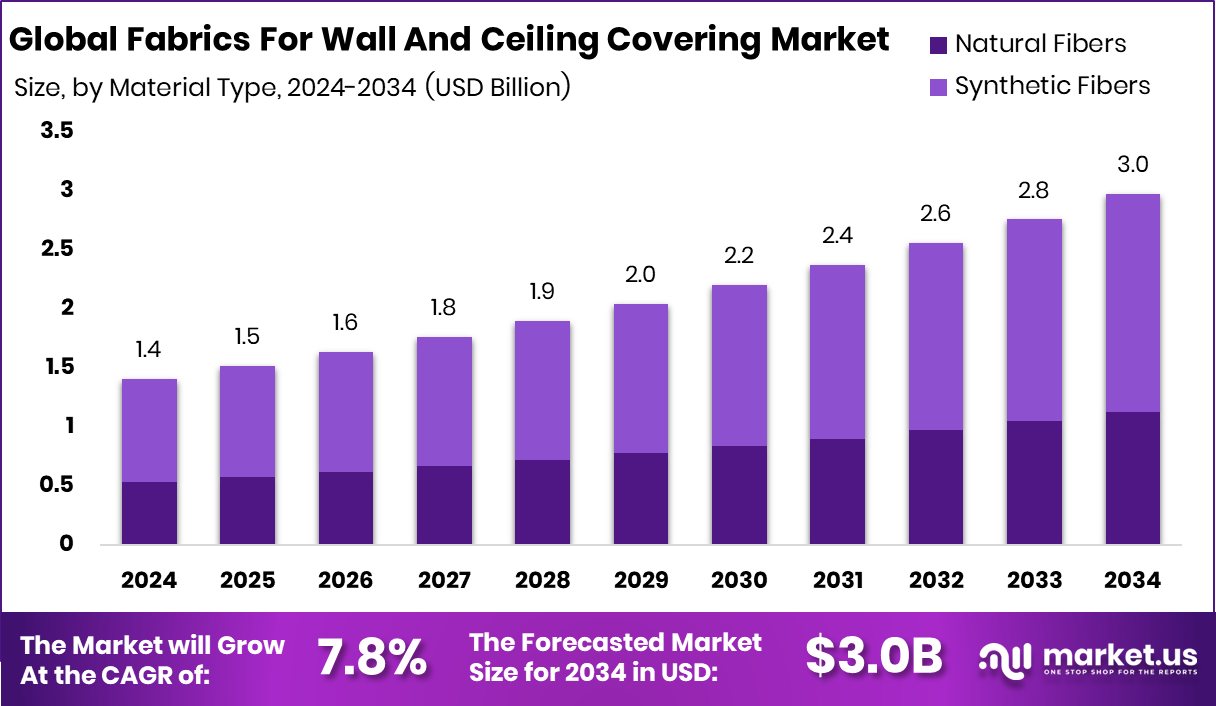
- The Global Fabrics For Wall And Ceiling Covering Market is expected to be worth around USD 3.0 billion by 2034, up from USD 1.4 billion in 2024, and is projected to grow at a CAGR of 7.8% from 2025 to 2034.
- The Fabrics for Wall and Ceiling Covering Market sees synthetic fibers leading with 62.3% dominance.
- Polyester remains the key material in the Fabrics for Wall and Ceiling Covering Market at 39.7%.
- Textile-Based Wall Coverings drive strong demand in the Fabrics for Wall and Ceiling Covering Market with 38.4% share.
- The Fabrics for Wall and Ceiling Covering Market grows as the commercial end-use accounts for 59.2% today.
- Fabrics for wall and ceiling coverings reached USD 0.6 Bn in the Asia Pacific.
➤ Directly purchase a copy of the report – https://market.us/purchase-report/?report_id=175076
Market Segments
By Material Type
Synthetic fibers led the market with a 62.3% share in 2024, driven by durability, moisture resistance, stain protection, and cost efficiency. Their strong performance in high-traffic commercial interiors and renovation projects made them the preferred material choice. Growing use in acoustic applications and flexible design solutions further strengthened demand. Manufacturers also introduced recyclable synthetic variants, improving their appeal in sustainable construction projects and reinforcing their dominance through continuous material innovation and wider application versatility.
By Fabrics
Polyester captured 39.7% of the market in 2024, supported by affordability, lightweight properties, and excellent print quality. Its ability to mimic premium textures at lower installation costs made it highly attractive for interior upgrades. Demand also increased with the rise of digitally printed wall coverings, where polyester delivers sharper, high-definition visuals. Added compatibility with fire-resistant and antimicrobial treatments expanded its use across hospitality, healthcare, offices, and residential décor, strengthening its leadership in modern textile covering applications.
By Application
Textile-based wallcoverings held a 38.4% market share in 2024, driven by demand for premium interiors that combine comfort, acoustic performance, and visual depth. Their tactile appeal made them especially popular in luxury homes, hotels, boutiques, and executive spaces. Rising adoption of soft architecture concepts further boosted demand. Sustainability trends also supported growth, as natural and recycled textile blends gained traction, helping designers deliver customizable, eco-friendly decorative solutions for sophisticated modern interior environments.
By End-use
The commercial segment dominated with a 59.2% share in 2024, fueled by upgrades across hotels, offices, retail stores, and public infrastructure. Businesses increasingly adopted fabric coverings to improve acoustics, strengthen brand aesthetics, and create engaging customer environments. Demand also rose from modern workspaces and experiential retail concepts that required customizable textures and colors. Preference for fire-retardant, antimicrobial, and durable materials ensured long-term value, while ongoing renovation cycles and hospitality expansion sustained strong segment leadership.
Regional Analysis
Asia Pacific led the Fabrics for Wall and Ceiling Covering Market with a 45.8% share valued at USD 0.6 billion, driven by strong construction, commercial expansion, and refurbishment demand. North America followed with steady renovation-led demand for premium interiors, while Europe maintained stable growth in durable decorative fabrics. The Middle East & Africa gained traction through hospitality and infrastructure projects, and Latin America saw moderate adoption supported by cost-effective, visually appealing textile-based interior solutions.
Top Use Cases
- Office Noise Control: Fabric wall and ceiling coverings are widely used in offices to reduce echo and background noise. They improve speech clarity, support focus, and create a more comfortable workspace. Acoustic polyester, wool, and recycled PET fabrics are common choices.
- Hotels and Luxury Interiors: Hotels use decorative fabrics on walls and ceilings to add warmth, elegance, and better sound comfort in rooms, lobbies, and lounges. Velvet, linen, and textured textiles help create a premium guest experience.
- Home Theaters and Media Rooms: These fabrics help absorb sound reflections, making voices, music, and movie audio clearer. They are often installed behind decorative panels or stretched across ceilings.
- Healthcare and Wellness Spaces: Hospitals, clinics, and therapy rooms use antimicrobial and low-VOC textile coverings to reduce noise and create calm healing environments.
- Schools and Libraries: Fabric coverings improve concentration by lowering classroom and library noise levels. Ceiling panels and wall textiles help students hear clearly and reduce distractions.
- Eco-Friendly Green Buildings: Sustainable projects use hemp, wool, flax, cork, and recycled PET fabric systems for both acoustic comfort and lower environmental impact.
Notable Company Developments
- In March 2025, Tepastex expanded its waterproof and multi-layer technical fabric range for interior and architectural use. The new focus on UV-resistant, flame-retardant, breathable, and fade-resistant textiles improves durability, moisture control, and acoustic comfort, making these fabrics ideal for wall panels, ceiling systems, and hospitality interior applications.
- In February 2025, Marmot Mountain, LLC expanded its advanced fabric technology with improved weather protection, insulation, durability, and moisture resistance across new apparel lines. These high-performance textile innovations also support wall and ceiling coverings requiring acoustic comfort, thermal insulation, and long-term durability, strengthening sustainable and functional interior fabric material applications.
Conclusion
The Fabrics for Wall and Ceiling Covering Market is growing steadily as demand rises for interiors that combine aesthetics, acoustic comfort, durability, and sustainability. Increasing use in commercial spaces, hospitality, offices, and premium homes continues to drive adoption. Innovations in synthetic fibers, polyester, recyclable textiles, and high-performance coated fabrics are expanding applications further. With strong interest in eco-friendly and functional interior materials, the market is well positioned for long-term global growth and design-led innovation.
Discuss your needs with our analyst
Please share your requirements with more details so our analyst can check if they can solve your problem(s)