Table of Contents
Overview
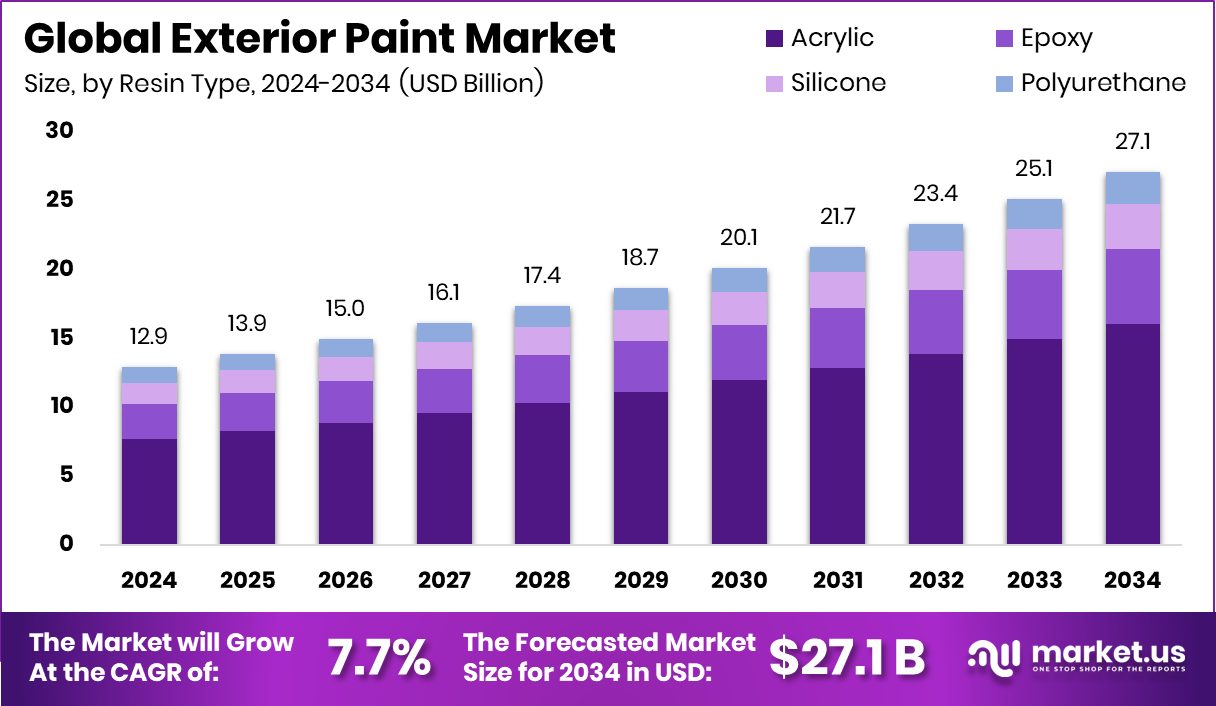
New York, NY – March 16, 2026 – The global exterior paint market is projected to grow significantly, reaching approximately USD 27.1 billion by 2034, compared to USD 12.9 billion in 2024, reflecting a CAGR of 7.7% from 2025 to 2034. The Asia Pacific region leads the market, accounting for 44.2% of the share and generating about USD 5.7 billion in revenue.
Exterior paint is a specialized coating applied to the outer surfaces of buildings, including walls, facades, and external fixtures. It serves both protective and aesthetic purposes, helping structures withstand environmental conditions such as rain, sunlight, heat, humidity, and pollution. These paints are engineered to resist cracking, fading, moisture penetration, and other forms of surface deterioration caused by long-term exposure.
The market reflects the overall supply and demand for exterior coatings across residential, commercial, and public infrastructure projects. Its growth is closely connected to housing construction, renovation activities, and government programs focused on building maintenance. Because buildings require periodic repainting to preserve durability and appearance, repainting cycles consistently support market demand.
Public and private investments in housing maintenance play a major role in driving consumption. For instance, homeowners in Euclid can access up to USD 7,500 through Community Development Block Grant funding for property improvements, including exterior painting. Additionally, lawmakers requested USD 50,000 for an emergency repainting project for military family housing, demonstrating how public housing upkeep contributes to paint demand.
Further demand is supported by real estate investment and infrastructure upgrades. Broad Creek Capital launched a USD 150 million fund targeting property-related developments that include exterior improvements. Meanwhile, innovation and industry expansion are gaining momentum through new funding initiatives. Ecoat secured €21 million to develop sustainable paint technologies, while a planned ₹9,000 crore buyout financed through structured funding and promoter stake pledges highlights strong long-term confidence in the paint industry’s growth.
➤ Click the sample report link for complete industry insights: https://market.us/report/global-exterior-paint-market/request-sample/
Key Takeaways
- The Global Exterior Paint Market is expected to be worth around USD 27.1 billion by 2034, up from USD 12.9 billion in 2024, and is projected to grow at a CAGR of 7.7% from 2025 to 2034.
- In 2024, acrylic resins dominated the Exterior Paint Market with 59.4% share, ensuring durability performance.
- Water-based products led the Exterior Paint Market at 82.9%, driven by regulations, safety, and sustainability demand.
- Residential applications captured 65.3% of the Exterior Paint Market, supported by housing growth worldwide trends.
- In the Asia Pacific, rapid urbanization and housing demand supported 44.2% market share, reaching USD 5.7 Bn.
➤ Directly purchase a copy of the report – https://market.us/purchase-report/?report_id=174327
Market Segments
By Resin Type Analysis
In 2024, acrylic resins held the leading position in the exterior paint market, accounting for 59.4% of total demand. Their dominance is largely due to strong adhesion, excellent color retention, and high resistance to UV rays and moisture. These characteristics make acrylic-based paints highly reliable in different weather conditions, including heat, rainfall, and humidity.
Acrylic coatings are widely used across residential and commercial buildings because they help maintain the surface appearance for longer periods and reduce the need for frequent repainting. Increased construction activities and renovation projects in 2024 further supported the widespread adoption of acrylic resins, particularly for surfaces such as concrete, masonry, and exterior walls.
By Product Type Analysis
In 2024, water-based paints dominated the exterior paint market with an 82.9% share. Their popularity is driven by lower volatile organic compound (VOC) emissions, easier application, and faster drying compared with solvent-based alternatives. Water-based coatings also align well with environmental regulations and green building standards, encouraging their adoption worldwide. Homeowners and contractors prefer these products because they produce minimal odor and are simple to clean after application.
Continuous technological improvements have enhanced their durability, weather resistance, and color stability, making them suitable for a wide range of exterior surfaces. As a result, water-based formulations have become the preferred option for most exterior painting applications.
By Application Analysis
The residential sector led the exterior paint market in 2024, capturing 65.3% of total consumption. Demand from this segment remained strong due to ongoing housing construction, renovation activities, and routine repainting cycles required to maintain building exteriors. Exterior paints are widely used to protect homes from weather exposure while improving their visual appearance.
Rapid urbanization, rising disposable income, and growing awareness of home maintenance also contributed to higher residential paint usage. Homeowners increasingly favor coatings that provide longer durability, improved moisture resistance, and heat-reflective performance. These preferences have strengthened the residential segment’s leading role in driving global demand for exterior paint products.
Regional Analysis
The Asia Pacific region led the exterior paint market, holding 44.2% of total demand and reaching USD 5.7 billion, driven by strong residential construction, rapid urbanization, and consistent repainting activity. Expanding housing stock and climate-related maintenance needs further strengthened regional consumption.
North America remained a stable and mature market, where demand is mainly supported by renovation cycles and routine repainting of existing homes, with homeowners focusing on durability and weather protection. Europe experienced steady growth due to the refurbishment of older buildings and the need for coatings that provide moisture resistance and long-term protection in varied climates.
The Middle East & Africa market was influenced by housing development and the need for paints that withstand heat and dust. Latin America saw moderate demand driven by residential construction and housing maintenance.
Top Use Cases
- Protecting Buildings from Weather: Exterior paint is widely used to protect buildings from harsh weather conditions like rain, sunlight, wind, and temperature changes. A good paint layer acts like a protective shield that blocks water and reduces damage from UV rays and heat. This helps walls last longer and prevents cracks, fading, and surface damage.
- Improving the Appearance of Buildings: Exterior paint is commonly used to improve the look of homes, offices, and other buildings. Choosing the right color and finish can give a fresh and attractive appearance without major renovation. A new coat of paint can make a property look modern and visually appealing.
- Preventing Moisture and Water Damage: Another important use of exterior paint is preventing water from entering walls. Quality paints create a protective seal that repels moisture and keeps walls dry. This reduces problems such as mold, mildew, wall cracks, and structural damage caused by water.
- Increasing Property Value: Exterior paint is often used before selling or renting a property. A well-painted building looks well-maintained and attractive to buyers. Painting the outside of a home can increase its resale value and make it easier to sell.
- Protecting Wood and Exterior Materials: Exterior paint is used on surfaces such as wood, brick, and masonry to protect them from damage. For example, paint seals wood surfaces and helps prevent rot caused by moisture exposure. It also protects materials from dust, sun exposure, and wear over time.
- Improving Energy Efficiency: Certain exterior paints help control building temperature. Light-colored or reflective paints can reflect sunlight and reduce heat absorption. This keeps buildings cooler during hot weather and can lower energy use for air conditioning.
Notable Company Developments
- In October 2025, Sherwin-Williams completed the acquisition of Suvinil, BASF’s architectural paints business in Brazil. Suvinil develops and sells decorative paints and coatings used in residential and commercial buildings. The business generated around $525 million in sales in 2024 and includes production facilities and distribution networks across Brazil. This move strengthens Sherwin-Williams’ architectural paint portfolio, including exterior coatings used in construction and repainting projects.
- In June 2025, AkzoNobel announced an agreement to sell a majority stake in AkzoNobel India to JSW Group. The deal includes the company’s decorative paints and liquid coatings business in India, which supplies products used on building interiors and exteriors. The transaction was valued at about €1.4 billion (around $1.6 billion) and was part of the company’s strategy to reshape its global business portfolio.
- In April 2024, Asian Paints launched Neo Bharat Latex Paint, a new paint category designed to make painting more affordable and accessible to households across India. The product offers multiple color options and aims to provide excellent performance while keeping costs lower for consumers. The launch was intended to help more homeowners improve and repaint their houses, including exterior walls.
Conclusion
The exterior paint market continues to grow steadily as buildings require protection and visual improvement over time. Exterior coatings play an important role in shielding surfaces from weather conditions such as sunlight, rain, heat, and pollution while also improving the overall appearance of homes and commercial structures. Demand is supported by ongoing construction activity, renovation projects, and regular repainting cycles that help maintain building durability.
Increasing awareness about long-lasting coatings, moisture resistance, and environmentally friendly paint solutions is also influencing purchasing decisions. As urban areas expand and property owners focus more on maintenance and aesthetics, the need for reliable exterior paint solutions is expected to remain strong across many regions.
Discuss your needs with our analyst
Please share your requirements with more details so our analyst can check if they can solve your problem(s)