Table of Contents
Overview
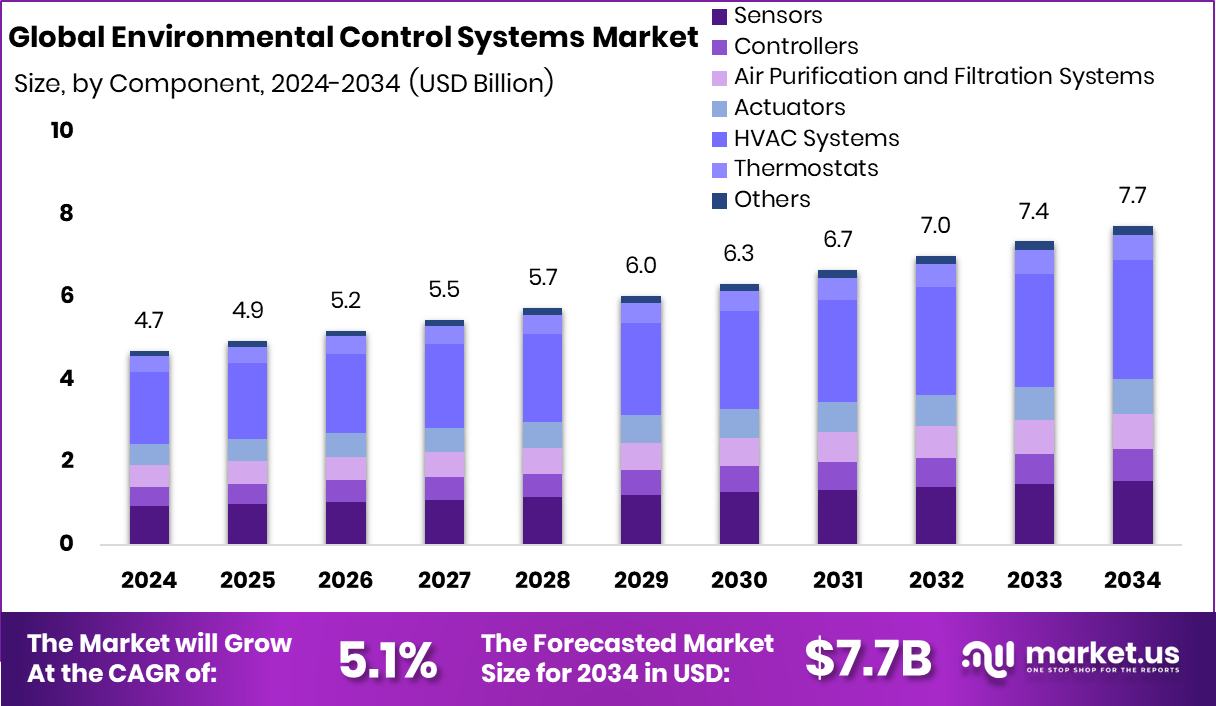
New York, NY – March 20, 2026 – The global Environmental Control Systems market is projected to grow from USD 4.7 billion in 2024 to approximately USD 7.7 billion by 2034, advancing at a CAGR of 5.1%. North America leads adoption, holding a 34.6% share valued at USD 1.62 billion, driven by strong industrial and institutional demand.
Environmental control systems combine technologies that regulate air quality, temperature, humidity, ventilation, and emissions within enclosed spaces. These solutions are essential across residential, commercial, industrial, and public environments to ensure safety, comfort, regulatory compliance, and operational stability.
Market growth is being fueled by increasing awareness of indoor air quality, climate-related challenges, and energy efficiency requirements. Public sector funding plays a major role in accelerating adoption. For example, Springfield schools are implementing $18.5 million in infrastructure upgrades that include HVAC replacements. The U.S. Department of Energy has also committed $180 million to improve energy efficiency and air quality in K-12 schools.
Rising temperatures and poor ventilation are further driving demand. Portland-area school disruptions led six districts to seek up to $100 million for HVAC improvements. Additionally, $1.2 million in ARPA funding was allocated for a new HVAC system at the Folsom Senior Center.
Advanced solutions are gaining traction, highlighted by a $3.5 million geothermal HVAC project at Oak Park and River Forest High School, emphasizing long-term sustainability and efficiency.
➤ Click the sample report link for complete industry insights: https://market.us/report/global-environmental-control-systems-market/request-sample/
Key Takeaways
- The Global Environmental Control Systems Market is expected to be worth around USD 7.7 billion by 2034, up from USD 4.7 billion in 2024, and is projected to grow at a CAGR of 5.1% from 2025 to 2034.
- HVAC systems lead the Environmental Control Systems Market with 37.3%, driven by strict indoor air quality regulations worldwide.
- Water treatment systems hold 34.1% share, supported by rising industrial wastewater reuse and environmental compliance needs.
- Manufacturing accounts for 27.5% share as factories adopt environmental control systems to meet emission standards.
- North America benefits from strict environmental regulations, supporting 34.6% share and USD 1.62 Bn market value.
➤ Directly purchase a copy of the report – https://market.us/purchase-report/?report_id=174473
Market Segments
By Component Analysis
In 2024, HVAC systems accounted for 37.3% of the Environmental Control Systems Market, underscoring their critical role in regulating air quality, temperature, and humidity. Their dominance is driven by increasing adoption across manufacturing plants, commercial spaces, and data centers, where maintaining stable indoor environments is essential. Organizations are integrating smart HVAC technologies equipped with sensors and automation to optimize energy use while meeting stricter efficiency standards.
Growing awareness of employee health, particularly regarding ventilation and air filtration, has further boosted demand. Additionally, changing climate conditions have increased the need for dependable heating and cooling solutions, reinforcing HVAC systems as a core component of environmental control strategies across industrial and commercial sectors.
By Product Analysis
Water treatment systems held a 34.1% share of the market in 2024, driven by rising concerns over water scarcity and environmental pollution. Industries are increasingly focused on treating wastewater and reusing water to reduce reliance on freshwater resources and meet regulatory standards. Advanced technologies such as membrane filtration, chemical treatment, and modern purification systems have been widely adopted to manage industrial discharge effectively.
Governments have also implemented stricter environmental regulations, pushing companies to upgrade outdated infrastructure. The growing emphasis on sustainable manufacturing and circular water usage has strengthened investment in these systems, making them essential for minimizing environmental impact while ensuring compliance and uninterrupted industrial operations.
By End Use Analysis
The manufacturing sector accounted for 27.5% of the Environmental Control Systems Market in 2024, reflecting its strong reliance on controlled environmental conditions. Industries such as chemicals, electronics, food processing, and pharmaceuticals require precise regulation of air quality, temperature, and water systems to maintain product standards and worker safety.
Increasing automation and the rise of high-precision manufacturing processes have further heightened the need for consistent environmental stability. At the same time, manufacturers face growing pressure to reduce emissions, manage waste, and comply with environmental regulations. These combined operational and regulatory demands have positioned manufacturing as a major driver of global demand for environmental control systems.
Regional Analysis
North America leads the Environmental Control Systems Market with a 34.6% share, valued at USD 1.62 billion, driven by advanced industrial infrastructure, strict regulations, and strong adoption of technologies across manufacturing, commercial, and utility sectors. The region’s focus on air quality, energy efficiency, and water compliance ensures steady demand. Europe follows with stable growth supported by strong environmental policies and sustainability-driven industrial practices.
Asia Pacific is the fastest-growing region due to rapid industrialization, urban expansion, and increasing emphasis on pollution control and workplace safety. Meanwhile, the Middle East & Africa show gradual growth through infrastructure development and diversification, while Latin America maintains steady progress with ongoing industrial activity and rising environmental investments.
Top Use Cases
- Indoor Air Quality in Buildings (Homes, Offices, Schools): Environmental control systems are widely used to keep indoor air clean and safe. They remove dust, allergens, and harmful pollutants while maintaining proper ventilation. This helps reduce respiratory problems and improves overall health.
- Smart HVAC for Energy Efficiency: Modern ECS uses smart HVAC systems with sensors and automation. These systems adjust airflow, temperature, and ventilation based on real-time conditions, saving energy and improving comfort.
- Industrial Manufacturing Control: Factories use ECS to control temperature, humidity, and air quality to ensure product quality and worker safety. This is especially important in industries like pharmaceuticals, electronics, and aerospace.
- Pollution and Emission Monitoring: Environmental systems are used in industries to monitor and control emissions like carbon monoxide and other gases. This helps companies meet environmental rules and reduce pollution.
- Humidity and Climate Control: ECS manages humidity levels to prevent mold, bacteria, and discomfort. They also maintain stable temperatures, improving comfort and protecting equipment or materials.
Notable Company Developments
- In March 2026, Siemens works on smart infrastructure systems like HVAC, energy, and building automation. In March 2026, Siemens partnered with Rittal to build efficient data center power and cooling infrastructure, improving thermal management and energy use for large facilities.
- In September 2025, Thermo Fisher Scientific works on laboratory equipment, environmental monitoring, and filtration systems. In September 2025, it acquired Solventum’s purification and filtration business for about $4 billion. This strengthens its filtration technologies used in water treatment, air control, and industrial environmental systems.
- In February 2025, Honeywell works in automation and environmental control systems for buildings and industries. In February 2025, it announced plans to separate automation and aerospace businesses. This move strengthens its focus on automation, including building controls, HVAC systems, and environmental management technologies.
Conclusion
The Environmental Control Systems Market is steadily expanding as industries and public institutions prioritize air quality, energy efficiency, and environmental safety. Increasing regulatory pressure, climate challenges, and the need for sustainable operations are driving adoption across manufacturing, commercial buildings, and infrastructure. Technologies such as HVAC, water treatment, and smart monitoring systems play a critical role in maintaining stable and compliant environments.
Public funding and infrastructure upgrades further support market growth, while innovation in energy-efficient and automated solutions enhances long-term value. Overall, environmental control systems are becoming essential for ensuring health, operational efficiency, and sustainability across global sectors.
Discuss your needs with our analyst
Please share your requirements with more details so our analyst can check if they can solve your problem(s)