Table of Contents
Overview
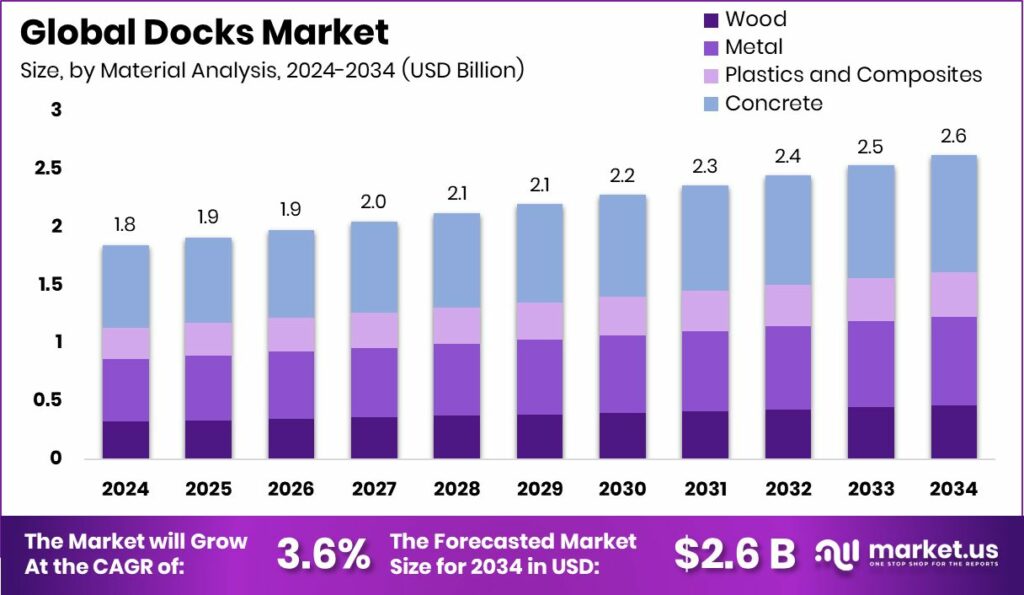
New York, NY – February 17, 2026 – The global docks market is projected to reach about USD 2.6 billion by 2034, rising from USD 1.8 billion in 2024, expanding at a CAGR of 3.6% between 2025 and 2034. North America leads regional demand with a 41.20% share, valued at roughly USD 0.7 billion. Docks are engineered structures built along rivers, lakes, and coastal areas to allow vessels to berth securely for cargo transfer, passenger handling, maintenance, and tourism activities. They may be fixed or floating and act as the operational link between marine transport and land-based infrastructure, supporting trade, logistics, fisheries, marinas, and waterfront economies.
The docks market includes design, construction, modernization, and management of commercial docks, industrial loading docks, marina facilities, and waterfront redevelopment projects. Growth is being driven by infrastructure modernization and operational efficiency improvements. Technology integration is becoming more visible, highlighted by Kargo securing $42 million to automate loading dock and warehouse processes, improving speed and safety.
Financial ecosystem support is also strengthening dock-linked activities, as Brazilian fintech infrastructure company Dock raised $110 million and an additional $3.5 million from Craft Ventures to enhance transaction systems connected to logistics operations. Public redevelopment funding, including a £55.2 million grant for Liverpool Waters’ Central Docks regeneration, further demonstrates long-term investment momentum.
➤ Click the sample report link for complete industry insights: https://market.us/report/global-docks-market/request-sample/
Key Takeaways
- The Global Docks Market is expected to be worth around USD 2.6 billion by 2034, up from USD 1.8 billion in 2024, and is projected to grow at a CAGR of 3.6% from 2025 to 2034.
- Concrete accounted for 39.5% of the Docks Market, driven by durability, load-bearing strength, and long-term infrastructure reliability.
- Floating docks dominated with 69.6% share in the Docks Market due to flexibility, easy installation, and tidal adaptability.
- Bumpers captured 17.8% of the Docks Market, supported by rising safety standards and vessel protection requirements.
- Commercial applications held 48.9% of the Docks Market, fueled by port expansion, marina development, and trade growth.
- North America Docks Market reached USD 0.7 Bn, supported by marina expansion projects.
➤ Directly purchase a copy of the report – https://market.us/purchase-report/?report_id=172849
Report Scope
| Report Features | Description |
|---|---|
| Market Value (2024) | USD 1.8 Billion |
| Forecast Revenue (2034) | USD 2.6 Billion |
| CAGR (2025-2034) | 3.6% |
| Segments Covered | By Material (Wood, Metal, Plastics and Composites, Concrete), By Product Type (Floating, Fixed), By Dock Accessories (Ladders, Bumpers, Cleats, Carts, Benches/Seats, Fish Cleaning Station, Kayak Rack, Trash Cans, Lighting, Handrails, Others), By End Use (Residential, Commercial, Industrial) |
| Competitive Landscape | Snap Dock, RHINO, INC., Tommy Docks, Hydrohoist, Connect-A-Dock, Carolina Docks, PMS Dock Marine Company, Cellofoam North America Inc., Sunstream, RONAUTICA QUALITY MARINAS, S.L. |
Key Market Segments
By Material Analysis
In 2024, concrete led the docks market with a 39.5% share, supported by its strength, durability, and long operational lifespan. It is widely used in ports, industrial waterfronts, and marinas where structures must handle heavy vessel loads and constant marine exposure. Concrete performs well under extreme weather, tidal shifts, and corrosion-prone coastal conditions, making it suitable for permanent installations. Compared to wood and metal, it requires less frequent maintenance, lowering long-term operating costs. Ongoing investments in port modernization and waterfront infrastructure across developed and emerging economies continue to strengthen demand for concrete dock systems.
By Product Type Analysis
Floating docks dominated the market in 2024 with a 69.6% share due to their flexibility and adaptability to changing water levels. These docks automatically adjust to tides and seasonal fluctuations, making them ideal for lakes, rivers, and coastal marinas. Their modular structure allows for easy expansion, relocation, and customization, offering scalable solutions for operators. Floating systems also involve simpler and faster installation compared to fixed docks, reducing construction time and complexity. Growth in recreational boating, marina development, and waterfront tourism projects continues to drive strong adoption of floating dock solutions globally.
By Dock Accessories Analysis
Bumpers accounted for 17.8% of the docks market by accessories in 2024, reflecting their critical role in dock protection. They absorb impact during vessel berthing, reducing structural damage and lowering repair expenses for operators. Widely installed across commercial ports, industrial docks, and marinas, bumpers enhance operational safety and infrastructure longevity. The increasing size of vessels and higher docking frequency have intensified the need for durable, high-performance bumper systems made from rubber, foam, or composite materials. Stricter safety regulations in ports further support consistent demand for advanced docking protection systems.
By End Use Analysis
The commercial segment led the docks market in 2024 with a 48.9% share, driven by expanding maritime trade and port capacity upgrades. Commercial docks facilitate cargo handling, passenger transport, fishing activities, and tourism operations, making them central to economic development. Rising global trade volumes and infrastructure expansion projects are increasing demand for durable and high-capacity dock systems. Additionally, growth in cruise tourism and waterfront retail developments is encouraging modernization of commercial docking facilities. Governments and private investors continue prioritizing efficient, scalable dock infrastructure to support long-term logistics and trade growth.
Regional Analysis
The docks market demonstrates diverse regional trends influenced by port infrastructure, maritime trade, and coastal development strategies. North America leads with a 41.20% share, valued at USD 0.7 billion, supported by advanced port systems, extensive marina networks, and ongoing dock upgrades across commercial and recreational sectors. Europe maintains stable demand due to established trade corridors, inland waterways, and strong marina tourism, with regulations encouraging modernization and safety improvements.
Asia Pacific is emerging as a key growth region driven by expanding coastal cities, increasing maritime logistics, and rising recreational boating activities. The Middle East & Africa benefit from strategic port investments and waterfront urban projects, while Latin America records gradual growth through port improvements, fishing operations, and selective marina expansion.
Top Use Cases
- Loading and Unloading Ships: Docks provide a stable space where large ships can tie up so cargo—like goods in containers, raw materials, or supplies—can be moved on and off the vessel quickly and safely. This is one of the most common everyday uses of docks at ports and harbours.
- Boat Mooring and Access: For boats at marinas or private waterfronts, docks act as safe platforms where boats are tied up (moored). People can walk on and off their boats without them drifting away.
- Fishing and Recreation: Docks are popular spots where people fish, relax by the water, or launch small recreational watercraft like kayaks, canoes, and paddleboards. They make water access easy and safe.
- Maintenance and Repair of Vessels: Dry docks (where water can be drained) let workers inspect, clean, fix, and maintain ships’ hulls and other parts that are normally underwater. This is essential for keeping ships seaworthy.
- Passenger Boarding and Disembarkation: Docks serve as boarding points for passenger ferries, cruise ships, and other transport boats, helping travellers get on and off vessels safely.
Recent Developments
- In January 2025, Snap Dock partnered with Wearth Group (parent company of Poralu Marine and Rotax) to produce and distribute Snap Dock modular docks and PWC ports in Europe, Africa, and the Middle East. This deal expands Snap Dock’s global presence and makes products easier to access in these regions.
- In April 2024, Meyer Distributing added Rhino, Inc. to its product line along with Snap Dock and other outdoor brands. This means Rhino’s marine recreation and dock-related products (like dock accessories and outdoor marine gear) are now being offered and shipped through a larger distributor network, helping them reach more retailers and customers.
Conclusion
The docks market continues to play a vital role in supporting maritime trade, waterfront development, and recreational water activities. Growing investments in port upgrades, marina expansion, and coastal infrastructure are strengthening long-term demand. Technological improvements, including modular floating systems and automated dock operations, are improving safety, efficiency, and flexibility. Urban waterfront regeneration projects are also creating new opportunities for modern dock installations across commercial and mixed-use developments.
As global trade, tourism, and logistics networks expand, the need for durable, adaptable, and low-maintenance dock solutions remains strong. Overall, the market outlook remains stable, supported by infrastructure modernization and evolving marine activities.
Discuss your needs with our analyst
Please share your requirements with more details so our analyst can check if they can solve your problem(s)