Table of Contents
Overview
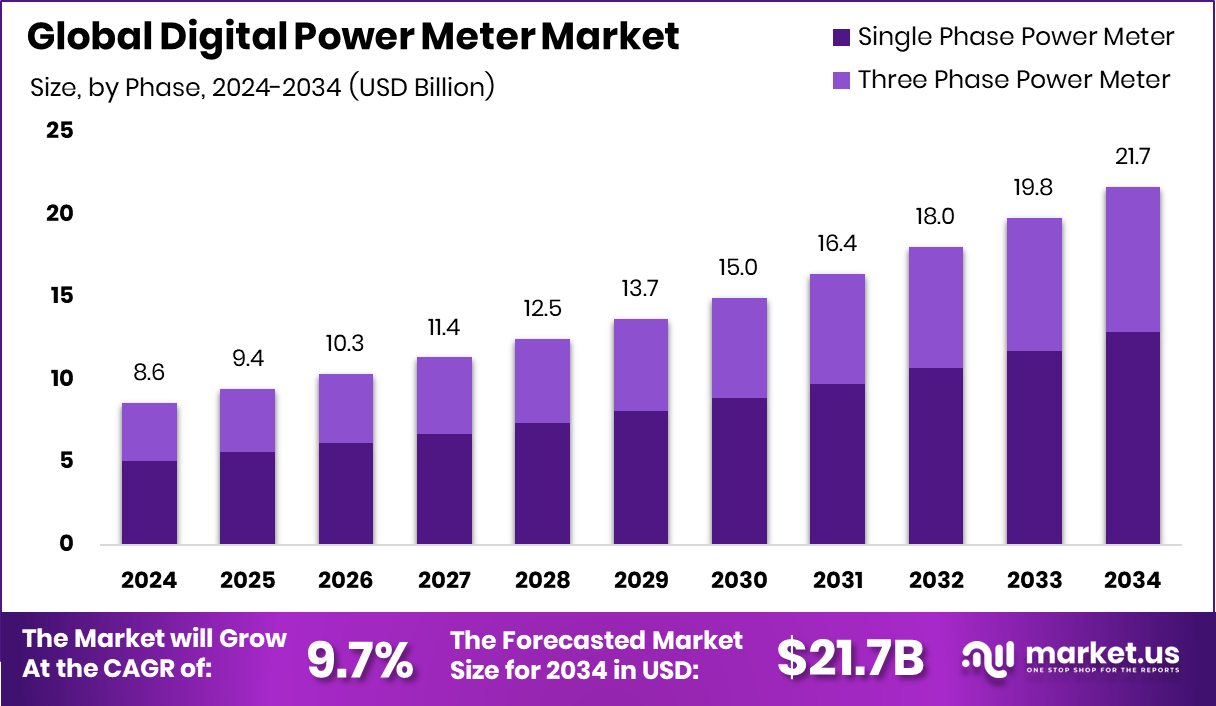
New York, NY – January 20, 2026 – The Global Digital Power Meter Market is projected to grow from USD 8.6 billion in 2024 to about USD 21.7 billion by 2034, supported by a 9.7% CAGR. Asia-Pacific leads with a 43.60% share, valued at USD 3.7 billion. Digital power meters have become essential as they offer real-time, accurate tracking of electricity use, reducing billing errors and improving transparency for households, businesses, and utilities. Their adoption is rising as countries modernize grids and aim for better energy efficiency.
Recent investments are boosting the ecosystem surrounding digital power systems. Brookfield’s USD 100 billion AI infrastructure fund, backed by Nvidia and KIA, reflects increasing demand for advanced digital and energy-dependent systems, indirectly strengthening the need for reliable power measurement.
Government efforts to lower energy expenses also create opportunities. In the UK, discussions about reducing household energy bills by up to £200 highlight the importance of accurate consumption data. However, penetration remains low in many regions, such as Bescom, where only 2% of consumers have smart meters despite everyone paying for them.
Large deployment contracts continue to accelerate market growth, including a ₹3,467 crore project to install 76 lakh smart meters. Smaller initiatives, like £30,000 digital-innovation grants, further encourage technology adoption and long-term market expansion.
➤ Click the sample report link for complete industry insights: https://market.us/report/global-digital-power-meter-market/request-sample/
Key Takeaways
- The Global Digital Power Meter Market is expected to be worth around USD 21.7 billion by 2034, up from USD 8.6 billion in 2024, and is projected to grow at a CAGR of 9.7% from 2025 to 2034.
- In the Digital Power Meter Market, single-phase meters dominate phase segmentation with 59.3% share.
- Within the Digital Power Meter Market, digital meter types lead product segmentation, holding 44.2% share.
- In the Digital Power Meter Market, residential applications lead usage demand, accounting for 51.8% share.
- Asia-Pacific region dominates the Digital Power Meter Market, holding 43.60% and USD 3.7 Bn.
➤ Directly purchase a copy of the report – https://market.us/purchase-report/?report_id=171127
Report Scope
| Report Features | Description |
|---|---|
| Market Value (2024) | USD 8.6 Billion |
| Forecast Revenue (2034) | USD 21.7 Billion |
| CAGR (2025-2034) | 9.7% |
| Segments Covered | By Phase (Single Phase Power Meter, Three Phase Power Meter), By Product Type (Digital Meter Type, Electrical Meter Type, Electromechanical Meter Type, Electronic Meter Type), By Application (Residential, Commercial, Industrial) |
| Competitive Landscape | Schneider Electric SE, Delta Electronics, Techno Meters, Hoyt Electrical Instrument Works, Inc., Chroma ATE Inc., Weschler Instruments, Sfere Electric, CSQ Electric, Eastron Electronic Co., Ltd. |
Key Market Segments
By Phase Analysis
Single phase power meters hold a dominant position in the Digital Power Meter Market, accounting for 59.3% of the global share in 2024. This leadership is mainly due to their widespread use in residential buildings and small commercial setups, where single-phase electricity connections are standard. These meters are designed to handle everyday voltage requirements efficiently, making them ideal for routine power consumption monitoring. Their strong adoption is also supported by the ongoing replacement of traditional mechanical meters with digital alternatives that offer better accuracy, reliability, and transparency.
Utilities favor single-phase digital meters because they are easy to install, require minimal system upgrades, and integrate smoothly with existing distribution networks. For end users, these meters provide clear and consistent readings, helping improve trust in billing systems. As a result, single-phase meters continue to be the largest volume contributor, supporting steady market penetration and long-term adoption across multiple regions.
By Product Type Analysis
Digital meter types lead the Digital Power Meter Market under the product category, capturing a 44.2% share in 2024. This dominance reflects the growing shift away from conventional metering technologies toward digitally enabled solutions that deliver precise measurement and efficient data handling.
Digital meters are increasingly preferred because they support accurate billing, minimize manual errors, and enable consistent power monitoring across different usage environments. Their strong market position is driven by the need for transparency and better operational control within electricity management systems. Utilities rely on these meters to improve service efficiency, while end users benefit from reliable consumption data that supports informed energy use.
The continued adoption of digital meter types highlights their compatibility with modern power infrastructure and evolving energy management requirements. This segment’s leadership reinforces its central role in shaping how electricity consumption is measured, monitored, and managed in the digital era.
By Application Analysis
The residential segment dominates the Digital Power Meter Market by application, holding a 51.8% share in 2024. This strong position reflects the high concentration of digital meter installations in households, which represent the largest group of electricity consumers globally. Growing awareness of energy usage, billing accuracy, and cost control has increased demand for digital meters in residential settings. These meters allow households to track consumption patterns more clearly, helping users better manage electricity use while reducing disputes related to billing.
For utilities, residential digital meters simplify the management of large customer bases by improving data accuracy and operational efficiency. The segment’s dominance also highlights the role of homes in driving large-scale deployment programs, as residential installations often form the foundation of smart metering initiatives. Overall, the residential sector remains a key driver of market volumes and long-term digital power meter adoption.
Regional Analysis
Asia-Pacific leads the Digital Power Meter Market, holding about 43.8% of the global share and valued at USD 60.8 million. This dominance is driven by a large base of electricity consumers, rapid urban growth, and widespread rollout of digital metering across residential and utility networks. Rising demand for accurate electricity monitoring positions the region as the main contributor to global market volumes.
North America represents a mature market, with steady adoption of digital power meters focused on precise consumption tracking and efficient grid management. Demand remains stable as utilities continue upgrading systems for reliability and transparency. Europe also shows consistent growth, supported by well-structured power distribution networks and a strong emphasis on transparent energy usage measurement for households and commercial users.
The Middle East & Africa region is developing gradually, with increasing use of digital meters to improve billing accuracy and reduce electricity losses. Latin America is similarly progressing, supported by power infrastructure modernization and growing awareness of the benefits of digital electricity measurement.
Top Use Cases
- Track Electricity Use in Real Time: Digital power meters show how much electricity you’re using at every moment. This means households and businesses can see their consumption instantly, not just once a month when the bill arrives. This helps people understand their energy habits and make smarter choices.
- Accurate Billing Without Manual Readings: These meters automatically send exact usage data to energy companies, so bills are based on what you really used. That removes errors from old-fashioned manual meter reading or estimates.
- Detect Power Surges and Outages: Smart digital meters can alert both users and utilities if there’s a sudden power spike, surge, or outage. This helps fix issues faster and prevents damage to appliances or equipment.
- Help Utilities Manage the Grid Better: Power companies use the data from digital meters to balance supply and demand on the grid. This improves reliability, reduces blackouts, and supports smooth electricity distribution.
- Identify and Reduce Energy Waste: By showing when and where power is used most, these meters help people spot wasteful appliances or habits. This can lead to lowering energy use and saving money.
- Support Smart Grid and Future Technologies: Digital power meters are essential for modern energy systems. They allow two-way communication between meters and utilities, which supports demand response, renewable energy integration, and advanced grid services.
Recent Developments
- In October 2025, Delta Electronics, Inc. announced that it had acquired 90.23% majority ownership in a destination company focused on energy technologies. This deal helps Delta strengthen its product portfolio in power components and energy systems which support digital energy monitoring and management tools (including those used with digital power meters).
- In July 2025, Schneider Electric announced it will buy the remaining 35% stake in Schneider Electric India Private Limited (SEIPL) from Temasek for about €5.5 billion in cash. This means Schneider Electric now has 100% ownership of its Indian arm, strengthening its position in energy technology and digital power solutions in a key market. The deal supports faster decision-making and growth in digital energy products, including smart meters.
Conclusion
The Digital Power Meter Market is steadily gaining importance as electricity systems move toward smarter and more transparent energy management. Digital power meters help users and utilities understand electricity consumption clearly, reduce billing errors, and improve trust in energy services. Their ability to support real-time monitoring and better control makes them valuable for homes, businesses, and power networks.
Growing focus on energy efficiency, grid modernization, and reliable electricity delivery continues to support adoption. As awareness increases and infrastructure improves, digital power meters are expected to play a central role in managing electricity use more responsibly and efficiently.
Discuss your needs with our analyst
Please share your requirements with more details so our analyst can check if they can solve your problem(s)