Table of Contents
Overview
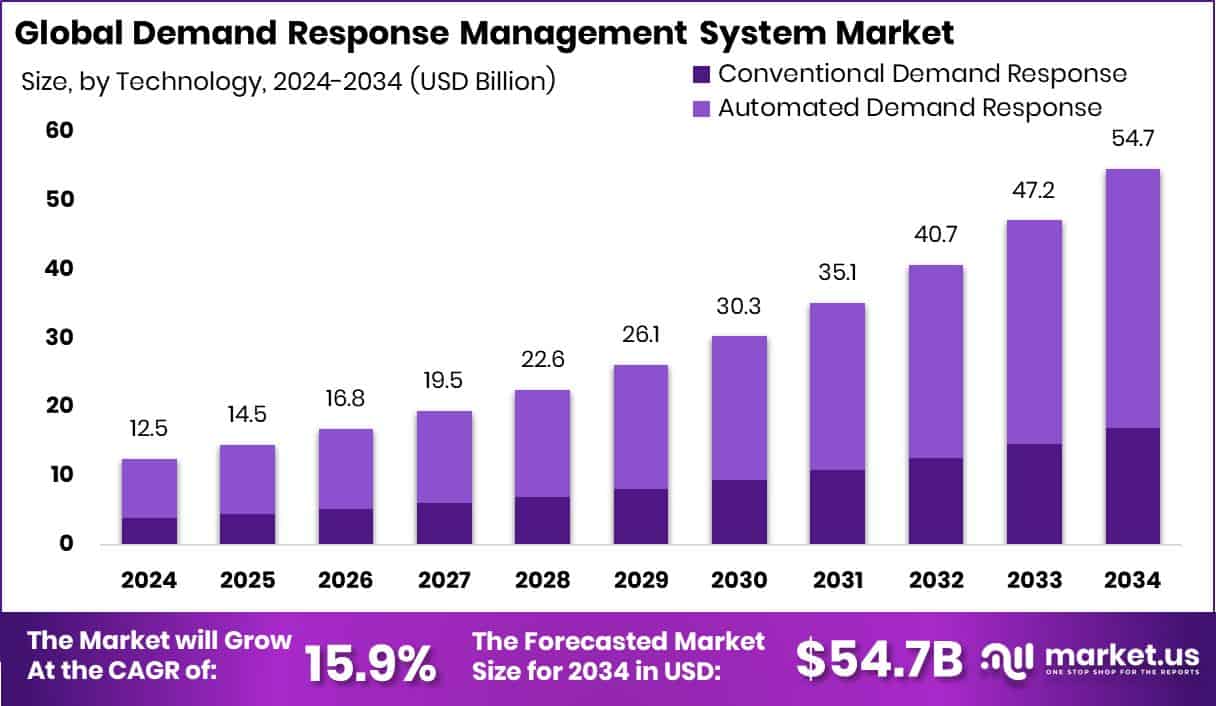
The Demand Response Management System (DRMS) market is projected to grow significantly, increasing from USD 12.5 billion in 2024 to about USD 54.7 billion by 2034, with a CAGR of 15.9% between 2025 and 2034. North America currently leads the market, holding around 43.5% share and generating roughly USD 5.4 billion in revenue.
A Demand Response Management System is a digital solution that enables utilities and large electricity consumers to manage energy consumption during periods of high demand. By tracking electricity use in real time, these platforms can automatically reduce or shift non-critical power loads when the grid is under pressure. This approach helps avoid outages, reduces electricity costs, and improves grid stability while allowing essential operations to continue.
The DRMS market includes software platforms, monitoring tools, and related services that support structured demand response programs for residential, commercial, and industrial users. As electricity networks become more complex due to renewable energy integration and energy storage adoption, these systems are increasingly important for balancing supply and demand and maintaining reliable grid performance.
Market expansion is supported by strong investment in energy infrastructure and clean power. For instance, Apraava Energy secured Rs 800 crore in funding to strengthen power infrastructure, while Power Capital raised €323 million to accelerate renewable energy expansion in Ireland. Additionally, Nuveen raised $1.3 billion for energy and power infrastructure projects, Sharing Energy secured ¥31.5 billion in Series C funding, and Base Power raised $200 million to scale energy storage solutions, further driving the need for advanced demand response technologies.
Top Key Players in the Market
- ABB
- Eaton
- Enel Spa
- ALARM.COM HOLDINGS, INC.
- General Electric
- Honeywell International Inc
- Itron Inc.
- Johnson Controls, Inc.
- Schneider Electric SE
- Siemens
1. ABB
ABB Ltd is a global technology company specializing in electrification, automation, robotics, and digital solutions for utilities, industry, transportation, and infrastructure. The company was formed in 1988 through the merger of Sweden’s ASEA and Switzerland’s Brown, Boveri & Cie. Today, ABB operates in more than 100 countries and employs over 100,000 people, providing technologies that help industries improve productivity and energy efficiency.
The company focuses on digital automation, smart electrification, robotics, and motion technologies that support sustainable industrial operations. ABB’s systems are widely used in energy infrastructure, manufacturing, transportation, and data centers. Its innovation strategy emphasizes electrification and automation solutions that improve operational performance while enabling cleaner and more efficient energy usage.
| Attribute | Details |
|---|---|
| CEO | Morten Wierod |
| Established | 1988 |
| Founders | ASEA & Brown Boveri |
| Headquarters | Zurich, Switzerland |
| Industry | Electrification & Automation |
| Key Products | Robotics, Automation Systems |
| Global Presence | 100+ Countries |
| Employees | ~110,000 |
| Revenue | ~$33B (2025 approx) |
| Stock Listings | SIX Swiss Exchange, Nasdaq Nordic |
| Core Markets | Industry, Utilities, Infrastructure |
2. Eaton
Eaton Corporation plc is a multinational power management company that develops technologies to help customers manage electrical, hydraulic, and mechanical power more efficiently. Founded in 1911, Eaton provides solutions for energy distribution, electrical components, vehicle systems, aerospace equipment, and industrial power systems. The company operates globally and serves customers in more than 175 countries.
Eaton’s strategy centers on electrification, renewable integration, and digital power management technologies. Its portfolio includes circuit protection devices, UPS systems, EV charging solutions, and grid infrastructure components. By supporting efficient energy usage and electrification trends, Eaton plays a significant role in modern power infrastructure and industrial automation systems.
| Attribute | Details |
|---|---|
| CEO | Paulo Ruiz |
| Established | 1911 |
| Founders | Joseph Oriel Eaton II, Viggo Torbensen |
| Headquarters | Dublin, Ireland |
| Industry | Power Management |
| Products | Electrical Systems, EV Components |
| Revenue | $24.88B (2024) |
| Employees | ~94,000 |
| Global Presence | 175+ Countries |
| Stock Exchange | NYSE |
| Divisions | Electrical, Industrial |
3. Enel S.p.A.
Enel S.p.A. is an Italian multinational energy company engaged in electricity generation, distribution, and renewable energy development. Founded in 1962 by the Italian government, Enel later became a publicly listed company and today operates across Europe, the Americas, Asia, and Africa. The company supplies electricity and gas to millions of customers globally and is among the largest utility providers in Europe.
Enel invests heavily in renewable energy, smart grids, and energy innovation technologies. Its subsidiaries develop wind, solar, geothermal, and hydroelectric power facilities, while its digital grid technologies support efficient power distribution. Through its renewable division, Enel Green Power, the company plays a major role in advancing global clean energy systems.
| Attribute | Details |
|---|---|
| CEO | Flavio Cattaneo |
| Established | 1962 |
| Founder | Italian Government |
| Headquarters | Rome, Italy |
| Industry | Electric Utility |
| Products | Electricity & Gas |
| Employees | ~60,000 |
| Global Presence | 28+ Countries |
| Customers | 61M+ |
| Energy Capacity | ~88 GW |
| Stock Index | FTSE MIB |
4. Alarm.com Holdings, Inc.
Alarm.com Holdings, Inc. is a technology company that develops cloud-based platforms for smart home, security, and energy management solutions. The company delivers software services that enable users to monitor and control security systems, automation devices, and energy usage through mobile and cloud platforms. Its technology integrates IoT devices, analytics, and automation to create connected home and business environments.
The company works with service providers and security dealers worldwide to deliver integrated monitoring and automation services. Alarm.com’s platform supports smart thermostats, video monitoring, access control, and energy management solutions for residential and commercial properties.
| Attribute | Details |
|---|---|
| CEO | Stephen Trundle |
| Established | 2000 |
| Founder | Jean-Paul Martin |
| Headquarters | Tysons, Virginia, USA |
| Industry | Smart Security & IoT |
| Products | Smart Home Platforms |
| Services | Security Monitoring |
| Employees | ~2,000 |
| Stock Exchange | NASDAQ |
| Global Presence | North America & Europe |
| Core Technology | Cloud IoT Platform |
5. General Electric
General Electric (GE) is an American multinational industrial company founded in 1892 through the merger of Edison General Electric and Thomson-Houston Electric Company. The company historically operated across multiple sectors including energy, aviation, healthcare, and industrial equipment. Over time, GE has been recognized as one of the most influential industrial corporations in the world.
Today GE focuses heavily on advanced technology sectors such as aerospace engines, power generation systems, and energy infrastructure. The company has contributed to major innovations in power systems, aviation technology, and industrial engineering, and it continues to invest in digital and advanced manufacturing solutions.
| Attribute | Details |
|---|---|
| CEO | Larry Culp |
| Established | 1892 |
| Founders | Thomas Edison & partners |
| Headquarters | Boston, USA |
| Industry | Industrial Technology |
| Key Products | Turbines, Jet Engines |
| Global Rank | Forbes Global 2000 |
| Employees | ~170,000 |
| Stock Exchange | NYSE |
| Core Markets | Aviation & Energy |
| Technology Focus | Industrial Innovation |
6. Honeywell International Inc.
Honeywell International Inc. is a multinational technology and manufacturing company headquartered in the United States. Its business segments include aerospace technologies, building automation, industrial automation, and energy sustainability solutions. The company traces its origins to the invention of a furnace regulator in the late 19th century, which laid the foundation for modern thermostat technology.
Honeywell develops advanced technologies for industrial automation, smart buildings, aviation systems, and digital industrial platforms. Its solutions support energy efficiency, operational safety, and automation in sectors such as aerospace, manufacturing, and energy infrastructure. The company operates globally with a workforce exceeding 100,000 employees.
| Attribute | Details |
|---|---|
| CEO | Vimal Kapur |
| Established | 1885 |
| Founder | Albert Butz |
| Headquarters | Charlotte, USA |
| Industry | Industrial Technology |
| Products | Automation & Aerospace Systems |
| Employees | ~102,000 |
| Revenue | ~$39B |
| Stock Exchange | NASDAQ |
| Fortune Rank | Fortune 500 |
| Core Segments | Aerospace, Automation |
7. Itron Inc.
Itron Inc. is a technology company specializing in energy and water resource management solutions. Founded in 1977, the company develops smart metering systems, network technologies, and analytics platforms used by utilities worldwide. Its products help utilities monitor electricity, gas, and water consumption more accurately and efficiently.
Itron’s technology enables smart grid infrastructure, energy data analytics, and distributed energy management systems. These solutions help utilities improve grid reliability, optimize energy distribution, and integrate renewable energy resources into modern power systems.
| Attribute | Details |
|---|---|
| CEO | Thomas Deitrich |
| Established | 1977 |
| Founder | Gary Burdge |
| Headquarters | Liberty Lake, USA |
| Industry | Smart Grid Technology |
| Products | Smart Meters |
| Services | Energy Analytics |
| Employees | ~5,000 |
| Stock Exchange | NASDAQ |
| Markets | Utilities & Cities |
| Core Focus | Smart Infrastructure |
8. Johnson Controls
Johnson Controls is a multinational company focused on building technologies, HVAC systems, and energy management solutions. Founded in 1885, the company initially developed the electric room thermostat and later expanded into building automation and energy efficiency technologies.
The company provides smart building systems, fire and security technologies, and heating, ventilation, and air-conditioning equipment. Johnson Controls supports commercial, industrial, and residential customers with digital building platforms designed to enhance sustainability, safety, and operational efficiency.
| Attribute | Details |
|---|---|
| CEO | George Oliver |
| Established | 1885 |
| Founder | Warren S. Johnson |
| Headquarters | Cork, Ireland |
| Industry | Building Technology |
| Products | HVAC Systems |
| Services | Building Automation |
| Employees | ~100,000 |
| Global Presence | 150+ Countries |
| Core Market | Smart Buildings |
| Stock Exchange | NYSE |
9. Schneider Electric
Schneider Electric SE is a global company specializing in energy management and automation solutions. Founded in 1836 in France, the company has evolved from a steel manufacturer into a leader in digital energy management technologies. Schneider’s products support industries, utilities, and buildings with intelligent power management solutions.
The company’s portfolio includes electrical distribution systems, industrial automation, energy software platforms, and smart grid technologies. Schneider Electric emphasizes sustainability and digital transformation by integrating IoT, software analytics, and automation into energy infrastructure systems.
| Attribute | Details |
|---|---|
| CEO | Peter Herweck |
| Established | 1836 |
| Founder | Schneider Family |
| Headquarters | Rueil-Malmaison, France |
| Industry | Energy Management |
| Products | Electrical Equipment |
| Employees | ~160,000 |
| Global Presence | 100+ Countries |
| Stock Exchange | Euronext |
| Core Technology | Smart Grid |
| Focus | Sustainability |
10. Siemens
Siemens AG is a German multinational technology company specializing in industrial automation, digital industries, smart infrastructure, and mobility technologies. Founded in 1847 by Werner von Siemens and Johann Georg Halske, the company has grown into one of the largest engineering and manufacturing firms worldwide.
Siemens develops advanced solutions for power generation, transportation systems, smart grids, industrial automation, and healthcare technologies. The company’s digital industry platforms combine software, automation, and AI to improve efficiency across manufacturing and infrastructure systems.
| Attribute | Details |
|---|---|
| CEO | Roland Busch |
| Established | 1847 |
| Founders | Werner von Siemens |
| Headquarters | Munich, Germany |
| Industry | Industrial Technology |
| Products | Automation & Digital Systems |
| Employees | ~320,000 |
| Global Presence | 200+ Countries |
| Revenue | €70B+ |
| Stock Exchange | Frankfurt |
| Core Segments | Industry, Mobility |
Conculsion
Demand Response Management Systems play an important role in improving the stability, efficiency, and flexibility of modern electricity networks. These systems enable utilities and energy consumers to monitor and adjust power usage during periods of high demand, helping reduce grid stress and support reliable energy distribution. As renewable energy sources and distributed power resources continue to expand, managing fluctuations in supply and demand becomes increasingly important.
Demand response platforms provide digital tools that help balance energy consumption, reduce operational costs, and support sustainable energy practices. By enabling smarter energy management, these systems contribute to resilient power infrastructure and the transition toward more efficient and environmentally responsible energy systems.
Discuss your needs with our analyst
Please share your requirements with more details so our analyst can check if they can solve your problem(s)