Table of Contents
Overview
New York, NY – March 31, 2026 – The global compressor oil market is on a steady growth path, supported by rising industrial operations, energy infrastructure, and expanding clean-power investments. Compressor oil plays a vital role in reducing friction, controlling heat, preventing deposits, improving sealing, and protecting compressor components under continuous high-pressure use. Its importance across manufacturing, automotive, chemicals, construction, and power systems continues to grow as industries depend on uninterrupted compressed air and gas performance.
Market momentum is strongly linked to broader industrial and energy project financing. Constant Energy’s THB 300 million green funding from HSBC and the $4 billion secured by the Taqa consortium for Saudi power plants are driving infrastructure activity that increases compressor deployment and lubricant consumption. At the same time, innovation-led energy systems are creating new long-term demand. Helical Fusion’s USD 5.5 million Series A extension and X-energy’s $700 million raise support advanced testing, cooling, and material-handling environments where compressor reliability is essential.
Policy and regional funding shifts are also reshaping future opportunities. While the U.S. cancellation of $13 billion in green energy funds introduces uncertainty, fresh investments elsewhere continue to support market expansion. A key example is the US$500 million DRE Nigeria Fund, co-led by NSIA, SEforALL, ISA, and Africa50, which supports distributed energy projects that rely on compressors and supporting lubrication systems.
➤ Click the sample report link for complete industry insights: https://market.us/report/global-compressor-oil-market/request-sample/
Key Takeaways
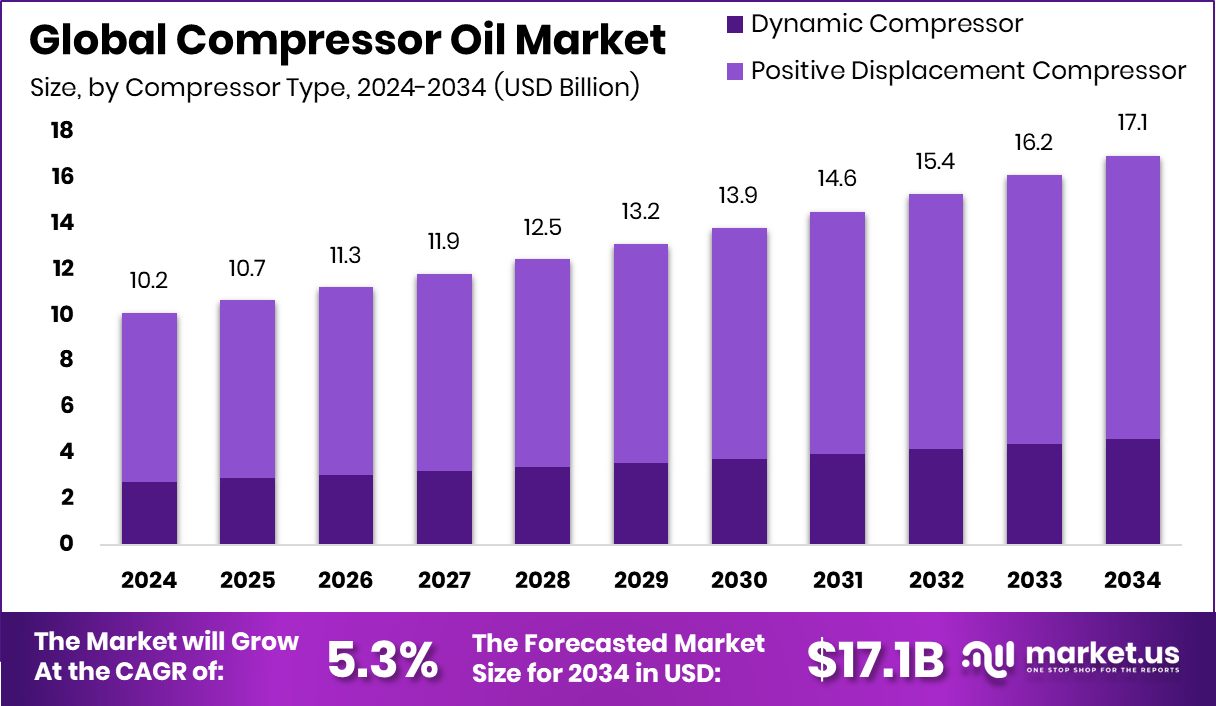
- The Global Compressor Oil Market is expected to be worth around USD 17.1 billion by 2034, up from USD 10.2 billion in 2024, and is projected to grow at a CAGR of 5.3% from 2025 to 2034.
- The Compressor Oil Market sees Mineral Oil at 49.2%, driving strong lubrication demand globally.
- In the Compressor Oil Market, Positive Displacement Compressors lead with 72.3%, shaping major consumption trends.
- The Compressor Oil Market reports Air Compressors dominating at 73.1%, supporting
- widespread industrial operations.
- Within the Compressor Oil Market, General Manufacturing holds 31.7%, reflecting a consistent need for reliable compressor lubrication.
- In the Asia Pacific, the Compressor Oil Market strengthens at 45.5%, achieving USD 4.6 Bn.
➤ Directly purchase a copy of the report – https://market.us/purchase-report/?report_id=175115
Market Segments
By Base Oil Analysis
Mineral oil dominated the compressor oil market with a 49.2% share in 2024, driven by its cost-effectiveness, dependable lubrication, and easy availability. It remained the preferred choice for manufacturing plants, workshops, and processing units operating under moderate conditions, where affordable and stable compressor performance was more important than premium synthetic formulations.
By Compressor Type Analysis
Positive displacement compressors dominated with a 72.3% market share in 2024, supported by extensive use in manufacturing, automotive services, workshops, and construction. Their reliable design and consistent airflow output increased demand for oils used in piston and rotary screw systems, strengthening their leadership across both small and large industrial operations globally.
By Application Analysis
Air compressors led the market with a dominant 73.1% share in 2024, as they remained essential for powering tools, assembly lines, packaging, cooling, and material handling. Their widespread use across factories and service industries sustained strong lubricant demand, making compressor oils critical for uninterrupted airflow, efficiency, and equipment protection in daily operations.
By End-use Analysis
General manufacturing dominated end-use demand with a 31.7% share in 2024, supported by strong compressor usage in metal fabrication, machinery production, food processing, and electronics assembly. Growing adoption of automated production lines and pneumatic systems kept lubricant demand steady, reinforcing the sector’s leading role in compressor oil consumption worldwide.
Regional Analysis
Asia Pacific dominates the compressor oil market with a 45.5% share, valued at USD 4.6 Bn, driven by industrial expansion, manufacturing growth, infrastructure projects, automotive production, and heavy machinery use. North America and Europe maintain steady demand through advanced industries, while the Middle East & Africa and Latin America show moderate growth supported by petrochemicals, construction, mining, and equipment modernisation.
Top Use Cases
- Manufacturing Machines: Compressor oil is widely used in factories to keep air compressors running smoothly for pneumatic tools, conveyor lines, and assembly machines. It reduces friction, controls heat, and helps avoid sudden machine stoppages during long production hours.
- Construction Equipment: On construction sites, compressors, power drills, jackhammers, paint sprayers, and sandblasting tools. Compressor oil protects moving parts from wear and overheating, which is important for heavy-duty outdoor work.
- Automotive Workshops: Garages and service centres use compressor oil in air compressors that run lifts, tire inflators, spray painting systems, and pneumatic repair tools. It helps maintain steady airflow and improves equipment life.
- HVAC and Refrigeration Systems: Cooling and refrigeration compressors need oil for smooth compression, heat control, and sealing. This helps AC systems, chillers, and cold storage units operate efficiently for long periods.
- Mining and Drilling Operations: Mining rigs and drilling machines use compressor oil in portable and rotary screw compressors for pneumatic drilling, air flushing, and dust control systems. It supports reliable performance in harsh environments.
- Oil, Gas, and Energy Plants: Power plants, refineries, and gas processing units use compressor oil in gas and air compression systems for cooling, sealing, and reducing wear in continuous-duty machinery.
Notable Company Developments
- In July 2025, Chevron completed the Hess acquisition. Chevron works in energy, fuels, and industrial lubricants, including compressor oils for heavy machinery and industrial systems. This deal strengthens its upstream and lubricant-linked business scale, supporting broader industrial operations where compressor oil demand remains important for equipment reliability and maintenance.
- In May 2024, ExxonMobil completed the Pioneer Natural Resources acquisition. ExxonMobil works in energy, chemicals, and Mobil industrial lubricants, including compressor oils used in heavy equipment and plant systems. This merger expands large-scale industrial operations, strengthening lubricant demand for compressors, rotating machinery, and continuous-duty equipment maintenance.
Conclusion
The compressor oil market is expected to maintain healthy long-term growth, supported by rising industrialisation, expanding manufacturing capacity, and increasing investments in energy, infrastructure, and clean technology projects. Demand remains strong because compressor oils are essential for reducing friction, controlling heat, improving sealing, and extending equipment life in continuous-duty systems.
Mineral oils continue to dominate due to affordability, while positive displacement and air compressor applications drive the majority of consumption. Asia Pacific remains the leading region due to its strong industrial base. Future growth will be supported by automation, equipment modernisation, and expanding use of compressors across manufacturing, energy, construction, and process industries worldwide.
Discuss your needs with our analyst
Please share your requirements with more details so our analyst can check if they can solve your problem(s)