Table of Contents
Overview
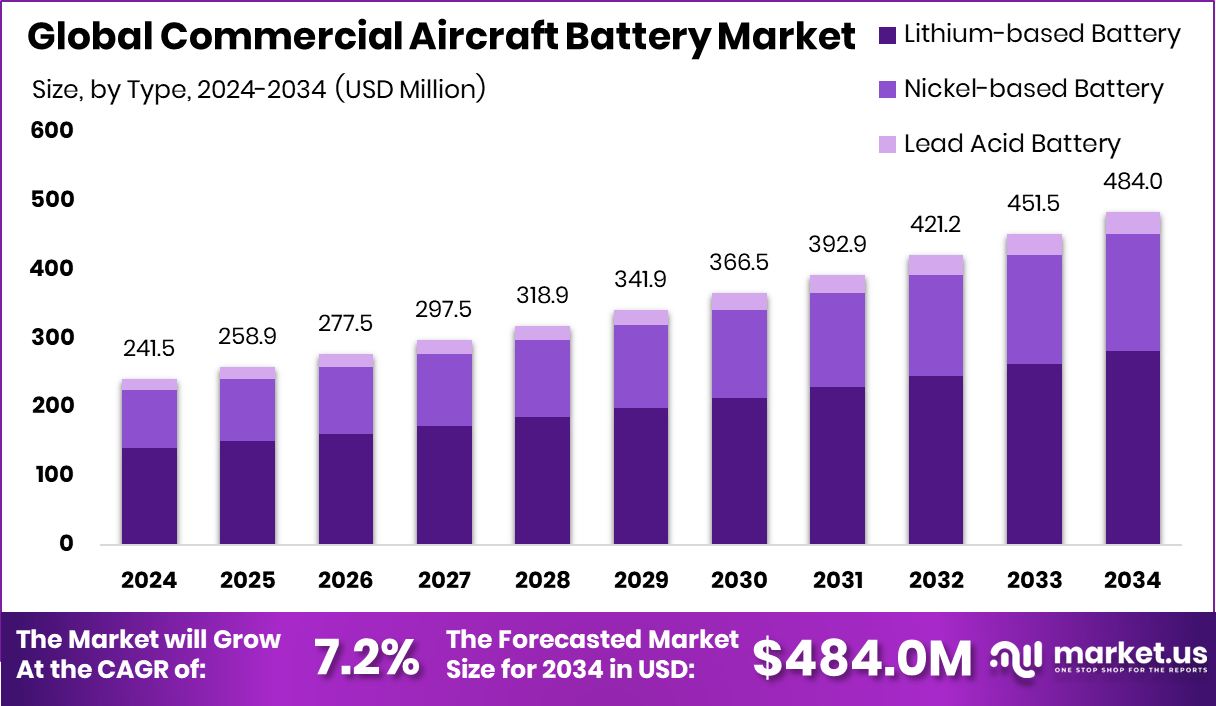
New York, NY – December 23, 2025 – The Global Commercial Aircraft Battery Market is set to reach USD 484.0 million by 2034, rising from USD 241.5 million in 2024 at a steady 7.2% CAGR. North America continues to lead the industry with 45.90% share, generating USD 110.8 million, driven by high fleet utilization and early adoption of advanced electrical systems.
Commercial aircraft batteries serve as essential onboard energy units, supporting engine starts, avionics, flight controls, emergency systems, and backup power. As aircraft architectures shift toward “more-electric” designs, demand for higher-density and safer lithium-based chemistries is accelerating. This transition also strengthens the replacement and maintenance cycle across narrow-body, wide-body, regional, and business jets.
Recent investments are reinforcing long-term supply security. TACC securing ₹1,230 crore from SBI for a lithium-ion anode plant and Waaree Energies deploying ₹300 crore into an advanced ACC lithium-ion facility highlight strong upstream capacity building. Parallel sustainability programs—including the £8.1 million UK aviation consortium, a €26.1 million battery-recycling grant, and ₹12 crore in seed funding for recycling operations—are shaping cleaner procurement frameworks.
Innovation is expanding beyond conventional lithium systems. India’s Offgrid raising $15 million to develop lithium-alternative technologies signals emerging opportunities in safer chemistries and circular energy systems, supporting the future of electrified aviation architectures.
➤ Click the sample report link for complete industry insights: https://market.us/report/global-commercial-aircraft-battery-market/request-sample/
Key Takeaways
- The Global Commercial Aircraft Battery Market is expected to be worth around USD 484.0 million by 2034, up from USD 241.5 million in 2024, and is projected to grow at a CAGR of 7.2% from 2025 to 2034.
- Lithium-based batteries held a 58.3% share in the Commercial Aircraft Battery Market due to high energy density.
- Centralised battery topology dominated the Commercial Aircraft Battery Market with 59.1%, enabling simplified power control.
- Power supply management led applications with 33.7%, supporting reliable energy distribution across aircraft systems.
- Strong aviation infrastructure in North America supports battery demand, sustaining its 45.90% share, worth USD 110.8 Mn.
➤ Directly purchase a copy of the report – https://market.us/purchase-report/?report_id=169097
Report Scope
| Report Features | Description |
|---|---|
| Market Value (2024) | USD 241.5 Million |
| Forecast Revenue (2034) | USD 484.0 Million |
| CAGR (2025-2034) | 7.2% |
| Segments Covered | By Type (Lithium-based Battery, Nickel-based Battery, Lead Acid Battery), By Topology (Centralized, Modular, Distributed), By Application (Power Supply Management, Energy Storage Management, Flight Control Systems, Safety Monitoring Systems, Others) |
| Competitive Landscape | RTX Corporation, Honeywell International Inc., Safran, Thales Group, EaglePicher Technologies, LLC, Saft Groupe SAS, Concorde Battery Corporation, GS Yuasa Corporation, EnerSys, BAE Systems plc, General Electric Company |
Key Market Segments
By Type Analysis
In 2024, Lithium-based Batteries dominated the Commercial Aircraft Battery Market’s By Type segment with a 58.3% share, driven by their high energy density and strong weight-to-power advantages. These batteries reliably support engine start, backup functions, avionics, and flight-control operations, making them well-matched to modern aircraft needs. Their proven certification history and stable performance in demanding aviation environments further enhance operator confidence.
Airlines increasingly prefer lithium systems for their longer service life and predictable power delivery. Their smooth integration with more-electric aircraft architectures also boosts adoption across both new production platforms and retrofit programs.
As fleet electrification accelerates, lithium-based batteries remain the primary choice for meeting stringent commercial aviation requirements for safety, reliability, and performance.
By Topology Analysis
In 2024, the Centralized topology dominated the Commercial Aircraft Battery Market’s By Topology segment with a 59.1% share. Its leadership stems from a proven architecture that manages power from a single control point, enabling efficient monitoring, maintenance, and fault detection—capabilities essential for commercial aircraft reliability.
Operators prefer centralized systems because they reduce overall complexity while ensuring consistent power supply to critical functions such as avionics, flight controls, and backup systems. The configuration’s long-standing presence across global fleets has strengthened operator trust, making it a common choice in both new aircraft designs and retrofit programs.
As airlines prioritize efficiency, safety, and standardized power management, centralized battery topology remains a key element in supporting dependable electrical performance across modern commercial aircraft platforms.
By Application Analysis
In 2024, Power Supply Management led the Commercial Aircraft Battery Market’s By Application segment with a 33.7% share, highlighting its critical role in maintaining stable and uninterrupted electrical flow across aircraft systems.
Batteries used in this application help manage load balancing, support voltage regulation, and ensure smooth transitions between power sources—functions essential for flight safety. Airlines prioritise this segment because any disruption in power supply can directly affect operational reliability and system performance.
Strong battery consistency in power management also reduces electrical stress and contributes to better overall efficiency. With its broad use across commercial aircraft platforms, power supply management continues to drive sustained demand, supporting the strict operational standards required throughout every phase of flight.
Regional Analysis
North America leads the Commercial Aircraft Battery Market with a 45.90% share valued at USD 110.8 million, supported by a well-established aviation ecosystem, high fleet utilisation, and strong emphasis on electrical reliability. Europe maintains steady growth driven by strict safety regulations, efficient maintenance frameworks, and continuous fleet upgrades that encourage the adoption of advanced battery systems.
Asia Pacific benefits from rising passenger volumes, expanding aircraft fleets, and sustained investment in aviation infrastructure, supporting consistent battery demand across regional and long-haul operations.
The Middle East & Africa show gradual progress as airlines modernise fleets and prioritise stable onboard power for long-distance routes. Latin America advances at a moderate pace, with demand largely supported by fleet maintenance needs and efforts to maintain operational continuity across commercial aviation networks.
Top Use Cases
- Engine Start Power: Aircraft batteries provide the initial electricity needed to start engines before the main generators begin working. Without battery power, many systems cannot spin up the engines safely on the ground.
- Backup Power During Flight: If the main power sources fail, batteries instantly supply electricity to keep critical systems running, such as flight controls and essential instruments.
- Support for Avionics and Navigation Systems: Batteries ensure continuous power to radios, navigation displays, and cockpit instruments, especially during power transitions or generator issues
- Emergency Lighting and Safety Systems: In an emergency or total power loss, batteries keep emergency lights and safety systems illuminated to help pilots and passengers.
- Power Conditioning and Voltage Support: Batteries help stabilize electrical voltage on the aircraft’s power bus, smoothing out power spikes or drops and protecting sensitive electronics.
- Ground Power Operations: When an aircraft is on the ground, and its engines are off, batteries provide essential electrical power to systems and may work in conjunction with external ground power units to keep systems active.
Recent Developments
- In June 2025, Saft and Safran Electrical & Power signed a deal to co-develop a high-voltage battery system for aircraft electrification, supporting next-generation electric aviation.
- In June 2025, Concorde Battery named Matt Fullerton as Central U.S. Technical Sales Manager to support customers and distributors in the aviation industry with their lead-acid aircraft batteries.
Conclusion
The Commercial Aircraft Battery Market is steadily advancing as airlines modernize fleets and adopt more electric aircraft technologies. Strong focus on safety, reliability, and improved power efficiency continues to drive innovation across battery systems used for engine start, backup supply, avionics, and emergency functions.
Growing interest in lighter, higher-performance chemistries is shaping future development, while sustainability and recycling initiatives are influencing procurement choices. With ongoing investment in electrification and steady upgrades in aircraft electrical architecture, the market is positioned for sustained, long-term growth.
Discuss your needs with our analyst
Please share your requirements with more details so our analyst can check if they can solve your problem(s)