Table of Contents
Overview
New York, NY – March 26, 2026 – The global biofortification sector is gaining momentum as efforts intensify to improve the nutritional quality of staple crops. Biofortification enhances the vitamin and mineral content of crops during growth, ensuring that essential nutrients are embedded from the seed stage rather than added after harvest. This approach is especially valuable for populations with limited access to diverse diets, as it strengthens everyday food quality and supports long-term public health.
The market focuses on developing and distributing nutrient-rich crops such as iron-enriched beans and vitamin-fortified cereals. It involves collaboration between plant breeders, research institutions, and agricultural programs working toward more resilient and nutritious food systems.
Growth is strongly driven by increased global investment in cereal improvement initiatives. Manitoba has raised its contribution to a cereals centre to $23.5 million, while the University of Florida is part of a $22 million USAID-funded cereal crops project, highlighting institutional commitment to nutrition-focused agriculture.
Demand is further supported by innovation in grain-based products. The $3.1 billion Ferrero–Kellogg’s deal and OffLimits raising $2.3 million for plant-based cereals reflect renewed industry interest in healthier options.
Investment activity continues to expand, with Better Nutrition securing Rs10 crore and Manitoba’s $13 million agriculture exchange initiative. Even unconventional examples, like Airbnb’s early $40 cereal box story, emphasise the lasting cultural and commercial relevance of cereals.
➤ Click the sample report link for complete industry insights: https://market.us/report/global-biofortification-market/request-sample/
Key Takeaways
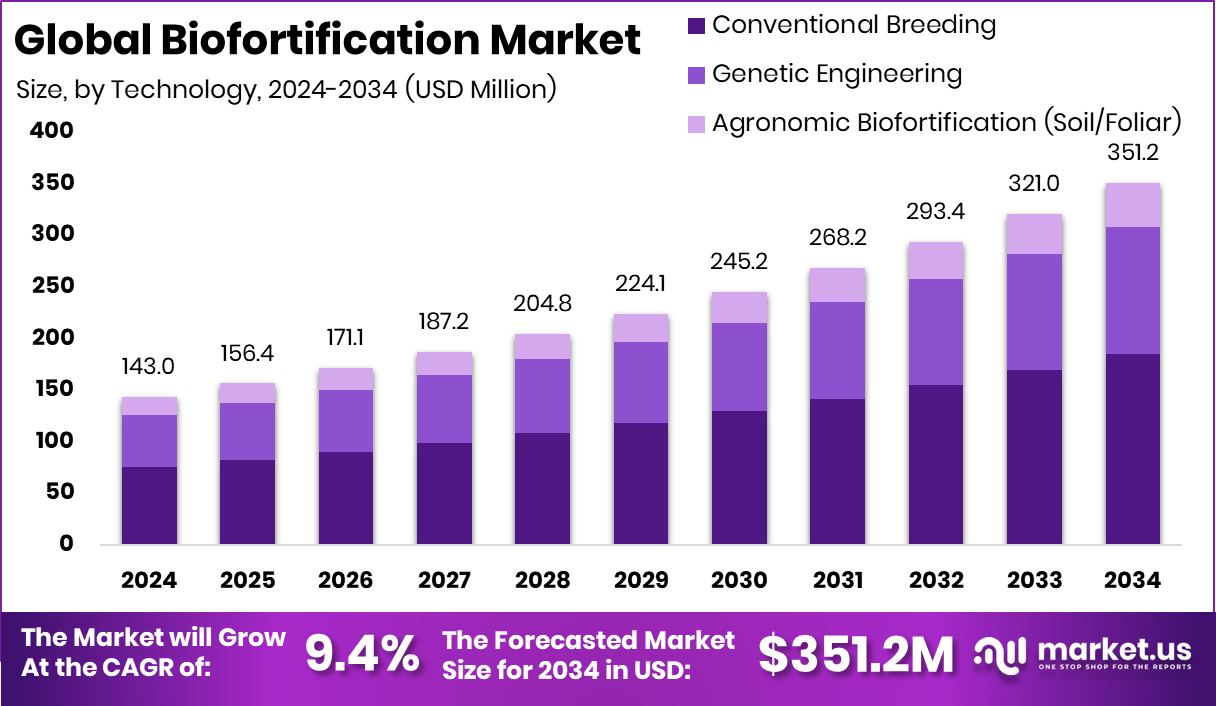
- The Global Biofortification Market is expected to be worth around USD 351.2 million by 2034, up from USD 143.0 million in 2024, and is projected to grow at a CAGR of 9.4% from 2025 to 2034.
- The Biofortification Market sees strong momentum as cereals dominate crop type with 48.3% share.
- Growing demand for nutrient-rich foods boosts the Biofortification Market, led by iron, targeting 38.7% share.
- The Biofortification Market expands steadily as conventional breeding technology holds a leading 52.8% share.
- Rising adoption in large-scale agriculture supports Biofortification Market growth, with commercial farming at 44.1%.
- The Asia Pacific region dominates biofortification demand, holding 49.5% and reaching USD 70.7 Mn.
➤ Directly purchase a copy of the report – https://market.us/purchase-report/?report_id=174769
Market Segments
By Crop Type Analysis
Cereals dominated the biofortification market in 2024 with a 48.3% share, driven by their role as staple foods across low- and middle-income regions. Crops like rice, maize, and wheat are prioritised due to their wide consumption and ability to deliver nutrients at scale. Governments and global organisations increased investments to enhance vitamin A, zinc, and iron content. Rapid adoption in rural systems and the need to address hidden hunger strengthened cereals as the most effective and scalable biofortification strategy.
By Target Nutrient Analysis
Iron led the biofortification market in 2024, accounting for 38.7% share due to rising concerns over iron-deficiency anaemia worldwide. Regions such as Africa and South Asia prioritised iron-rich crops to improve public health outcomes. Biofortified beans, pearl millet, and rice gained acceptance for naturally boosting iron intake without changing diets. Support from global agencies and nutrition-focused agriculture initiatives encouraged adoption, while improved cultivation practices ensured consistent nutrient levels, strengthening iron’s dominance in long-term food security strategies.
By Technology Analysis
Conventional breeding dominated the biofortification market in 2024 with a 52.8% share, mainly due to its cost-effectiveness and high acceptance. Unlike genetic modification, it faces fewer regulatory barriers and aligns with traditional farming practices. Breeders used natural genetic variation to enhance nutrient content while maintaining taste and yield. This approach enabled faster scaling through seed distribution systems and research collaborations. Its affordability and compatibility with smallholder farming reinforced its position as the leading technology in biofortification development.
By End-Use Analysis
Commercial farming led the biofortification market in 2024, holding a 44.1% share due to the increasing commercialisation of nutrient-rich crops. Large-scale farms adopted biofortified seeds to meet growing demand from food processors, health-focused brands, and institutions. Crops like wheat, sweet potatoes, and legumes were produced at scale for supply chains. Government support through subsidies, training, and market linkages encouraged adoption, while contract farming and rising awareness of healthy foods further strengthened commercial farming’s dominance.
Regional Analysis
Asia Pacific dominated the biofortification market with a 49.5% share valued at USD 70.7 Mn, driven by large-scale adoption of nutrient-rich crops in densely populated agricultural economies. North America follows with strong institutional support and growing commercial adoption.
Europe is growing steadily because of regulations that focus on sustainability, while Latin America is growing because of public nutrition programs. The Middle East & Africa region is progressing with increased interest in climate-suitable, nutrient-dense crops, reflecting rising global awareness of biofortification.
Top Use Cases
- Fighting Iron Deficiency (Anaemia): Biofortified crops like iron-rich beans and pearl millet help people get more iron from daily food. This is very useful in countries where anaemia is common, especially among women and children. These crops improve haemoglobin levels without needing supplements.
- Improving Eye Health with Vitamin A Crops: Vitamin A-rich crops such as orange sweet potatoes and maize help prevent night blindness and improve immunity. These are widely used in African countries to support children’s health and reduce vitamin A deficiency.
- Strengthening Immunity with Zinc Crops: Zinc-biofortified rice and wheat are used to improve immunity and child growth. Since these are staple foods, people can easily consume more zinc without changing their eating habits.
- Reducing Malnutrition in Rural Areas: Biofortification helps people who depend on basic foods like rice or maize. It increases nutrients directly in these crops, making it a low-cost and long-term solution for hidden hunger in poor communities.
- Supporting Farmer Income and Livelihoods: Farmers grow biofortified crops for both consumption and selling in markets. This improves their nutrition and also provides income opportunities through better-quality produce.
- Enhancing Child Nutrition and Growth: Special crops like high-protein maize help children get better nutrition where diets lack protein. These crops support healthy growth and reduce stunting in low-income regions.
Notable Company Developments
- In January 2025, Syngenta partnered with Heritable Agriculture to use AI technology to identify the best-performing crop varieties. This helps develop crops with better quality, yield, and nutrition by selecting the right genetics for each environment.
- In November 2024, Corteva partnered with BP to develop low-carbon bio-based feedstocks for aviation fuel. This focuses on improving crop output and quality for sustainable use, thereby supporting higher crop value and agricultural innovation.
- In April 2024, Bayer signed an agreement with AlphaBio Control to develop and market a new biological insecticide for crops like cereals and oilseeds. This supports healthier crop production and higher-quality yields, which, in turn, help nutrient-rich crop development.
Conclusion
Biofortification is a sustainable way to improve nutrition by increasing vitamins and minerals in staple crops during growth. It helps fight hidden hunger, especially in developing regions. With strong support from governments, research bodies, and agritech companies, adoption is growing steadily. The approach strengthens food security, improves public health, and offers long-term, cost-effective solutions for global nutritional challenges.
Discuss your needs with our analyst
Please share your requirements with more details so our analyst can check if they can solve your problem(s)