Table of Contents
Market Overview
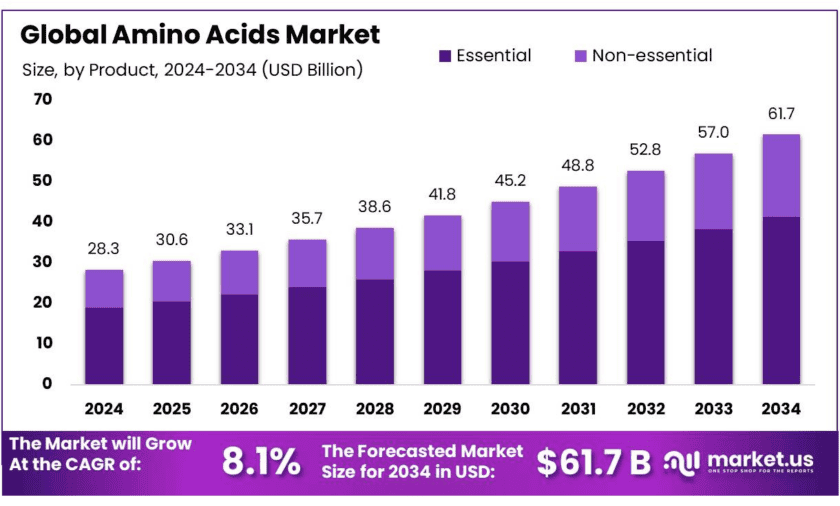
The Global Amino Acids Market demonstrates strong growth potential market value will rise from USD 28.3 billion in 2024 to USD 61.7 billion by 2034. This expansion represents a compound annual growth rate of 8.1% from 2025 to 2034. Consequently, manufacturers and investors see significant opportunities in this space.
The Indian amino acids industry plays a pivotal role across multiple sectors. Key application areas include animal nutrition, pharmaceuticals, food processing, and agriculture. Moreover, amino acids serve as organic compounds essential for protein synthesis and metabolic regulation. Consequently, India experiences a steadily increasing demand for these vital nutrients.
Expanding livestock industries fuel amino acid consumption in India. Rising consumer awareness about health and nutrition further accelerates market growth. Additionally, advancements in production technologies enable more efficient manufacturing processes. Therefore, India represents a critical growth market for amino acid suppliers.
Government initiatives strongly support India’s amino acids industry growth. The Department of Animal Husbandry and Dairying launched programs like the National Livestock Mission. Moreover, the Rashtriya Gokul Mission aims to enhance livestock development and improve feed quality. These efforts create a stable demand for feed-grade amino acids.
The Animal Husbandry Infrastructure Development Fund (AHIDF) provides substantial financial backing. With an allocation of ₹15,000 crore, this fund encourages private sector investment. Additionally, the initiative supports developing animal husbandry infrastructure, including animal feed plants. Therefore, government backing directly stimulates market expansion.
Key Takeaways
- Amino Acids Market size is expected to reach USD 61.7 billion by 2034, from USD 28.3 billion in 2024, growing at a CAGR of 8.1%.
- Essential amino acids are projected to account for approximately 58.5% of the global amino acids market share.
- Plant-based amino acids held a dominant market position, capturing more than a 44.2% share.
- Food-grade amino acids held a dominant market position, capturing more than a 39.5% share.
- The Food and Beverage industry held a dominant position, capturing more than a 32.1% share.
- Asia Pacific region held a commanding 45.9% share of the global market, valued at approximately USD 12.9 billion.
➤ Curious about the content? Explore a sample copy of this report – https://market.us/report/global-amino-acids-market/request-sample/
Market Segmentation Overview
By Product
Essential amino acids lead market growth with a projected 58.5% share in 2025. The human body cannot synthesize these amino acids, requiring dietary intake. Key applications include dietary supplements, pharmaceuticals, and animal feed. Consequently, rising health awareness drives this segment’s expansion.
Non-essential amino acids also show steady demand across multiple industries. Products like alanine, arginine, glutamine, and taurine serve specialized applications. Additionally, manufacturers utilize these compounds in pharmaceuticals and personal care products. Therefore, both essential and non-essential categories contribute to overall market growth.
By Source
Plant-based amino acids dominated the global market with a 44.2% share in 2024. Increasing consumer preference for plant-based diets drives this dominance. Moreover, advancements in fermentation technology enable efficient production. Consequently, soy, peas, and other legumes provide natural and sustainable amino acid supplies.
Animal-based sources and chemical synthesis represent alternative production methods. Fermentation technology continues to gain popularity due to its sustainability benefits. Additionally, clean-label product trends favor naturally derived amino acids. Therefore, plant-based sources will likely maintain their leading market position.
By Grade
Food-grade amino acids captured a dominant 39.5% market share in 2024. Rising consumer demand for fortified and functional foods drives this segment. Additionally, growing health consciousness encourages nutritional enhancement of everyday food products. Consequently, manufacturers increasingly incorporate amino acids into beverages and processed foods.
Feed grade and pharma grade segments serve specialized industry needs. Animal nutrition represents a significant market for feed-grade amino acids. Moreover, pharmaceutical applications require high-purity amino acids for drug formulations. Therefore, each grade category addresses distinct customer requirements and quality standards.
By End Use
The Food & Beverage industry led the global market with a 32.1% share in 2024. Amino acids enhance nutritional profiles and functional properties of food products. Key drivers include health-conscious diets and demand for functional foods. Additionally, amino acids improve taste, texture, and nutritional value across product categories.
Animal feed, pharmaceuticals, and dietary supplements represent other major end-use segments. Pet food manufacturers increasingly incorporate amino acids for animal health benefits. Moreover, the personal care and agriculture sectors show growing adoption rates. Therefore, diverse end-use industries support broad market participation.
Drivers
Government initiatives significantly drive the food amino acids market growth worldwide. Countries like China and India actively support amino acid integration into food systems. For instance, China plans to lower soymeal content in animal feed from 13% in 2023 to 10% by 2030. This strategy aims to decrease annual soybean imports by about 10 million metric tons, encouraging synthetic amino acid adoption.
India promotes Quality Protein Maize (QPM) cultivation enriched with essential amino acids. The Rashtriya Krishi Vikas Yojna established centers for QPM processing and value addition. Manufacturers integrate QPM into biscuits, cakes, and pasta products. Consequently, these initiatives combat malnutrition while enhancing staple food nutritional quality, directly benefiting market expansion.
Major Challenges
Regulatory hurdles create significant barriers for amino acid food additive manufacturers. The U.S. Food and Drug Administration (FDA) oversees additive safety through rigorous testing requirements. Under the Food Additives Amendment of 1958, substances must prove safety before approval. Moreover, the GRAS designation allows self-affirmation, raising concerns about evaluation thoroughness and potentially delaying product launches.
European Union regulations impose strict evaluation processes through the European Food Safety Authority (EFSA). Manufacturers must complete comprehensive safety assessments before receiving authorization for food products. These lengthy approval processes can delay product development significantly. Additionally, increased compliance costs may hinder innovation, particularly for smaller companies entering the amino acids market.
Business Opportunities
Functional foods present substantial growth opportunities for amino acid manufacturers. Consumers increasingly seek products offering health benefits beyond basic nutrition. Amino acids support muscle repair, immune function, and metabolic processes. Consequently, food companies can differentiate products by incorporating amino acids, capturing health-conscious consumer segments willing to pay premium prices.
Dietary supplements represent another expanding market for amino acid suppliers. Branched-chain amino acids (BCAAs) like leucine, isoleucine, and valine attract fitness enthusiasts. These compounds support muscle recovery and performance enhancement. Additionally, the Food Safety and Standards Authority of India (FSSAI) updates food fortification standards to include amino acids, facilitating wider product accessibility across population segments.
Regional Analysis
Asia Pacific dominated the global amino acids market with a 45.9% share in 2024, valued at USD 12.9 billion. The region’s large population base drives substantial consumption. Moreover, increasing health consciousness and robust industrial activities support market growth. Countries like China and India show particularly strong demand due to rising disposable incomes and urbanization trends.
The United States leads regional growth through advanced pharmaceutical and food processing industries. Additionally, strong consumer awareness regarding protein nutrition supports supplement sales. Europe follows with steady demand from functional food manufacturers and animal nutrition sectors, creating balanced global market distribution.
Key Players Analysis
- ADM leads as a global supplier of food ingredients and agricultural products. The company produces essential amino acids like lysine and methionine. These compounds mainly serve animal nutrition and human health needs. Moreover, ADM applies advanced fermentation technology for high-quality output.
- Ajinomoto Co., Inc. serves as a major player in amino acids. The company specializes in food-grade and pharmaceutical-grade products. Ajinomoto manufactures a wide range including glutamic acid, aspartic acid, and leucine. Additionally, the firm supplies these for the food, beverage, and animal feed sectors.
- MartinBauer Group stands out for natural and plant-based amino acid solutions. The company delivers products for food, beverages, and nutraceuticals. MartinBauer uses high-quality raw materials in its production. Furthermore, the firm adopts environmentally friendly methods.
Conclusion
The global amino acids market shows a strong growth trajectory through 2034. Essential amino acids and plant-based sources lead market segments. Moreover, food-grade products and Food & Beverage end-use applications dominate current demand patterns, creating clear investment priorities. Business opportunities abound in plant-based amino acids and fortified food products. Strategic partnerships with government programs can accelerate market access.
Discuss your needs with our analyst
Please share your requirements with more details so our analyst can check if they can solve your problem(s)