Table of Contents
Overview
New York, NY – March 10, 2026 – The agricultural testing sector is expanding as farming systems increasingly rely on scientific data to improve productivity, soil health, and environmental protection. Agricultural testing involves analyzing soil, water, crops, seeds, and farm inputs to assess nutrient levels, detect contamination, and monitor crop performance. These insights help farmers make informed decisions about fertilizers, irrigation, and crop protection while supporting sustainable land management.
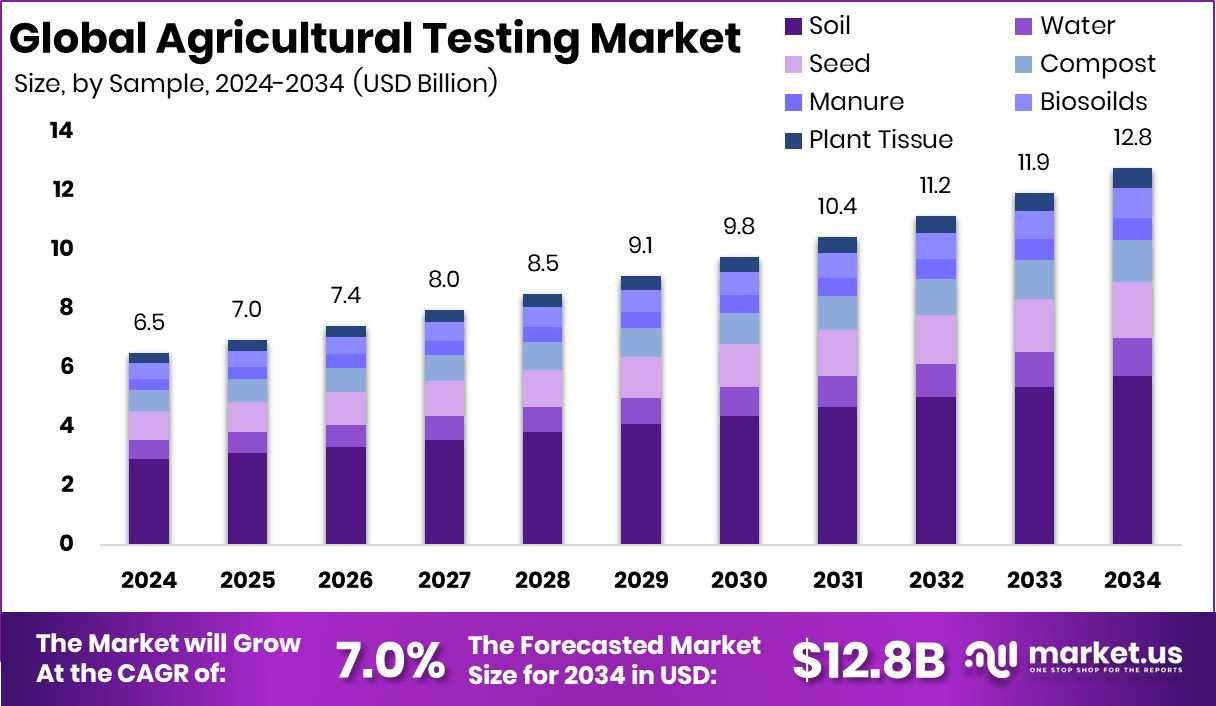
The industry is projected to reach USD 12.8 billion by 2034, up from USD 6.5 billion in 2024, driven by the adoption of modern, data-driven farming practices. Asia Pacific currently leads the market with 38.9% share, generating USD 2.5 billion, largely due to rapid agricultural expansion across the region.
Institutional and research funding continue to support innovation in this field. Researchers from the College of Agriculture secured $106 million in grants, while a €30 million ecosystem initiative is testing regenerative agriculture at the landscape level to improve long-term soil health.
Government investments in conservation are also boosting demand. Florida agencies have requested nearly $500 million for land conservation projects, and an additional $14.6 million has been allocated to help farmers safeguard soil and water resources.
Private and startup investments further highlight growing interest in soil intelligence and sustainable agriculture. India’s Varaha received €30.5 million, Elaniti secured €1.5 million, and Citizens of Soil raised €2.1 million to advance soil-focused innovations.
Despite challenges such as $66 million in federal research funding losses in South Dakota, grassroots initiatives remain active, including a $2,000 student soil research grant supporting future agricultural research.
➤ Click the sample report link for complete industry insights: https://market.us/report/agricultural-testing-market/request-sample/
Key Takeaways
- The Global Agricultural Testing Market is expected to be worth around USD 12.8 billion by 2034, up from USD 6.5 billion in 2024, and is projected to grow at a CAGR of 7.0% from 2025 to 2034.
- Soil sampling leads the Agricultural Testing Market with 44.8%, driven by rising soil health monitoring needs.
- Safety Testing dominates the Agricultural Testing Market at 62.7%, supporting food quality, export compliance, and consumer trust.
- Conventional technology holds 66.3% share in the Agricultural Testing Market due to affordability, reliability, and wide laboratory adoption.
- The Asia Pacific Agricultural Testing Market reached USD 2.5 Bn, holding a strong 38.9% regional share.
➤ Directly purchase a copy of the report – https://market.us/purchase-report/?report_id=174098
Market Segments
By Sample Analysis
In 2024, soil samples represented the largest segment in the Agricultural Testing Market, accounting for 44.8% of the global share. Soil health remains central to crop productivity and sustainable farming, prompting farmers to regularly test soil for nutrient balance, pH levels, organic content, and contamination risks before planting. Increasing fertilizer costs and concerns over soil degradation are encouraging growers to rely on soil analysis to optimize input usage and reduce waste.
Government initiatives such as soil health card programs and the expansion of precision agriculture are further supporting demand for soil testing services. These tests help farmers make informed land management decisions, improve yields, and minimize environmental damage. With climate variability affecting soil conditions, the need for frequent, accurate soil testing continues to grow across both developed and emerging agricultural regions worldwide.
By Application Analysis
In 2024, safety testing dominated the Agricultural Testing Market by application, capturing 62.7% of total demand. This leadership is largely driven by stricter food safety regulations and increasing international trade requirements. Governments and global trade organizations require testing for pesticide residues, heavy metals, pathogens, and mycotoxins to ensure food safety and regulatory compliance. Exporters and food processors depend heavily on these tests to meet international standards and prevent shipment rejections.
Rising consumer awareness regarding food quality, safety, and traceability is also encouraging producers to adopt more comprehensive testing practices. Safety testing protects consumer health while safeguarding brand reputation and market access. As global food supply chains expand and regulatory oversight strengthens, the demand for reliable safety testing across grains, fruits, vegetables, and processed agricultural products continues to grow steadily.
By Technology Analysis
In 2024, conventional technologies held the leading position in the Agricultural Testing Market, accounting for 66.3% of overall adoption. Traditional laboratory-based techniques such as wet chemistry, chromatography, and culture methods remain widely used due to their reliability, accuracy, and regulatory acceptance. Many testing standards and government regulations still recognize conventional methods as benchmark procedures, which supports their continued dominance. These technologies are also preferred by small and mid-sized laboratories because they require lower initial investment and rely on readily available skilled personnel.
While modern rapid and automated testing technologies are gradually gaining attention, conventional methods remain the backbone of agricultural testing worldwide. Their established credibility and cost-effectiveness make them especially important in regions where access to advanced digital or automated systems is still limited, particularly in developing countries where resources for modern testing may be scarce.
Regional Analysis
Asia Pacific leads the global Agricultural Testing Market with a 38.9% share, valued at USD 2.5 billion, making it the largest regional market. This leadership is driven by extensive agricultural activity, large farming populations, and increasing awareness of soil quality, crop safety, and yield optimization. Countries across the region rely heavily on testing services to monitor soil fertility, detect residues, and support export-focused agriculture.
North America represents a mature market supported by well-established testing practices and strong regulatory frameworks, though its market share remains lower than that of the Asia Pacific. Europe maintains a steady demand due to strict food safety regulations and standardized agricultural quality requirements.
Meanwhile, the Middle East & Africa are gradually adopting testing services as farming modernization progresses. Latin America is also witnessing rising interest in agricultural testing as commercial and export-oriented farming continues to expand.
Top Use Cases
- Soil Nutrient Testing for Better Crop Growth: Farmers test soil to check nutrients like nitrogen, phosphorus, and potassium. The results help them know what nutrients are missing and how much fertilizer to apply. This avoids wasting fertilizers and improves crop growth. Soil testing also measures pH, organic matter, and other properties that affect plant health. By using this information, farmers can manage soil fertility and increase yields while reducing environmental damage.
- Pesticide Residue Testing for Food Safety: Agricultural testing labs analyze fruits, vegetables, and grains to detect pesticide residues. These tests ensure chemical levels remain within safe limits set by food safety authorities. If residues are too high, the product may not be allowed to enter the market or export supply chains. Testing protects consumer health and helps farmers and food companies follow food safety regulations.
- Irrigation Water Quality Testing: Farmers test irrigation water to check for harmful chemicals, salts, or pollutants. Poor-quality water can damage crops, reduce yield, or contaminate soil over time. Water testing helps farmers identify contamination from industrial activities, agricultural runoff, or natural sources and choose safer water for irrigation.
- Detecting Soil Contamination and Land Safety: Testing is also used to detect harmful substances such as pesticide residues or heavy metals in soil. This is especially important for farms located near industrial areas or previously treated land. Soil residue testing helps determine whether land is safe for growing food and guides farmers in cleaning or managing contaminated soil.
- Improving Fertilizer Efficiency and Reducing Costs: Agricultural testing helps farmers apply fertilizers more accurately. Instead of using large amounts blindly, farmers apply only what the soil needs. This saves money, reduces nutrient losses, and improves fertilizer efficiency. In many cases, testing-based nutrient management can significantly improve crop yield and soil productivity.
- Monitoring Crop Health and Preventing Disease: Testing methods and modern technologies analyze plant samples, soil conditions, and environmental factors to detect diseases or stress in crops early. Early detection allows farmers to take action quickly, preventing the spread of pests or diseases and reducing crop losses. This helps maintain healthy crops and stable production.
Notable Company Developments
- In January 2025, SGS acquired Aster Global Environmental Solutions, a company based in Ohio, USA. Aster Global focuses on environmental validation and monitoring services. This acquisition helps SGS strengthen its environmental and sustainability testing capabilities, which are important for agriculture, soil monitoring, and environmental safety related to farming activities.
- In October 2024, Eurofins Agro Testing acquired FarmFacts, a soil sampling specialist previously owned by BayWa AG. FarmFacts has more than 35 years of experience in agricultural software and soil sampling services. With this acquisition, Eurofins expanded its agricultural testing services across several European countries, including Germany, Poland, the Baltics, Austria, and Switzerland. The move strengthens Eurofins’ ability to provide soil analysis and digital agriculture solutions to farmers and agronomy professionals.
- In March 2024, Intertek announced the acquisition of Base Metallurgical Laboratories (Base Met Labs) in North America. The company specializes in metallurgical testing and laboratory analysis. By acquiring this lab, Intertek expanded its scientific testing capabilities and strengthened its laboratory network in the Americas. This development supports Intertek’s wider testing services, including environmental and material analysis that can be used in agriculture and natural resource sectors.
Conclusion
The agricultural testing market plays an important role in supporting modern farming and sustainable food production. Testing services help farmers understand soil health, crop quality, water safety, and contamination risks, allowing them to make better decisions in the field. As agriculture becomes more data-driven, the use of testing is increasing to improve productivity while protecting natural resources.
Governments, research institutions, and private companies continue to promote testing to ensure food safety and environmental protection. Growing awareness about soil conservation, safe food supply, and responsible farming practices is encouraging wider adoption. Overall, agricultural testing will remain essential for improving crop performance, maintaining quality standards, and supporting long-term agricultural sustainability.
Discuss your needs with our analyst
Please share your requirements with more details so our analyst can check if they can solve your problem(s)